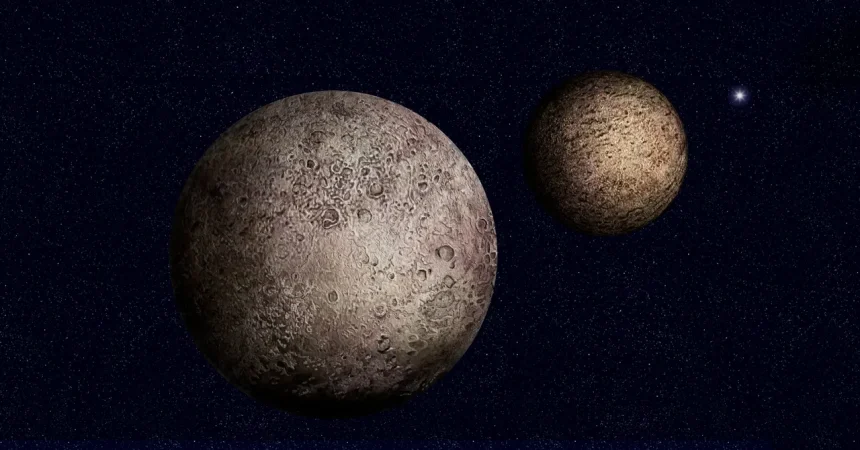
The vast, frigid reaches of our solar system have long been considered well-mapped territory, but the James Webb Space Telescope (JWST) has recently pulled back the curtain to reveal a chemical conundrum that has left astronomers scratching their heads. While observing the distant dwarf planet Pluto and Saturn’s massive moon, Titan, the telescope’s sensitive instruments detected a peculiar, stubborn chemical signature that simply does not exist in any of our scientific databases. This isn’t a case of a flickering sensor or a glitch in the data transmission; the signal has been independently confirmed by two separate instruments on the JWST. As a result, researchers are faced with a fascinating realization: we are looking at a chemical “fingerprint” that has never been recorded by human science, potentially representing a material that has never been synthesized in a laboratory or, perhaps, a type of chemistry we have yet to discover.
To understand why this discovery is so momentous, it helps to think of spectroscopy as the ultimate cosmic CSI. Every molecule and element in the universe interacts with light in a very specific, predictable way. By measuring which wavelengths of light are absorbed by an object, scientists can identify its composition with high precision, much like a detective using a fingerprint at a crime scene. For decades, researchers have been building a vast library of these “fingerprints” for common substances like water, methane, and carbon dioxide. When the JWST team compared their deep-space findings to these extensive archives, they drew a complete blank. Finding a signal that defies existing knowledge is exceedingly rare in modern astronomy, and for these two distinct worlds, it has suddenly pushed this mystery to the very top of the planetary science agenda.
The signal appears as a distinct absorption band centered at 5.113 micrometers, a specific point in the infrared spectrum that refuses to align with any known physical substance. The research team, whose findings are currently pending publication in the journal Astronomy & Astrophysics, has already begun the painstaking process of elimination. They have run simulations against complex organic compounds and various cosmic ices—including benzene, acetylene, and various ketenes—but none provided the perfect match. This leaves us with two compelling, if slightly unsettling, possibilities: either this signal represents a familiar material behaving in a strange, previously unstudied physical state, or we have stumbled upon an entirely new class of chemical compounds that occupy these icy alien surfaces.
What makes this puzzle even more gripping is the environment in which the signal was found. Titan and Pluto are essentially the planetary equivalent of “odd couples.” Titan is a thick-atmosphered world with a surface pressure higher than Earth’s, featuring weather, rivers, and lakes of liquid methane at a bone-chilling –180 degrees Celsius. Pluto, by contrast, is a tiny, lonely world with an atmosphere so thin it is essentially a vacuum, its surface a frozen landscape of nitrogen and carbon monoxide ice at an even colder –235 degrees Celsius. The fact that this identical, unidentified chemical signature exists on both worlds, despite their vastly different atmospheres, pressures, and compositions, suggests that this substance isn’t just an anomaly—it is a pervasive, shared secret of the outer solar system.
As the scientific community begins to digest these findings, the focus must shift from observation to experimentation. The next major step involves going back to the laboratory to recreate these extreme, alien conditions. Scientists will need to mix gases and ices to build synthetic versions of the surfaces of Pluto and Titan, hoping to observe how chemicals react and bond under such crushing cold and pressure. It is a humbling reminder that even in our own celestial backyard, nature is far more creative and complex than our textbooks currently allow. This mystery stands as a testament to the fact that every time we build a powerful enough window into the universe, we don’t just see more of what we know; we find parts of the universe that are still waiting to be named.
Ultimately, this mystery marks the beginning of a fresh chapter in planetary science. If this unknown compound is indeed something entirely new to our chemical catalogs, its discovery will force us to rethink how organic materials behave in the frozen vacuum of space. By tracing the origin and nature of this 5.113-micrometer signal, we might unlock secrets about the early development of our solar system or gain new insights into the building blocks of life that might exist elsewhere. The JWST has provided the evidence, but the work of solving it now moves into the hands of chemists and astronomers alike. As we wait for the final analysis, one thing is clear: the solar system is still capable of surprising us, holding onto its mysteries until we are ready to ask the right questions.