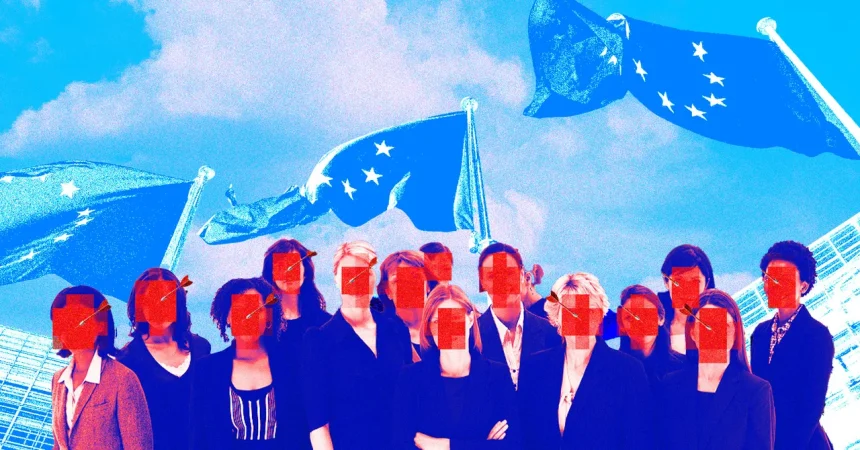
There is a particular kind of violation that does not leave a bruise, but leaves a lasting scar across a person’s public and private life. For a female politician in Europe, it might begin with a notification from a colleague, a stranger, or a journalist, telling her that her face has been stripped from a professional portrait, fused onto someone else’s body, and placed on a website devoted to sexual humiliation. She did not pose for the image, did not consent to its creation, and has no idea how long it has been circulating. But there it is, searchable, shareable, and part of a growing library of abuse. According to new research shared with WIRED, this is not a rare or isolated ordeal. Nearly 150 politicians across Europe have been swept into harmful deepfake pornography networks over the past several years. The vast majority of them are women. Some have had their likenesses inserted into explicit videos. Others have had their names, official photos, and even personal details cataloged in disturbing database-like entries, sitting alongside links to tools that can generate new fake sexual images on demand. The research paints a stark picture of an entire political class targeted by an industry of image-based abuse, with women carrying almost the whole burden.
The findings come from Benjamin Shultz, a researcher and fellow at the German digital democracy think tank Agora Digitale Transformation and lead researcher at the American Sunlight Project. Shultz spent months analyzing roughly 160 domains that host deepfake abuse and other forms of nonconsensual sexual content. He built his database in July by compiling the names, roles, and official details of more than 5,800 national members of parliament from all 27 countries in the European Union, then used custom search engines to track where those politicians appeared across the networks of abuse sites. The results are startling. At least 138 women MPs from 22 EU countries have appeared on or been mentioned by the sites, while only nine male MPs were referenced in any way. That means, by Shultz’s calculations, a woman in Parliament is 33 times more likely than a male colleague to be caught up in this ecosystem. The distribution is not even across Europe. Politicians from Germany, the Netherlands, Italy, and France showed up most often, and the more senior a politician was, the more likely they were to be targeted. The research did not simply find active videos hosted on these domains. Shultz divided the abuse into categories: content being actively hosted, indexed traces of content that had already been removed, and a more insidious category involving profiles and “gateways” designed for the creation of new material. Many sites displayed the names of MPs beside their official parliamentary photographs, sometimes linking to their social media accounts or other personal information. Some pages even included sections that “rated” women’s bodies, according to the report. Next to these biographical entries were frequently links to so-called nudifier applications or the sites’ own tools that claimed to digitally undress anyone in a photo. “It has all the images, all the information, and a direct link to the tool, and in three clicks you can generate,” Shultz said. “That’s just as bad as actually hosting the content.”
For the women whose lives are now tangled up in this network, the research confirms what many had long suspected but could not prove: they are not alone, but they are singled out in a systematic way. Suzanne Kröger, a Dutch member of parliament with the Progressive Netherlands group, is one of the women targeted. She spoke with WIRED about her reaction to the findings, and her voice carries both anger and grief. Kröger said the research is “really deeply disturbing” and lays bare the scale of an abuse that has been quietly thriving online. She stressed that politicians have platforms and voices, and can speak out against what is happening. But, she added, “meanwhile, there are millions of women victims of these criminal acts.” The distinction matters. Political office may have made these women visible, but the abuse is not theirs alone. It is a mirror of a broader culture that uses sexual humiliation to silence, shame, and intimidate women across every sector of public life. The chilling effect is real. Multiple researchers and lawmakers say that when women see their peers targeted with deepfake pornography simply for doing their jobs, the message is clear: public office is dangerous for women. Shultz argues that this discourages women from running for office in the first place, and then pushes those who do serve out of public life. “There’s so much evidence to support that this does real psychological damage,” he said. “This also does reputational damage for the future if they want to fade out of politics and have another career.” The harm is not limited to the moment of discovery. It lingers, shaping decisions about whether to continue in a visible role, whether to speak on controversial topics, whether to let a photograph be taken at all.
Sarah Dobbe, a Dutch Socialist Party MP who was also caught up in the listings, emphasized the need for immediate and compassionate responses. “Deepfake videos are used to intimidate politicians but also to belittle women,” she said. “It is very important that if a woman or girl is victimized in this way, she can get direct support if needed, and that the content is removed quickly.” Her words point to a painful reality: the burden of responding to these crimes often falls on the victims themselves, at a moment when they are already dealing with shock, embarrassment, and fear. There is no single, simple helpline that every woman knows about, no automatic removal process across hundreds of websites, and no guarantee that even if one copy of an image is deleted, another will not appear. In that vacuum, the abuse becomes even more isolating. When a woman in politics is targeted, she may worry that drawing attention to it will only amplify the material. She may fear that people will blame her for having a public profile, or that her dignity will be reduced in the eyes of her colleagues. She may even question whether it is worth staying in public life at all. That is exactly the kind of silence the creators of these sites want to produce. The fact that researchers like Shultz were able to find and identify so many women in so many different countries is a sign that this is not a random or isolated phenomenon. It is a coordinated, scalable, industrialized form of gendered harassment aimed at one of the most visible groups in society.
None of this exists in a vacuum. Since AI-created deepfakes first appeared around the end of 2017, the technology behind them has moved from obscure research labs to the pockets of anyone with an internet connection. The tools are more accessible than ever, the results are more realistic, and the number of people creating nonconsensual sexual images has exploded. Over the past several years, millions of such images and videos have been generated, mostly by men and boys, and they have been used to harass, intimidate, and blackmail women and girls in nearly every imaginable setting. Schools around the world have been hit, with at least dozens of countries reporting incidents involving fake explicit images of students. The same infrastructure that powers those campaigns is being turned on politicians, celebrities, journalists, and other public figures. Henry Ajder, an AI adviser and deepfake expert who has been tracking this ecosystem since 2018, says the new research is not surprising but is still important because it gives officials a clearer sense of scale. “The whole infrastructure is set up to do this at scale with ease,” he said. In other words, the websites are not amateur efforts abandoned in the corners of the internet. They are designed to run like businesses, with user-friendly interfaces, membership tiers, and in some cases customer support. They profit from the humiliation of women, and they have developed workarounds to stay online even as law enforcement agencies have tried to shut them down. The men listed on these sites, the nine male MPs referenced, are a tiny fraction that only underscores how specifically women are being targeted. This is not about politics in the abstract; it is about punishing women for entering political spaces that were historically dominated by men, and making them feel unsafe, unwanted, and degraded.
There is also something profoundly dehumanizing about the way the abuse is organized. To see one’s own face on a page that also contains a link to a tool for stripping clothes from any photograph is to understand, in a single horrifying moment, that one’s body has become public property in the eyes of strangers. The women in the research did not have to be famous in the celebrity sense. They simply had to be public officials, visible enough to photograph and name. Their official parliamentary portraits, taken to represent them as elected representatives of their people, are being repurposed for the exact opposite purpose: to reduce them to objects, rated and ranked by anonymous users. For the women involved, the psychological cost is hard to overstate. It is one thing to be attacked in a debate or criticized in the press; that is part of the rough and tumble of democratic life. It is another thing entirely to be rendered as a sexual image without consent, knowing that strangers are looking at it, and that the image may be used to blackmail or humiliate them at any moment. The damage can be professional, reputational, and deeply personal. Politicians are often told to develop thick skins, but no one should have to develop a thick skin against having their body digitally stripped and exposed to the world. The research is a reminder that the internet has become a place where women in public life have to navigate constant threats of sexualized abuse, and where those threats are too often treated as an acceptable price of prominence.
And yet, the story does not end with despair. Shultz personally alerted all of the politicians who appeared in the research, and offered guidance on how the content might be removed. That simple act of contact, a researcher reaching out to warn someone that her image has been abused, stands in contrast to the silence and inaction that many victims experience. It represents a small but important shift in the way societies are beginning to respond. The fact that researchers have documented these websites, and that WIRED has declined to name them to avoid feeding attention to abusive content, shows that there is a growing awareness of the harm they cause. But awareness is not enough. The challenge now is for governments, courts, and technology companies to catch up with the reality of deepfake abuse. Stronger laws are needed that explicitly criminalize the creation of nonconsensual intimate images, including those made with artificial intelligence. Platforms need to do more to detect and remove such material quickly, before it spreads. Law enforcement agencies need training and resources to investigate these crimes. And women and girls who are victimized need access to support services, mental health care, and legal advice, without shame and without blame. Most importantly, society as a whole must refuse to accept this as normal. Politicians have a duty to speak out, not just for themselves but for the millions of women who do not have a platform. Researchers like Shultz and Ajder are helping to pull back the curtain, but the responsibility for change belongs to all of us. The research is a wake-up call: when women are systematically targeted in this way, it is not only a personal tragedy for each victim. It is a threat to democracy itself, because it seeks to drive women’s voices out of public spaces. The response must be as strong as the attack: clear condemnation, swift action, and unwavering support for every woman who has been subjected to this violation.