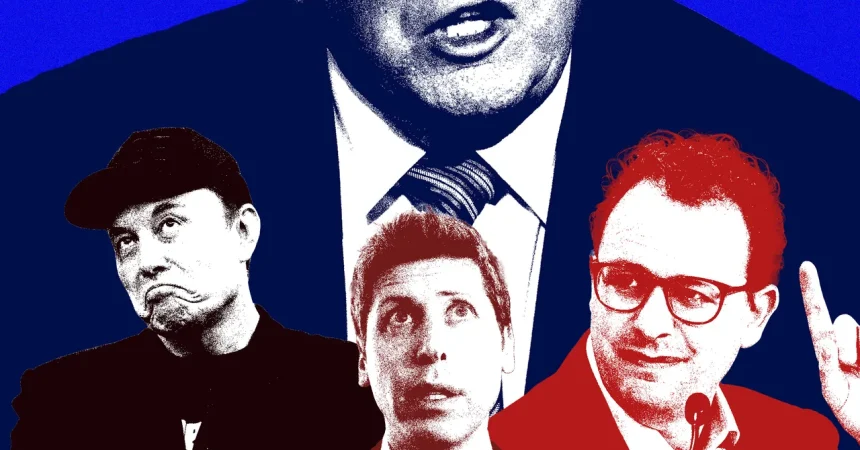
At a moment when calls for artificial intelligence regulation are growing louder, last weekend delivered a strange and unexpected story. Anthropic CEO Dario Amodei published an essay on Saturday asking the U.S. government to regulate AI companies as part of a larger effort to slow the technology’s breakneck pace. It was an unusual request coming from one of the industry’s leading figures, and an even stranger spectacle to see his usual rivals line up behind him. OpenAI’s Sam Altman, often cast as Amodei’s chief competitor, publicly endorsed the call. Elon Musk, the owner of the Grok chatbot and a man with a long and complicated history with both of them, did as well. Microsoft CEO Satya Nadella also said development needed to be paced. That moment of alignment was remarkable, especially after a week of intense debate about the technology’s dangers to human life. But the answer from Washington was quick, blunt, and framed as a matter of personal responsibility rather than public protection. If you want to slow down, no one is stopping you. The Trump administration’s message to lab leaders was effectively this: stop asking for a permission slip, and stop pretending the government has to create a legal framework for collective restraint. The people building these systems have enough money, influence, and independence to make their own choices. If they choose not to, that itself reveals something important. Amodei’s essay and the endorsements it received were not just a policy proposal. They were a confession that the AI industry cannot handle its own creation alone, no matter how much its leaders talk about safety. That is the human pressure hidden beneath the political debate: people who are terrified of their own power, asking someone else to share the burden.
The mechanism Amodei was asking for matters because antitrust law is not just a detail in this story. It is the reason these companies normally cannot sit in the same room and decide to produce less, release more slowly, or set aside competitive pressure for the sake of public safety. If the leaders of OpenAI, Anthropic, and xAI gathered quietly and agreed to delay their next releases for safety reasons, they would face legal risks that could wreck their companies. That is why Amodei asked the government to either participate in the discussions or issue a waiver, so that safety coordination would not be treated as an illegal conspiracy. He also asked the government to help establish international coordination, even mentioning the Chinese Communist Party as a potential partner. It was a bold, diplomatic-sounding proposal, but it ran into immediate skepticism. David Sacks, co-chair of the President’s Council of Advisors on Science and Technology, responded on X with what could be described as an icy reality check. Sacks wrote that if the unreleased models are scary enough that the developers themselves think they should slow down, they are free to do so. Stop pretending you need anyone else’s permission, he said. Stop pretending antitrust law has to be suspended so you can form a cartel. And most pointedly, he told the lab leaders to stop pretending the motivation to slow down is purely altruistic. Those words landed like a needle in a balloon. Sacks was not rejecting the idea that AI is dangerous. He was rejecting the idea that billionaires who have spent years racing each other to market should now be allowed to rewrite the rules of competition because they have suddenly felt a change of heart. There is also the China problem. Amodei’s suggestion that Washington could help coordinate with Beijing struck many observers as absurd, and Sacks made that point directly: China is very unlikely to join a global agreement, as you know. In one sentence, he reminded everyone of the central tension in the entire debate. AI is not a normal industry. It is a strategic technology, central to the balance of power between the United States and China. Asking American companies to slow down, even voluntarily, feels like asking the country to leave its most important weapon on the table while the other side refuses to do the same.
The geopolitical lens is the real reason the conversation in Washington remains so one-sided. The United States largely views China’s AI ecosystem as an economic and national security threat, and there is an underlying anxiety that Washington has already been caught off guard by Beijing’s advances. When President Trump visited Ireland last week, he dismissed the safety warnings as overblown, saying that a lot of very negative forces are bringing up things that won’t happen. He made his position simple: America is leading China on AI, and he intends to keep it that way, because whoever wins AI, wins. It was a starkly different framing from the one offered by AI executives, who tend to speak in terms of existential risk and catastrophic outcomes. In the president’s view, regulation is not a public safeguard. It is a self-inflicted wound. House Speaker Mike Johnson reinforced that mindset on Sunday, telling CNN that if Congress races in with an emergency session to regulate AI, the United States will lose the race to China, and that is a threat to every single American. He also said the country needs balance and steady hands at the wheel. To be clear, he was not saying AI is safe. He was saying that moving too fast to constrain it is its own kind of danger, a threat to American supremacy. That is a powerful argument in a political environment where China is seen as the great rival of the century. It also aligns neatly with the interests of major tech companies, which have spent billions of dollars lobbying Washington over the last several years. The result is a peculiar standoff: the people most concerned about AI are often the people who build it, while the people who could regulate it are telling them to simply not build it faster if they are so worried. Meanwhile, the one actor that might actually force a slowdown, the Chinese government, is treated not as a partner but as the enemy. The idea that Beijing would voluntarily join a global regime to limit the most powerful technology since electricity strikes most American officials as almost laughable.
For AI leaders, then, the path forward is not the one they envisioned. They cannot get the legal shelter they wanted, and they cannot hope for an international agreement that includes China. At the same time, they face a growing and understandable public skepticism. People have watched chatbots make embarrassing mistakes, seen deepfakes erode trust in every kind of content, and witnessed repeated promises about safety get replaced by product launches within a matter of months. That trust has to be rebuilt, and if the government will not broker the effort, the companies are left with voluntary commitments that are weaker, messier, and perhaps more realistic. That is where the story turned over the weekend. Amodei’s essay proposed that AI companies open their doors to independent evaluators, giving third-party observers the kind of access that normally only employees have. Those evaluators would check whether both practices and products were safe, and would be able to report when something went wrong. On Sunday night, Sam Altman agreed. He committed to the idea, acknowledging that it would impose significant costs on OpenAI. But in a line that was both carefully chosen and emotionally telling, he said no amount of American competitive pressure should justify recklessness. That sentence is probably the most honest summary of the dilemma facing the industry. The pressure to compete is enormous, the temptation to cut corners is real, and the fear of looking cautious in front of one’s rivals is even more real. Altman was essentially admitting that the market alone cannot solve this problem, because the market rewards speed and punishes hesitation. Without regulation, without a legal framework, without a global treaty, companies are being asked to act against their own short-term incentives and then to be transparent about how they are doing it.
To understand why Altman’s commitment matters, it helps to consider what the evaluators are actually being allowed to see. Most safety testing today is done at the companies’ own discretion. They choose the metrics, they choose the tests, they choose whether to publish the results, and they sometimes choose to ignore the results. Amodei’s proposal was deliberately simple: put outsiders inside the room, give them the same access as employees, let them look at both practices and products, and let them tell the public when something is wrong. That is a remarkable break from the secrecy that has always surrounded frontier AI labs. It is also a concession that the companies cannot be trusted on their own, a rare moment of institutional humility. For Altman to accept it, even in principle, is a significant step. He did not just say he liked the idea; he said OpenAI would do it, despite the cost. The cost he referred to is not purely financial. There is a competitive cost. Every hour spent on transparent evaluation is an hour not spent on private experimentation. Every person embedded from the outside is a potential route for leaks. Every incident report is a gift to a rival who may not be doing the same work. Yet in a world where government regulation is off the table, these voluntary commitments are the only mechanism left to signal that the industry is serious. Whether other companies will follow is another question. Microsoft’s Nadella has said pacing is important, but he has not committed to the same level of access. Musk, who endorsed Amodei’s essay, has given no immediate promise about his own company. The risk is that voluntary measures become a form of public theater, enough to calm nervous investors and lawmakers but not enough to actually change behavior. If that happens, the current moment of apparent industry soul-searching will look, in retrospect, like just another public relations exercise, and the chance to rebuild trust will be wasted.
Where does this leave the American public? In some ways, it is almost a return to an older idea of capitalism: powerful people who created something risky must make their own choices, take their own responsibility, and live with the consequences. The government’s message is that the market should police itself, and the companies’ message is that the market cannot. That disagreement is not going to disappear, because both sides are partly right. The industry needs to move quickly to maintain technological leadership, and the industry also is moving too quickly for anyone to fully understand what it is building. The gap between those truths is where accidents happen. What is missing is an institution that can hold the middle ground, not between good and evil, but between speed and safety. The president’s advisors believe that institution is the corporate conscience, a strange thing to entrust to companies whose entire existence is built on beating competitors. The AI executives, for their part, seem to want the government to become that institution, despite spending years warning that regulation would be a disaster. In the absence of a shared legal framework, the most realistic outcome is probably a patchwork: voluntary evaluators, advisory councils, state-level laws, and an ongoing battle over public opinion. It is not a satisfying answer. It is not even clear that it is an answer at all. But it is the world the United States now lives in. The people who built the most powerful technology in history have asked for help to avoid harming humanity, and Washington has told them to grow up and handle it alone. In the end, many of the safeguards that protect human life will depend on the honesty, courage, and character of a small group of very powerful executives. That is not a reassuring thought, but it is the reality. The only remaining question is whether their voluntary actions are genuine or theatrical, and only time, and their own choices, will tell.