There are mice that you buy because they work, and then there are mice that you buy because they make you feel something. The Wallhack M-001 is emphatically in the second category. From the first moment you pick it up, it feels different—lighter than you expect, somehow more deliberate, like a small piece of machinery rather than a disposable gadget. But the real magic doesn’t hit you until you turn it over. That’s when the world stops for a second, because there is no bottom shell. Instead of the usual sealed plastic slab, a thin frame runs around the circumference of the mouse and holds six gliding feet in place. Everything between those feet is open air, and through that open space you can see the entire printed circuit board and the battery sitting there, completely exposed. It’s a startling sight. We’ve been conditioned to think of the underside of a mouse as a boring, featureless black surface, a place that exists only to keep dust out and slides smooth. This mouse turns that assumption upside down. It invites you to look at the anatomy of the thing, to see the components that make it work, and to appreciate them exactly the way you might appreciate the open engine bay of a classic sports car. The first time I flipped it over, I laughed out loud. It felt almost rebellious, as if the mouse was saying, “Why should I hide what I am?” There’s also something oddly intimate about it. You are seeing the heart and brain of the device, laid out like a diagram in a textbook. It makes the mouse feel alive, or at least it feels like a product designed by people who genuinely care about what happens inside the shell. That alone sets the M-001 apart from almost every other mouse on the market. It turns a moment as ordinary as flipping a mouse over to clean the sensor into a mini-ritual of admiration.
What makes that exposed circuit board even more interesting is the fact that it’s not just there for looks. The PCB is doing structural work. It’s not simply sitting inside a plastic shell, minding its own business; it is actually a primary load-bearing component. This is a technique borrowed from a very different world: the world of supercars and sport bikes. The Ferrari F50, for example, famously used its engine block as a stressed member of the chassis, meaning the engine itself helped carry the loads and provided rigidity to the whole car. That technology came directly from Ferrari’s Formula 1 program, where every gram counts and every part has to justify its existence. Wallhack has essentially applied the same philosophy to a computer mouse. Instead of relying on a thick, heavy bottom plate to keep everything stiff, the PCB ties the structure together, giving the mouse strength while also saving weight. It’s a clever trick, and it works. The mouse feels solid in your hand, not hollow or flimsy, but it also feels wonderfully light. That’s a huge advantage for competitive gamers, who spend hours making tiny, precise movements and notice every extra gram. But beyond the practical benefits, there’s an undeniable cool factor. Knowing that your mouse has a stressed-member PCB, just like a Ferrari, makes it impossible to think of the M-001 as an ordinary peripheral. It’s engineering with a little bit of poetry in it. Every time I looked at that exposed circuit board, I felt a little jolt of excitement, because it was a reminder that somebody, somewhere, decided to do something genuinely different. It’s one of those ideas that seems obvious in hindsight, but only after someone else had the courage to build it.
Right behind that PCB sits the real star of the show: a hot-swappable battery. I’ve tested quite a few mice with removable batteries over the years, and nearly all of them have some kind of compromise. Magnetic connectors can be too weak or too fiddly. Rotating locks require too much force and don’t give satisfying feedback. Sliding trays feel brittle, like they might snap if you look at them wrong. Wallhack, however, has completely nailed it. The battery uses a custom, spring-loaded ejector mechanism that feels exactly like an SD card slot or a Nintendo Switch cartridge. To insert the battery, you simply press it in until you feel a small, precise click, and it locks into place. To remove it, you press again until you feel another click, and it pops out just enough for you to grab it. It is intuitive, fun, and reassuringly sturdy. In fact, I found myself swapping batteries just for the pleasure of feeling that mechanism work. There is a certain kind of satisfaction that comes from a perfectly engineered click, the same reason people love closing the door on a well-built car or mounting a lens on a nice camera. The mechanical feedback is crisp and confident, and it makes you trust the product just a little bit more. Beyond the satisfying sensory experience, the hot-swappable battery changes the way you think about power entirely. Because you always have a spare battery charging in the dongle, the mouse has effectively infinite battery life. You never have to stop using it to plug in and charge. You never have to worry about whether it’s going to die in the middle of an important moment. You just perform the little click-swap dance, slide the depleted battery into the charger, and pop the fresh one into the mouse. It turns battery management from a chore into a ritual, and it completely eliminates the anxiety that usually comes with wireless peripherals.
Of course, no great engineering decision comes without a trade-off, and the M-001 has a fairly radical one. Because hot-swappable batteries mean you never really need to plug the mouse in, Wallhack decided to remove the USB-C port entirely. There is no way to charge the mouse directly, and no way to use it with a cable. It is exclusively a 2.4G wireless mouse, and that’s it. This sounds a lot scarier in theory than it is in practice. During my time with it, the lack of a USB-C port never actually inconvenienced me, because there was always a fully charged battery waiting in the dongle. I never had to worry about being tethered to a desk, and I never had to deal with a cable snagging on the edge of my keyboard. But it’s still worth acknowledging the vulnerability. If you let both batteries run dead, or if you lose the dongle, or if the dongle itself stops working, there is no backup plan. You can’t just grab a cable and keep playing while the mouse charges. You have to wait. That’s a real commitment, and it’s not for everyone. But there is a clear upside: removing the USB-C port and its associated charging circuitry means fewer components inside the mouse, which means less potential interference between the antenna and the receiver. The connection is theoretically cleaner and more direct, with lower latency and fewer opportunities for electrical noise to sneak in. It’s a focused, almost obsessive design decision, the kind of thing you only see when an engineer really believes in a vision. I came to appreciate it over time. It feels less like a limitation and more like a statement. This mouse was designed to be wireless, and it’s not going to apologize for that. It’s the same kind of bold thinking that made the battery-swapping mechanism so satisfying in the first place.
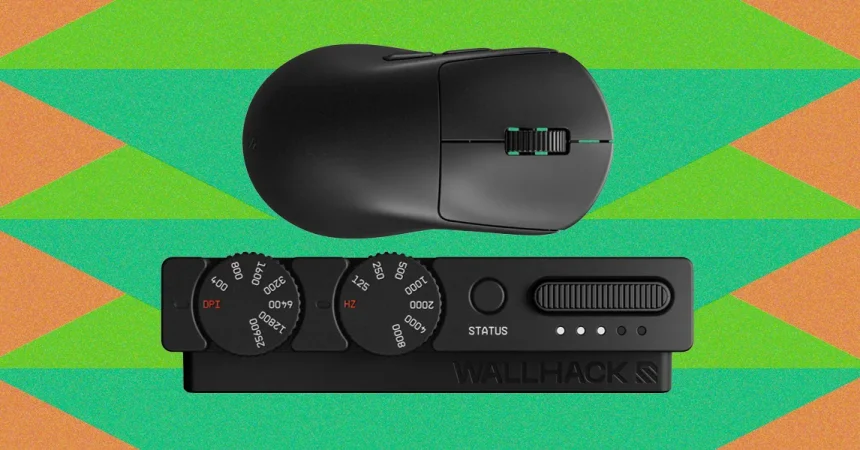
Now let’s talk about the dongle, because dongles are usually the most forgettable part of any wireless mouse. In every high-polling mouse I’ve reviewed, the dongle has been a bit of a pain point. High polling rates require proximity, which means you need a little receiver sitting on your desk. Most of these are small, light, and almost apologetic. They have one or two functions, maybe a few LED indicators to show battery life or connection quality, and they inevitably slide around because the cable pulls them. Before long, they end up on the floor, tangled in a mess of wires, and you have to fish them out with a flashlight and a lot of patience. Wallhack has completely solved this problem by giving the dongle purpose, function, and I’d even argue dignity. Instead of a cheap plastic widget, the dongle is a medium-sized metal wedge with a beautiful gunmetal gray finish that matches the mouse. It feels solid in your hand and looks like a piece of modern sculpture on your desk. It has two camera-like dials up front, a button, and a slot for a rechargeable battery. The first dial controls DPI, with settings from 400 all the way up to 25,600. The second controls the polling rate, from 125 Hz up to a blistering 8,000 Hz. That’s an incredible level of control, and you can adjust both settings without ever opening any software. It makes the dongle an essential part of the experience, not just a passive receiver. You can set your sensitivity, change your polling rate, and keep your spare battery charged all in one place. The dials themselves are machined with precision, giving you tactile feedback that feels like adjusting a high-end camera lens. And because the dongle is a solid metal wedge, it stays exactly where you put it. No more sliding around. No more cables pulling it off the desk. For the first time, I actually wanted to keep the dongle visible, because it looked good and did something useful. That’s rare. That’s special.
In the end, the Wallhack M-001 is more than just a mouse. It’s a tiny manifesto about the way we think about the objects we use every day. It takes something as ordinary as a computer peripheral and treats it with the same care and ambition that you’d expect from a supercar or a high-end camera. When you flip it over and see the bare circuit board, you’re seeing a design philosophy that values honesty and openness. When you feel the spring-loaded battery click into place, you’re feeling the result of thoughtful, precise engineering. When you spin the dials on that metal dongle, you’re touching the future of what peripheral design can be. The M-001 is not perfect, and it’s not for everyone. The lack of USB-C will scare off people who want the safety net of a cable. The reliance on hot-swappable batteries requires you to adopt a new routine. The exposed PCB might make some people nervous, as if it’s fragile, even though it’s actually part of the structure and perfectly solid. But the best products are rarely the ones that appeal to everyone. The best products are the ones that commit to a vision, that make choices, that have a point of view. The Wallhack M-001 has all of that in spades. It’s a small, unassuming object that manages to feel revolutionary. It makes you wonder what else could be improved if we simply asked the question “why do we do it this way?” It borrows ideas from Formula 1 and supercars and applies them to a device that most people barely think about. It turns the boring underside of a mouse into a window into its soul. It transforms the forgettable dongle into a control center, a charger, and a piece of art. For gamers, it offers performance. For tinkerers, it offers wonder. For anyone who appreciates well-made things, it offers a small but genuine dose of joy. That’s a rare gift for a peripheral, and it’s exactly what makes the M-001 so memorable.