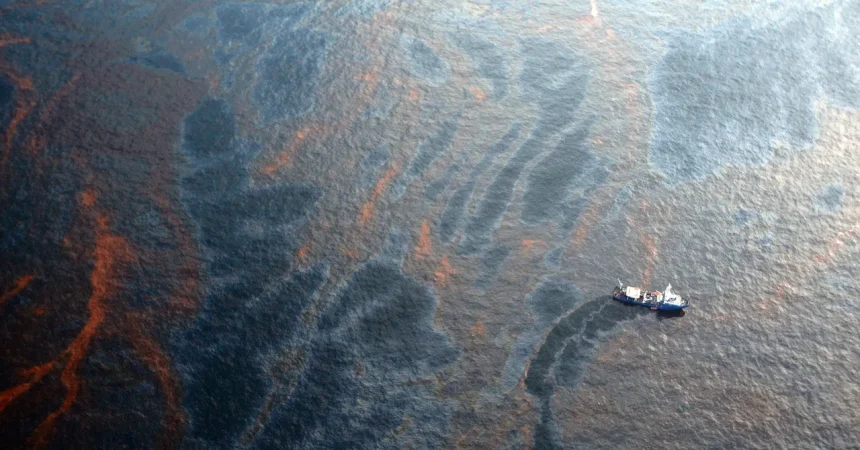
Fifteen years have passed since the Deepwater Horizon rig exploded, and the television cameras have long since moved on. But beneath the waves of the Gulf of Mexico, the story is still unfolding—quietly, invisibly, and far deeper than most of us ever think about. A growing body of research has shown that the spill did far more than coat shorelines and kill pelicans. It has produced a slow, creeping catastrophe in the open ocean, especially in the vast middle depths known as the deep-pelagic zone. That underwater realm, stretching from about six hundred and fifty feet below the surface down to a mile or more, holds roughly ninety percent of the Gulf’s total volume. It is neither sunny shallows nor abyssal seafloor; it is a cold, dark, endless water column that most people imagine as empty. New research led by Tracey Sutton, a professor of marine and environmental sciences at Nova Southeastern University in Florida, suggests that this hidden world has been severely depleted, and that the consequences are still rippling through the food web. One especially haunting possibility is that lingering oil compounds may be interfering with the ability of deep-sea creatures to find mates in the dark, jamming the exquisitely sensitive chemical messages they use to detect one another across miles of black water. Imagine trying to meet someone in a crowded room, except the lights are off, no one can speak, and someone has filled the room with a chemical fog that masks every scent. That may be life for these animals today.
The impacts are not limited to tiny fish and jellyfish. They reach all the way to the ocean’s top predators, including whales. Sutton points to a 2024 study that found an eighty percent decline in deep-diving toothed whales across the region. The Mississippi River canyon, once home to a large resident population of sperm whales, has apparently lost them entirely. “We used to have a big resident population of sperm whales right off the Mississippi River, but we haven’t seen a sperm whale in 10 years,” Sutton said. These great predators do not browse on plankton; they depend on occasional, dense patches of squid and fish at specific depths. Those patches, Sutton explained, have vanished. The delicate threads that connect the deep-pelagic world to the largest animals on Earth have snapped in ways the surface world cannot see. When deep creatures drift upward at night to feed, and sink again by day, they carry energy and nutrients from the surface into the deep. This daily vertical migration is the pulse of the ocean, and when whole communities of small animals disappear, the heartbeat falters. For an animal like a sperm whale, which navigates by sonar and hunts in darkness, a missing school of deep-sea squid is not just a hungry day—it is a reason to leave and never return. The silence in that part of the Gulf is not just a metaphor; it may reflect an ecosystem too degraded to support the magnificent titans that once thrived within sight of the Louisiana coast.
To reach these findings, Sutton and his colleagues did not rely on guesswork. They went out into the Gulf again and again, in weather both rough and fair, and took a census of the deep. Beginning with a nine-month baseline of sampling in 2011, they returned for nine more surveys between 2015 and 2023, covering a wide grid around the spill site. Their tools were surprisingly old-fashioned and remarkably precise: large nets that open and close at different depths, lowered from the decks of research vessels. Standing on slippery decks under a hot Gulf sun, with ocean spray soaking through their clothes, teams of scientists worked around the clock to haul the nets up and down, sometimes sampling at noon and sometimes at midnight, because many deep-sea species migrate vertically hundreds of feet twice each day. Each netful of creatures had to be sorted and identified by experts in every group, from gelatinous organisms to bristlemouth fish. It is painstaking, exhausting, often smelly work—science at its most physical. But they did not stop there. The ship’s echosounders provided an independent check, bouncing sound waves off the water column to measure the abundance of marine life in aggregations that might be missed or undersampled by nets. In all, they gathered tens of thousands of individual samples and observations. The combination was like taking both a high-resolution photograph and a doctor’s ultrasound of the deep Gulf. The results were stark. Over a decade, the region’s deep-pelagic life declined dramatically, with many once-common species becoming rare and some disappearing entirely.
Other marine scientists have praised the study in unusually strong terms. Bruce Robison, a senior scientist at the Monterey Bay Aquarium Research Institute, who was not involved in the research, called it “comprehensive and carefully composed” and said he knew of no other study with such an incredible number of net samples. He noted that the species in question are not commercially fished, which means their decline cannot be blamed on the fishing industry. This is, Robison said, the first time that human impacts have been shown to deplete marine life even in very deep ocean water, far from the surface and far from the direct flow of any river. That is a startling proposition: the idea that the deep ocean, which seems so remote and vast, is not a safe refuge from human activity. Robison also urged the public to understand just how disastrous the spill was. “The Gulf has not recovered, and it’s been over 15 years,” he said. He went on to draw a parallel to another emerging industry: deep-sea mining. That activity, if it is done without care, could discharge wastewater containing metals and lubricants into the open water column, and could have similarly severe negative consequences for deepwater pelagic ecosystems. The lesson from the Gulf is that what we pour into the ocean does not simply vanish. It travels, it accumulates, and it degrades a living system that we are only beginning to understand.
Three independent lines of evidence tell the same story: the net hauls, the acoustic surveys, and genetic sampling of the water. Each method has its own biases and blind spots; all three point in the same direction. Jeffrey Drazen, a marine ecologist at the University of Hawaii at Manoa, who was not part of the study, described this as “unusually strong evidence to support his conclusions.” But the strongest part of the new paper may be its detective work. Sutton and his colleagues did not simply assume the oil spill was responsible for the decline. They systematically tested alternative explanations. Could it have been changing ocean temperatures? No. Could it be natural climate cycles like El Niño? No. Could it be overfishing? No, because these species are not commercially caught. Could it be some other form of pollution? No single other cause fit the data. Drazen summed it up in a way that is both cautious and devastating: “Through logical elimination,” he said, “and without actually pointing a finger, they leave no doubt that the oil spill is the cause of the decline.” This is how science often works—not by dramatic courtroom accusations, but by carefully narrowing the possibilities until only one explanation remains. It is a powerful reminder that you do not need to see oil on the beach to know that an ecosystem is still suffering. The damage is written in the living numbers of the ocean itself.
What does this mean for the rest of us? It means the Deepwater Horizon spill was not a contained, short-lived disaster with a tidy ending. It was a wound that the ocean has been unable to heal, hidden beneath a calm and glittering surface. It means that the deep sea, which we often think of as the largest and least vulnerable habitat on Earth, is actually fragile in ways we have only just begun to grasp. The animals that live there are not charismatic dolphins on the surface or colorful fish on coral reefs; they are translucent, bioluminescent, strange-looking creatures that spend their whole lives in cold and darkness. But they are the foundation of the ocean’s food web, the pulse of the planet’s largest living space, and they are in trouble. The new research also gives us a warning about the future. As humanity looks to the deep ocean for minerals, oil, and gas, we should remember that the damage from the Gulf spill was not limited to the seafloor or the shoreline. It reached into the very middle of the water column, and it has persisted for more than a decade and a half. The Gulf has not recovered—not because scientists have not tried or because nature is not resilient, but because the scale of the injury was simply too large, and the deep sea is not built for quick healing. Yet this is not a story without hope. The best hope we have is knowledge: the kind of careful, difficult, unglamorous science that counts every net, every fish, every echo. That knowledge allows us to see the invisible, and to understand that the ocean is not a bottomless pit for our waste but a living, breathing, connected world. The least we can do is pay attention, before the silence beneath the waves grows even deeper.