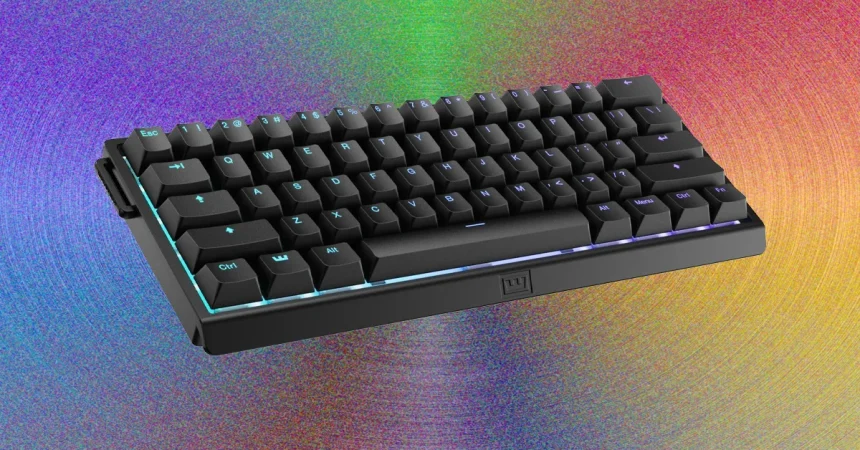
The Wooting 60HE v2 stands out in a crowded market not just because it’s a high-end mechanical keyboard, but because it feels like a genuine tool for competitive excellence. The most talked-about feature is likely its Simultaneous Opposing Cardinal Direction (SOCD) customization, which is a total game-changer for tactical shooters like Counter-Strike 2 or Valorant. By prioritizing one directional input over another, the keyboard virtually eliminates the delay between movements, making strafing and peeking feel lightning-fast and incredibly consistent. It’s a controversial edge, though; because this feature lowers that reaction buffer to near-zero levels without demanding extra mechanical skill from the player, some competitive leagues have already moved to restrict it. Even so, testing it across various titles makes it clear that the fine-tuning available through the Wootility software offers a level of control that traditional mechanical keyboards simply cannot match.
Beyond the software-driven advantages, the core gaming experience is remarkably polished. While earlier generations of Hall Effect keyboards from major brands often felt a bit hollow or lacked that satisfying, tactile “click” we associate with premium boards, Wooting’s Lekker switches successfully bridge that gap. They are exceptionally smooth and consistent, providing instantaneous, low-latency feedback that makes every keystroke feel purposeful. Even the RGB lighting—which is often a neglected afterthought—is handled with care. While the default LEDs might lean a little too far into the cool blue spectrum for some, a quick tweak in the software allows you to calibrate the white balance perfectly, ensuring the aesthetics are just as refined as the hardware’s internal performance.
One of the most refreshing aspects of the 60HE v2 is how approachable it is from a maintenance standpoint. In an era where many tech companies treat their hardware like sealed black boxes, Wooting has embraced a “Peak Repairability” philosophy. The internal architecture is beautifully simple; you can disassemble the entire board in a matter of seconds without needing to be a specialized engineer. Whether you’re swapping out the sound-dampening layers or just cleaning the internals, the construction remains robust and secure. It’s a rare piece of consumer tech that encourages you to open it up, tinker with it, and keep it running for the long haul, rather than forcing you to retire it the moment something feels off.
The keyboard also manages to defy the biggest hurdle for analog boards: compatibility. Historically, if you bought a proprietary hall-effect keyboard, you were stuck with whatever switches the manufacturer decided to sell you. Wooting has flipped the script by adopting the versatile KS-20 design. This move opens the door to a massive ecosystem of switches from reputable brands like Gateron and Geon, meaning your keyboard isn’t locked in time at the moment of purchase. While competitors like Razer or ROG often limit you to only two or three proprietary options, the 60HE v2 allows for a growing, curated experience that evolves as the custom mechanical keyboard market grows.
If there is a minor point of contention, it comes down to the design of the physical chassis. Sticking to the standard GH60 form factor dictates that the USB-C port sits on the left side of the PCB, rather than a centered, isolated daughterboard. While a centered port would be more convenient for cable management and theoretically easier for long-term repairs, it’s a minor design compromise. By choosing standardization, Wooting has made it significantly easier for users to swap cases or find aftermarket parts. It’s a practical, sensible trade-off that favors the consumer’s ability to customize their setup, and it’s a choice that ultimately makes more sense than forcing a proprietary, hard-to-replace internal layout.
When you weigh all these factors—the cutting-edge gameplay advantages, the clever internal design, the switch compatibility, and the high-quality build—it’s easy to see why the 60HE v2 is currently one of the best gaming keyboards on the planet. It lacks wireless connectivity, which might be a dealbreaker for minimalist desk enthusiasts, but for those who value absolute performance, it fills every other need with confidence. At a $240 price point, it isn’t an impulse buy, and the current backorder status means you’ll need a bit of patience to get one in your hands. However, if you are a serious gamer who values longevity, tactile feedback, and total control over your inputs, it is an investment that easily justifies its cost.