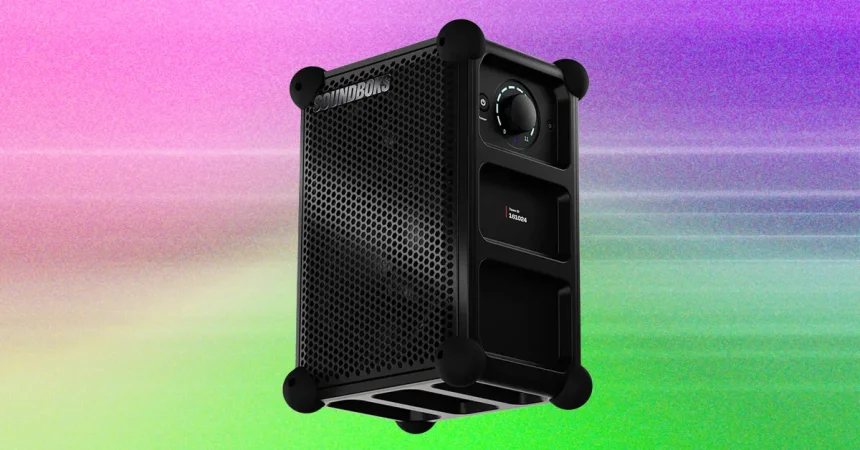
Some speakers are content to sit quietly in a corner and fill a room with background music. The Soundboks Rider is not one of those speakers. From the moment you take it out of the box, it feels like something with a purpose, and when you turn it on, the purpose is immediately clear. This is a speaker designed to command a space. But the most surprising thing about the Rider is not just that it’s loud. It’s that it remains composed and clear even when it’s pushing serious sound. I’ve spent time with plenty of portable speakers that collapse into mud at high volume, with harsh highs and a bass that turns into a monotonous rumble. The Rider doesn’t do that. Across every volume range, it sounds good. The low end is full and powerful, but it isn’t overpowering in the mix. It sits where it should, underneath the vocals and mids, giving the music a solid foundation without drowning out the details. That kind of balance is harder to achieve than most people realize, and it’s what separates a well-designed speaker from a merely loud one. The sound profile matches the speaker’s understated, PA-style aesthetic: clean, strong, detailed, and unpretentious. There’s no fake shimmer or exaggerated color, just a direct, honest presentation that makes you want to keep listening. It’s a little like having a proper sound system at a backyard party, except it all fits in a portable box. And if you ever want to test its limits, it can output up to 118 dB SPL. For context, that is well within the range of physical pain and comparable to a rock concert. I’m honestly not sure when or where I’d need to push out that much audio. It feels like having a fire extinguisher in your kitchen—you may never use it, but there’s something comforting about knowing it’s there. If you ever do need that kind of volume, though, the Rider is more than ready.
Visually and physically, the Rider is a study in no-nonsense design. It doesn’t try to be a piece of furniture, and it certainly doesn’t try to be a light show. There are no unnecessary flourishes, no disco LEDs, no futuristic angles. It looks like what it is: a serious speaker built for real use. The enclosure is rugged, the components feel solid, and the overall impression is one of quiet confidence. You get the sense that this thing could survive being thrown in the back of a car, bounced around a trailer, left on a grassy hillside, or caught in an unexpected drizzle without missing a beat. In an era where lots of electronics feel fragile and disposable, that sturdiness is a genuine point of appeal. It’s also a very portable option given what it can do. You’re not taking it on a jog, but you can easily bring it to a park, a campsite, a tailgate, or a friend’s place. The battery life is another big strength. I didn’t have to babysit the charge; it simply lasted long enough that I stopped thinking about it, which is exactly what you want from a party speaker. There’s a certain freedom in not worrying about a power cable. You can just put the Rider where you want it and leave it there. The app follows the same basic philosophy. It’s streamlined and unfussy, with no cluttered home screen or pointless social features. From your phone you can control basically every speaker function remotely, including volume, sound profiles, EQ modes, and even turning the whole speaker off. It’s the kind of app that feels like an afterthought in the best way—it’s there to help, not to demand attention. In a world of bloated software, the Rider’s simplicity is quietly welcome.
That said, the app is not perfect, and the connection process left me scratching my head more than once. Getting the Rider and my phone to actually talk to each other was finicky. I had to pair, unpair, re-pair, power off, and power on a few times before they would cooperate. For a product at this price, that first impression is a little awkward. You expect a $600 speaker to be seamless. Instead, I spent several minutes doing the digital equivalent of pushing two people into a conversation and hoping they hit it off. The situation got even more annoying when, after a firmware update, the app told me to forget the speaker and pair it all over again. So I went through the entire dance a second time, muttering under my breath and wondering why a supposedly premium experience required so much troubleshooting. I want to be fair here, because I’ve tested hundreds of wireless audio gadgets over the years. Bluetooth problems with brand-new products are less surprising than you might think. Hardware and software are complicated, and the first few weeks of a product’s life often involve a patch or two. In many cases, these issues get sorted out within a month or two of software updates. It’s entirely possible that by the time you read this, the Rider’s pairing quirk will be a distant memory. But at the moment, it made the whole experience feel decidedly less premium than the price tag suggests. It’s not a dealbreaker, but it’s a reminder that good speakers are sometimes held back by their own tech. When a speaker is this simple in concept, you’d love for the digital side to match. Instead, you’re stuck with a minor but nagging annoyance that you’ll probably forget about—until you have to set it up again at a party.
Stepping back, there’s no denying that the Soundboks Rider is an excellent speaker. In terms of loudness, durability, and battery life, it runs circles around most of the competition. That includes larger, bulkier party-slash-karaoke speakers like the Sony Tower 5 and the JBL PartyBox Club 120. Those are serious machines in their own right, but the Rider still manages to stand out. It delivers comparable or better performance in a more portable package, and it does so without the theatrics. That’s not an easy trick. But there’s another side to the story. As a larger portable Bluetooth speaker meant to stand completely on its own, the Rider is a bit niche, especially at $600. Niche doesn’t mean bad. It means you have to be a specific kind of person to get real value out of it. I can’t think of many people in my life who need this combination of loud and bombproof in their daily speaker. Most of us are listening in a living room or a small backyard, with maybe a handful of people around. Most of us don’t have a crowd that requires a sound system capable of reaching rock-concert volume. And most of us could get by just fine with something considerably cheaper. The $500 Sony ULT Field 7 is a great option that costs less. The $330 JBL PartyBox Encore Essential 2 is another speaker that can fill a room or a patio without breaking the bank. Those alternatives might not have the same extreme volume ceiling or tank-like construction, but they don’t need to. They are designed for real human parties, not hypothetical festivals. It’s easy to be dazzled by a spec sheet that says 118 dB. It’s harder to look at your own calendar and admit that you don’t actually host events that require that much power.
At the end of the day, the overkill question is really a question about your life. Soundboks markets the Rider as a portable party speaker built for spontaneity and outdoor adventure. That’s an appealing vision. It invites you to imagine warm summer nights, long drives, bonfires, group trips, and dance parties under the open sky. For someone whose weekends actually look like that, the Rider might be the perfect companion. It’s big enough to bring to any party. It’s durable enough that you never have to worry about the small stuff. It’s loud enough to cover noise from wind, waves, or a crowd of people talking. There is a real pleasure in owning a tool that simply can’t be outmatched. You never have to ask whether the speaker can handle the situation. The only question is whether you are willing to haul it there. But for my spontaneous adventures, the Rider is honestly overkill. My spontaneous adventures tend to be modest: a small get-together on a balcony, two or three friends in a kitchen, a lazy afternoon in a park with a playlist playing in the background. Those moments are lovely, but they do not need a speaker that could serve a small festival. At normal listening levels, the Rider is barely ticking over. You’re carrying around a lot of extra volume and paying a lot of extra money for abilities you’ll never use. There’s nothing wrong with that if it makes you smile, but it’s not the most practical use of $600. If your adventures include a lot more people and a lot more space than mine, however, the calculus shifts completely. Then the Rider isn’t overkill at all—it’s exactly right. It takes away the fear of bringing a speaker to a big gathering, because you know it can handle it. That confidence, honestly, might be worth the price all by itself.
So where does this leave us? The Soundboks Rider is an excellent speaker. I could nitpick the app and I could argue about the price, but neither of those things changes the fundamental quality of the hardware. It sounds great across all volume levels. It is sturdy and reliable. It lasts long enough to be trusted. And it offers a level of output that is genuinely uncommon in the portable category. That is a rare combination, and Soundboks deserves credit for pulling it off. But it is also important to be honest about what this speaker is not. It is not a casual living-room speaker. It is not a budget-friendly option. It is not a device you’ll probably ever use at full volume. And it is definitely not the right choice for someone who just wants something a little better than their laptop speakers. The Rider is a specialist’s tool. It does one specific job—deliver loud, clear, durable sound in a portable package—and it does that job extraordinarily well. If that job is your job, you will love it. If it isn’t, you can probably spend less money and get a speaker that fits your life more neatly. The app’s early connectivity quirks are a minor concern, and they’re likely to be fixed with updates, but they’re still worth remembering before you spend $600. None of that changes the main point. This is a special speaker, but its specialty is not for everyone. It knows exactly what it wants to be, and it makes no apologies for it. Maybe that’s the most refreshing thing of all. In a market full of products trying to please everyone, the Rider is happy to be the one you don’t need—until the day you really, really do. And if that day comes, you’ll be glad it was there.