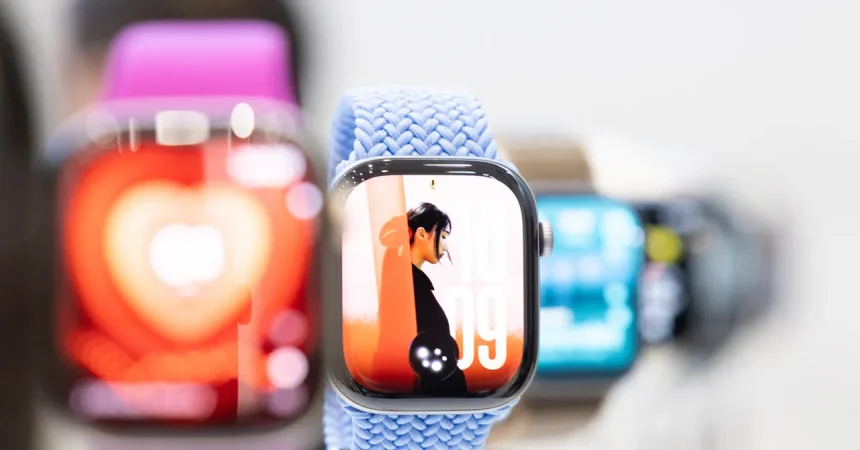
Apple has always understood that the best technology is the kind you forget you’re wearing, and the newest Apple Watch feels like the brand leaning even harder into that idea. It’s not just about faster processors or brighter screens anymore; it’s about making the watch feel less like a tiny computer strapped to your wrist and more like an intuitive, almost instinctive extension of your body. One of the most immediately noticeable changes is how much easier it is to use with just one hand. We’ve all been there—standing in a crowded train, carrying groceries, or holding a coffee and a bagel while trying to check a notification without dropping everything. Apple has expanded its gesture controls to make this kind of multitasking feel genuinely effortless. A simple tap of your index finger and thumb together can pull up widgets in the Smart Stack, and a double-tap lets you scroll through them without ever touching the screen. A quick wrist flick can silence a timer, dismiss a notification, or return you to the watch face. These gestures sound small in theory, but in practice they’re surprisingly natural, almost like the watch is reading your intention rather than waiting for a literal tap. They also offer a degree of discretion that’s hard to overstate—you can glance at your messages, snooze an alarm, or check your next meeting without ever making it obvious you’re interacting with a device. For anyone juggling a million things at once, or for those moments when you want to stay present without completely unplugging, this kind of gesture-based navigation transforms the watch from a screen you stare at into a quiet assistant that works in the background of your life.
Underneath that thoughtful interaction layer, the new S11 chip delivers the usual generational leap in speed and graphics, but the more meaningful upgrade is in how the watch understands you. The Neural Engine has been made more efficient, which means everything feels faster and smoother, but it also powers a remodeled pedometer that’s designed to improve step counts and distance measurements, especially during indoor walks and runs. If you’ve ever walked on a treadmill and watched your watch credit you with a suspiciously low number of steps, you’ll understand why this matters. In head-to-head comparisons with the previous Series 11, the actual numbers didn’t seem radically different, which is probably a good thing—consistency is what you want from a fitness tracker. But the experience of checking your progress has gotten a lot better thanks to a new Steps complication. Instead of opening the Activity app and waiting for a screen to load, you can now put your real-time step count right on the watch face. It’s a small thing, but it changes how you engage with your daily movement. You don’t have to make a deliberate effort to check in; the information is just there, gently nudging you to walk a little more, take the stairs, or get up from your desk. It’s the kind of subtle behavioral cue that makes health tracking feel less like homework and more like a friendly reminder from someone who cares about your wellbeing. There’s something deeply human about wanting to see your progress at a glance, without making a production out of it, and Apple seems to understand that the best health data is the kind that integrates seamlessly into your day rather than demanding your attention every time you want to know where you stand.
The bigger hardware story, though, is Apple’s new Health Sensing System, and this is where the watch starts to feel less like a gadget and more like a medical device you actually want to wear. The Series 12 includes 32 electrodes for ECG readings, jumping from just two on the Series 11. That’s a massive leap, and it means better skin contact and more reliable heart data. The photodiodes have also been rearranged into a ring configuration for improved optical sensing, and the green LEDs responsible for heart rate tracking are now larger, allowing for more accurate readings. But the real game-changer is how often the watch is now listening to your body. The Series 11 took a heart rate measurement roughly every five minutes when you were relatively stationary. The Series 12, by contrast, measures your heart rate every five seconds, even while you’re moving. That’s a staggering difference in data volume. Instead of getting a few isolated snapshots throughout the day, you get a continuous, flowing picture of how your heart responds to everything—stress, a brisk walk, a moment of excitement, a tense email, a deep sigh. For anyone trying to understand their body on a deeper level, this is invaluable. You can see patterns you’d never notice with occasional readings, like how your heart rate spikes before a meeting or calms after a few minutes of deep breathing. The watch also measures heart rate variability (HRV) much more frequently—as often as every five minutes, compared to every two hours on the previous model—and it tracks two distinct variants: recovery HRV and overall HRV. HRV is a fascinating metric for people who are serious about wellness because it reflects your body’s readiness to handle stress in real time. With this level of sampling, you’re not just guessing at how recovered you feel; you’re seeing actual physiological evidence of your nervous system’s state. And you can access all of this information through the Heart Rate app or via new live heart rate complications on your watch face. It’s a lot of data, but presented in a way that feels approachable, giving you the chance to become more attuned to your body without needing a medical degree to interpret it.
Perhaps the most anticipated addition for Apple Watch enthusiasts is the new Readiness app, which finally brings a unified recovery score to the platform. We’ve seen this feature from competitors like Garmin and Oura for years, and Apple fans have been eagerly waiting for their own version. The idea is simple: instead of making you interpret a dozen different metrics yourself, the watch synthesizes your activity, sleep, and other health data into a single score that estimates how prepared you are for the day ahead. It takes seven days of sleep data before the score becomes available, which is standard for wearables because it needs to establish a baseline that’s unique to you. Once it does, you get a quick, digestible number that tells you whether to push hard or take it easy. For people who love data but don’t always have the time or energy to contextualize it themselves, this is a welcome shortcut. Instead of staring at a graph of your sleep stages, heart rate variability, and overnight restorative metrics and trying to figure out what it all means, you get a clear signal. That said, I’m someone who remains a little skeptical of any proprietary algorithm that claims to boil down the complexity of human physiology into a single number. Recovery is deeply personal, and no algorithm is going to understand how you feel after a stressful week or a bad night of sleep better than you do. But even with that caveat, Readiness is useful—not as an absolute truth, but as a prompt to pause and pay attention to your body. It reminds you to check in with yourself, to notice if you’re pushing too hard, and to consider whether you actually need that extra rest day. And later this year, Apple is planning a redesigned Health app with a new Longevity tab and metrics like Health Age, which compares your health data to that of your demographic. I haven’t gotten a chance to test those features yet, and I’m both curious and slightly terrified to see my Health Age. It feels like one of those things that will either be surprisingly encouraging or quietly devastating, depending on how much sleep I’ve been getting and how many donuts I’ve eaten in the past month. But that’s the nature of health tracking—it holds up a mirror, and you have to be ready to look.
The most controversial new addition, and perhaps the one that raises the most interesting questions, is Apple’s Audio Intelligence suite. This is a collection of four audio-focused features, including accelerated Shazam and Sound Recognition, the latter of which has been available on the iPhone since 2020. These are useful but not particularly groundbreaking. The features that really push boundaries are Siri Recap and Live Rewind, both of which use the watch’s microphone to capture and process audio, and neither of which I’ve been able to test yet since they’re slated to arrive later this year. Siri Recap is clearly Apple’s answer to the explosion of AI notetaking tools. When enabled, it can transcribe conversations and generate summaries using Apple Intelligence. In a briefing, I watched it turn a PTA meeting into a detailed set of notes and reminders that seemed genuinely useful—action items, follow-ups, key decisions, all neatly organized. For anyone who spends their days in meetings, classes, or interviews, the appeal is immediately obvious. Imagine never having to frantically scribble notes while simultaneously trying to participate in a conversation. Imagine being able to be fully present, knowing the watch has your back. But it also moves the Apple Watch into some murky waters. Wearing a watch that passively listens to your conversations, even if only when activated, is a concept that makes a lot of people understandably uncomfortable. There are questions about privacy, consent, and the ethics of recording in shared spaces. Apple insists that everything is processed on-device and that you have full control over when it’s listening, but the existence of such features inevitably changes the social dynamics of conversations. Are you obligated to tell people you’re wearing a watch that can transcribe and summarize what they say? What happens to that data? How easy is it to accidentally enable the feature? These are not insurmountable concerns, but they are ones Apple will need to address thoughtfully if it wants to avoid a backlash. The technology itself is remarkable, but it’s also a reminder that our devices are becoming more aware of us than ever before, and that awareness carries a responsibility.
At the end of the day, the new Apple Watch Series 12 feels like a device caught between two very different futures. On one hand, it’s an incredibly capable health companion, with sensors that track your heart continuously, an algorithm that assesses your readiness, and a redesign of the Health app that promises to give you a more holistic view of your wellbeing. The gestures make it more intuitive, the step tracking is more accurate, and the overall experience is smoother and more polished than any previous model. It’s a watch that wants to help you live a better, more mindful life. On the other hand, it’s also moving into more sensitive territory with features like Siri Recap, which raises profound questions about how much we want our devices to listen, interpret, and remember. The balance between helpful and invasive is delicate, and Apple is treading a tightrope. For the person who wants to understand their body better, who wants to be more present in their daily life, and who is tired of staring at a thousand unrelated health stats, this watch is a genuinely compelling upgrade. The more frequent heart rate readings, the Readiness score, the new complications, and the effortless gesture controls all come together to create a device that feels less like a gadget and more like a companion. But it’s also clearly a product that is looking toward a future where our devices are even more integrated into our lives, where the watch isn’t just tracking what we do but also listening to what we say and helping us make sense of it. Whether that future feels liberating or unsettling probably says more about you than it does about the watch. For now, I’m excited about the health features, cautiously optimistic about the AI tools, and keenly aware that the line between technology that empowers us and technology that observes us is getting thinner by the day. The Apple Watch Series 12 isn’t just a smartwatch anymore; it’s a reflection of how far we’ve come—and a glimpse of just how complicated our relationship with technology is about to become.