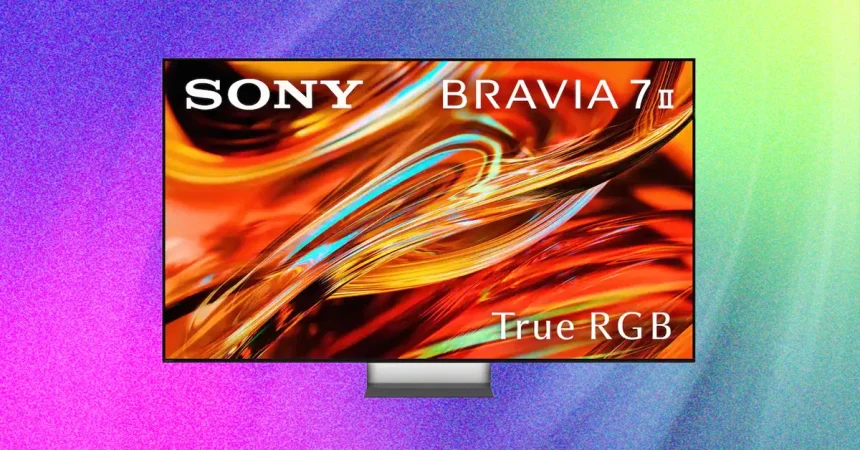
When you bring a new television into your home, you’re looking for those “wow” moments—the kind of clarity that makes a mountain mist feel tangible or the subtle shades of a buffalo’s coat pop from the screen. Unfortunately, my time with the Sony Bravia 7 Mark II felt more like watching a world dimming than one coming to life. During initial demo reels, the color reproduction and contrast ratio struggled to land the landing. Delicate scenes, like fog drifting over a white mountain peak, lacked the necessary separation to look distinct, while the lush greens of grass behind a fence felt muted and sleepy. Even something as straightforward as a brown buffalo roaming a field lacked tonal variety, flattening the image in a way that robbed the scenery of its natural depth.
The struggle continued when I turned my attention to the screen’s ability to handle dark, moody environments. In true cinematic fashion, dark colors should feel deep, rich, and immersive, yet the Bravia 7 Mark II consistently rendered dark sequences as dull and washed out. Watching films like The Creator or Awake on Netflix became a frustrating exercise in squinting; in a key scene where a character rides a bike at night, the screen failed to balance the lighting. I could just barely make out the protagonist’s face, but the environment around her—the background details and a person in a blue shirt—simply vanished into a murky void. Even fiddling with various picture modes, including the XR Contrast Booster, failed to breathe any meaningful life into those shadows.
There were, however, unique moments where this TV’s particular personality seemed to shine, albeit in a niche way. Animated features like Hoppers on Disney+ actually looked quite lovely, benefiting from an understated backlighting profile that gave the film a soft, artistic, “matte” feel, similar to what you might see on a dedicated art television. While the vibrant colors of an iPhone 17 Pro screen initially made the TV’s output feel a bit pulled-back, I eventually warmed up to the aesthetic for animation. It isn’t the punchy, high-octane visual experience most users crave, but for those who prefer a gentler, more painterly approach to visuals, it offers a specific flavor that isn’t entirely without merit.
Streaming performance provided its own set of highs and lows. On the positive side, casting functionality was flawless; firing up Dune II via the HBO Max app was a seamless experience, especially when compared to the hit-or-miss connectivity I’ve encountered on competitors like the Hisense UR9. However, the inconsistency returned when watching standard broadcast media. News programs looked decidedly flat and lacked the vibrancy one hopes for, and the screensaver mode—specifically when displaying classic oil paintings of shipwrecks—was disappointing. The lack of contrast made these masterpieces look like they were being viewed through a heavy fog, failing to capture the drama of the scenes depicted.
The audio experience on the Bravia 7 Mark II is a tale of two setups. Relying solely on the built-in speakers leaves a lot to be desired; they are notably inferior to the audio output found on the Hisense UR9, lacking the depth and presence of a more robust internal system. However, the story changes completely when you integrate external hardware. When I hooked up my Klipsch “The Nines II” speakers to test Dolby Atmos using the movie Unbroken, the room finally came alive. The sound of plane engines, distant explosions, and overlapping dialogue filled the space with a true sense of scale—a feat the Hisense struggled to replicate even with the same setup. For this TV, a high-quality soundbar or external speaker system isn’t just an accessory; it is a fundamental requirement.
Finally, the gaming experience was, much like the rest of the unit, a bit of a mixed bag that leaned toward underwhelming. Running a PC through the Vietnam level of 007: First Light—a visually stunning sequence involving sun-drenched water and dramatic cliffs—revealed the TV’s inability to maintain consistency. When the sun was blazing, the contrast held up beautifully, providing a sharp, clear image. But the moment the gameplay shifted into a shaded area, the picture quality plummeted, leaving the image looking washed out and muddy. While the 120Hz refresh rate performed adequately, the overall clarity and responsiveness just couldn’t keep pace with the Hisense UR9 Mini RGB. For gamers and cinephiles alike, the Bravia 7 Mark II offers a specific, softer visual signature that may appeal to art lovers, but it struggles to match the punchy, vivid, and reliable excellence required for top-tier modern entertainment.