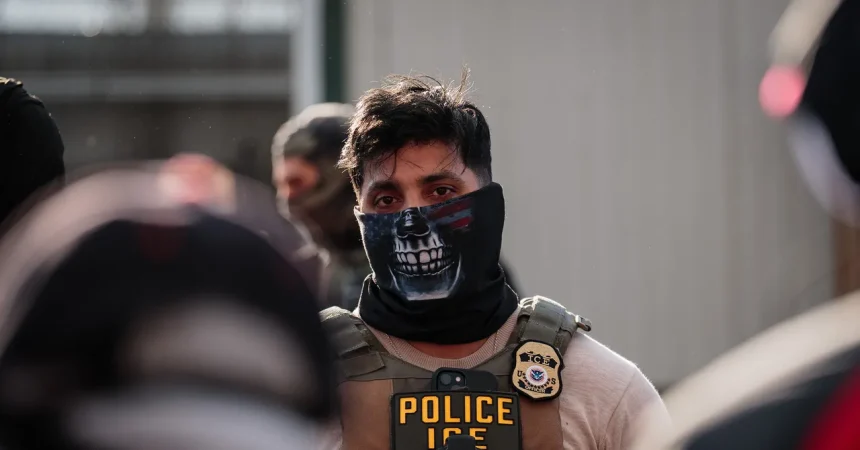
The Trump administration’s legal offensive against several states and the city of Philadelphia marks a contentious chapter in the ongoing debate over policing, transparency, and federal authority. By challenging local laws that mandate accountability for Immigration and Customs Enforcement (ICE) officers, the federal government has positioned itself in direct opposition to state-level efforts to demand conduct standards. Specifically, these lawsuits target legislative mandates that require officers to abandon the use of masks during immigration raids and to clearly display unique identifiers. While state officials argue these measures are essential for public safety and officer accountability, the Department of Justice maintains that such requirements strip federal agents of their anonymity, effectively placing them in mortal danger by exposing their identities to potential retaliation from the public.
At the heart of the government’s legal argument is the fear that publicizing the faces or identities of ICE officers invites “doxing”—a practice where sensitive personal information is harvested from the internet and weaponized. In its complaints against jurisdictions like New York, New Jersey, and Connecticut, the administration specifically cites the existence of a digital art project known as “ICESpy.” The government’s narrative suggests that activists are using sophisticated facial recognition technology to track agents, essentially turning the digital landscape into a hunting ground for federal employees. To the administration, the threat is presented as a high-tech reality that necessitates federal intervention to protect the anonymity—and by extension, the lives—of those engaged in enforcement.
However, the reality behind these high-stakes legal arguments is far less ominous once the technical facts are unpacked. Kyle McDonald, the artist behind the ICESpy project, points out that the government is essentially fighting a ghost. The database powering his project is rooted in aging, self-reported data pulled from LinkedIn nearly a decade ago. It reflects a workforce that has changed drastically since its inception; the list primarily contains administrative, legal, and executive staff, with only a fraction representing the boots-on-the-ground deportation officers now operating in the field. Consequently, the claim that someone could identify a modern-day ICE officer using this outdated repository isn’t just an exaggeration—it is, by the creator’s own admission, logically and technically absurd.
The claim that ICESpy poses a security threat further crumbles under the weight of actual usage statistics. Analysis of the site’s traffic logs reveals a platform with virtually zero real-world impact. During a sample week of activity, the site recorded a negligible number of page views, with almost no attempts to utilize its facial recognition features. Moreover, the results produced by the software are reportedly so inaccurate that they could never be reliably used to identify a federal employee, let alone facilitate a targeted attack. The government’s characterization of this niche art experiment as a dangerous tool for systemic doxing fails to align with its actual performance or utility.
The federal government’s attempt to frame the “ICE List” website as a similar threat is equally problematic. While ICE List serves as an accountability tracker tasked with documenting enforcement incidents, vehicle sightings, and professional histories, it functions more like a public record archive than a malicious tracking tool. Most of the data remains derived from public, voluntary disclosures that employees themselves shared on professional networking sites long before they became the subject of digital scrutiny. By painting these transparency-focused initiatives as sophisticated weaponized databases, the Department of Justice is arguably prioritizing federal immunity over the same democratic principles of accountability that apply to every other level of law enforcement.
Ultimately, this legal battle speaks to a deeper tension regarding who gets to demand visibility in our society. The administration’s pivot toward citing obscure, non-functional art projects to justify keeping federal agents masked and nameless suggests that the issue is less about genuine safety and more about avoiding the scrutiny that accompanies public service. If our court systems are now expected to treat decade-old, inaccurate LinkedIn scrapes as credible digital threats, the standard for keeping public officials accountable becomes dangerously high. As these lawsuits proceed, the core question remains whether the government’s desire for concealment should supersede the right of the public to witness and verify the conduct of those exercising state power on their streets.