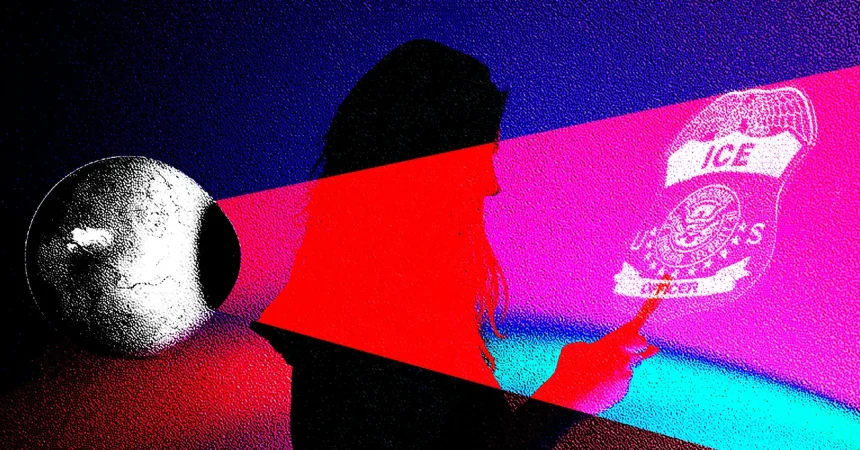
The incident involving Paigelynn Gonyea, a poll worker in Syracuse, New York, serves as a startling case study on the shifting boundaries of federal oversight and individual expression. While performing her civic duties during a primary election last June, Gonyea was confronted by Immigration and Customs Enforcement (ICE) agents who had tracked her down to her place of work. The agents arrived bearing a warning notice, alleging that she had “doxed” a federal official through a social media post. In reality, Gonyea’s online activity consisted of sharing a news report from the Minnesota Star Tribune that identified a federal agent involved in a fatal shooting, accompanied by a call for legal accountability. This encounter highlights the tension between a citizen’s right to critique government actions and an agency’s increasingly aggressive pursuit of those who speak out against its representatives.
For Gonyea, the experience was not merely surprising but deeply demoralizing. When the agents demanded she sign a waiver effectively admitting to—and apologizing for—purported threats against federal officers, she refused. To her, signing the document would have been a concession of guilt regarding an act she never committed, as sharing a journalistic report is a fundamental aspect of public discourse, not a criminal threat. The agents’ arrival at a polling site—a sanctuary of democratic participation—cast a shadow over her work. It felt designed to intimidate, creating a chilling atmosphere where a private citizen was suddenly forced to defend her constitutional right to free speech while simply trying to assist her community in the voting process.
The investigation into Gonyea was spearheaded by ICE’s Office of Professional Responsibility (OPR), a department that traditionally functions as an internal watchdog meant to hold the agency and its contractors accountable. Typically, the OPR’s scope is confined to administrative tasks like security clearances, facility inspections, and internal disciplinary oversight. However, recent evidence suggests that the office has expanded its reach, pivoting toward the surveillance of American civilians who criticize the agency online. By utilizing internal investigative resources to pursue dissenting voices rather than police internal misconduct, the OPR appears to have pivoted from a guardrail against agency abuse to an instrument of external monitoring, which leaves many legal experts and observers deeply concerned about democratic overreach.
Data regarding the scale of these investigations reveals a significant uptick in activity. Court filings indicate that in roughly a year, the OPR investigated over 130 cases characterized as “doxing” or threats against ICE personnel. Yet, despite this high volume of investigations, the agency has been notably opaque about how many of these inquiries actually rose to the level of criminal prosecution. This gap suggests that the OPR may be using the process of investigation—subpoenas, intimidation, and monitoring—as a tool for suppression, regardless of whether a crime has actually been committed. In the rare instances where cases are brought to the Department of Justice, the targets often involve individuals whose behaviors have been stretched beyond the legal definition of a “true threat,” raising questions about the legitimacy of these federal efforts.
Legal advocates at organizations like the ACLU stress that the First Amendment remains a robust safeguard for citizens who criticize the government, even when that speech is harsh or anonymous. Convicting someone for purely expressive conduct is an uphill battle legally because the Constitution strictly limits the government’s power to punish speech that is merely offensive or critical of public officials. When federal agencies use administrative subpoenas to attempt to unmask anonymous critics, they often retreat when challenged in court, suggesting that their legal footing is frequently tenuous. By withdrawing these demands rather than defending them before a judge, the federal government appears to be engaging in a tactic of “regulatory harassment,” hoping citizens will self-censor out of fear of further personal exposure.
Ultimately, the story of Paigelynn Gonyea is a sobering reminder of the necessity for transparency and restraint within federal bureaucracies. When an agency tasked with enforcing the law begins to use its vast surveillance capabilities to target everyday citizens for their political views or social media commentary, the balance of power shifts dangerously. A democracy relies on the ability of the public to hold government officials accountable, especially those who wield the power of life and death, such as federal agents. If the price of pointing out public wrongdoing is an unexpected visit from armed agents at one’s place of employment, then the fundamental right to dissent is under direct attack. Protecting this freedom requires that we remain vigilant against the quiet expansion of federal surveillance into the private lives of those who simply insist on transparency.