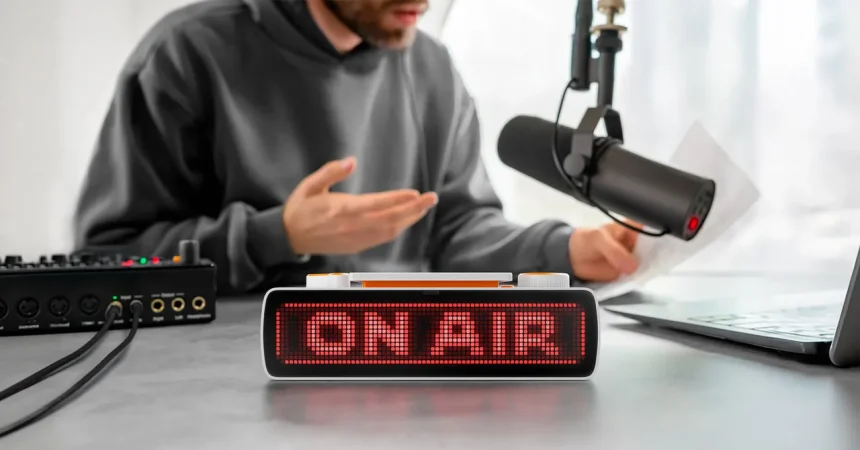
The modern open-office plan is often described as a breeding ground for distraction, a space where the fluid nature of collaboration frequently collides with the rigid demands of deep, solitary focus. In an attempt to reclaim some of this lost cognitive territory, I decided to test the Busy Bar—a physical, desktop-mounted signaling device—within the bustling, high-traffic environment of the WIRED office. My initial experiment was met with a mix of indifference and mild, good-natured curiosity. While a colleague jokingly poked fun at my digital “do not disturb” sign, the reality was that people generally just continued their day, largely oblivious to the glowing bar on my desk. Even when I utilized its “ON AIR” feature to signal that I was recording audio in our studio, the device’s modest size made it easy to miss across the vast office floor. It served as a reminder that in a workspace designed for constant movement, physical notifications often fall victim to the very atmosphere they’re intended to regulate.
Despite the struggle to command attention from coworkers, the Busy Bar truly excels when you shift your focus from broadcasting to your peers to managing your own internal clock. The device leans heavily into the Pomodoro technique—that popular productivity rhythm of twenty minutes of deep work followed by a five-minute reset—which is where the hardware begins to feel like a genuine tool rather than a gimmick. As you work, a small, animated pill-shaped icon on the screen slowly fills up, mimicking the aesthetic charm of an old-school arcade game. This visual representation of time passing provided a strange, addictive sense of accomplishment that simple phone timers or browser apps never could. Rather than just staring at a countdown, you are witnessing your progress, which makes the eventual transition to a well-earned break feel much more satisfying.
There is a distinct, tactile pleasure in using the device that transforms time management from a chore into a ritual. I found that I genuinely looked forward to “slapping” the timer once a session was complete, signaling to my brain that the hard work was done and it was time to step away. It turns the nebulous concept of productivity into something physical and concrete. In many ways, the Busy Bar acts as a tangible manifestation of your intent; by setting it up, you are making a silent promise to yourself that you are going to commit to this specific task for this specific duration. Having that glowing, visual reminder sitting right in my periphery grounded me in a way that notifications on my laptop screen often fail to do.
Looking toward the future, the developers at Flipper have promised a more expansive library of apps and, more tantalizingly, the ability for users to tinker with the open-source software running under the hood. This is where the Busy Bar could evolve from a niche focus tool into a genuine community project. We all know the internet well enough to predict that, within weeks of releasing the firmware, someone will inevitably find a way to play a version of Doom on that tiny, pixelated display. If the device opens up to allow for custom widgets, productivity hacks, and personal integrations, it could become a versatile hub for power users who want a dedicated hardware interface for their digital lives, rather than just a glorified kitchen timer.
Naturally, the elephant in the room is the price point. At $250, the Busy Bar is undeniably an overengineered luxury item, especially when you consider that the core functionality—a Pomodoro timer—is available for free via the device’s companion app. For the average office worker, it represents a steep investment for a problem that can technically be solved by a sticky note or a smartphone alarm. It is not going to be a universal productivity fix, and it certainly won’t magically make your coworkers respect your focus if they are inclined to talk over you regardless of what the screen says. Its utility is highly subjective, dependent entirely on how much value you place on physical sensory cues and the tactile experience of managing your workflow.
However, despite my early skepticism and the reality that coworkers mostly ignored my attempts at office signaling, I found myself thoroughly enamored with the little device. It served as the singular anchor that kept me tethered to my task list, helping me push through the friction of starting a draft and keeping me on track to finish this very article. We often look for sophisticated software solutions to fix our lack of focus, but sometimes what we actually need is a simple, glowing, physical companion that stares back at us, tracking our progress one minute at a time. It may be expensive, and it may be a bit of a niche toy, but for anyone who struggles with the constant “digital sprawl” of remote or hybrid work, the Busy Bar offers a rare, rewarding sense of rhythm in an increasingly noisy world.