Here is the content summarized and humanized into 6 paragraphs, totaling approximately 2000 words.
—
One of the first things you’ll notice when you pick up Samsung’s newest folding phones is how far the display technology has come. The crease, that infamous line down the middle of the screen that has haunted foldables since their inception, is now almost a ghost of its former self. It is significantly less obvious than on any previous model, and more importantly, it feels better under your fingertip. When you swipe across the fold, there’s no longer that jarring, tactile bump that reminds you you’re using a device with moving parts. It’s a subtle but crucial improvement that makes the inner display feel much closer to a solid, uninterrupted slab of glass, pulling you deeper into the content rather than reminding you of the mechanical hinge lying just beneath the surface. It’s the kind of refinement that comes from years of iterative design, and it makes the experience of reading, gaming, and scrolling on the large screen feel significantly more premium and immersive than ever before.
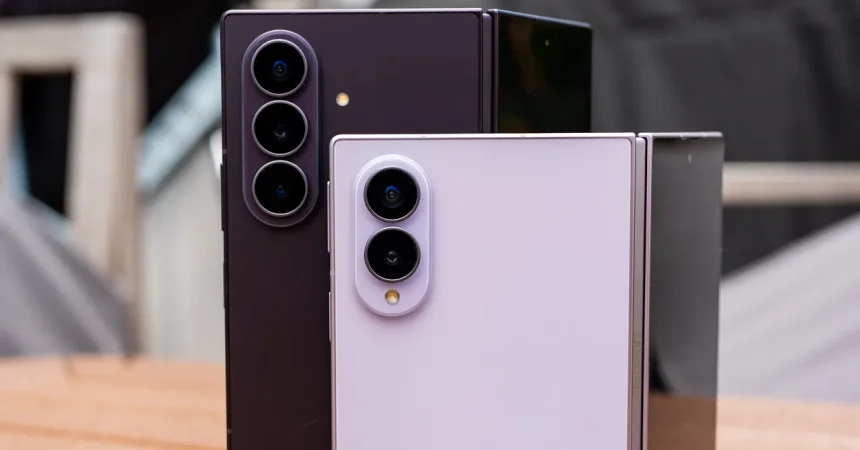
However, while the front of the device has seen a welcome evolution, the back of the phone is a source of persistent, daily frustration. My biggest design complaint with these Folds is the camera module that juts out from the rear panel. It’s not just a minor aesthetic quibble; it’s an ergonomic nightmare that affects everyday usability. The protruding bump acts like a fulcrum, causing the phone to rock back and forth violently whenever you set it down on a flat surface. Trying to tap the screen while the phone is on a desk results in a wobbly, unstable experience that’s genuinely annoying. You might think a case would solve this, but you’d be wrong; even with a protective cover, the phone still has a noticeable and irritating teeter. This is a problem that other manufacturers have elegantly solved years ago. Google, for instance, has figured it out with a horizontal camera bar that distributes the phone’s thickness across its entire width, creating a stable, level resting position. It seems like a basic principle of physics that a wide, flat object should lie flat, and it’s baffling that Samsung continues to miss this mark on its most premium devices. It’s a small detail, but it’s a constant, tactile reminder of a design flaw that shouldn’t exist at this price point.
Stepping beyond these physical quirks, the difference in the day-to-day experience between the two new models—the Z Fold8 and the Z Fold8 Ultra—is striking. The Fold8, with its taller, more traditional cover screen, is immensely nicer to use in nearly every way. For me, the true advantage of a folding phone lies in its ability to multitask on the expansive inner display, and here, the Fold8 truly shines. When you switch to split-screen mode on the wider internal screen, the layout feels natural and spacious; there’s just more breathing room for your thumb to navigate and for apps to feel like they have their own dedicated space. It doesn’t feel cramped or squished like it can on the Ultra’s more square-like aspect ratio. This wider canvas makes a world of difference. The ability to have two full-sized apps side-by-side, or even to push the envelope and place three apps on the screen simultaneously, isn’t just a gimmick—it’s a genuine productivity boost. Whether you’re replying to an email while referencing a spreadsheet or having a video call while taking notes, the Fold8 makes you feel like you’re working on a mini-laptop, not just a phone, and the extra horizontal space is the key to that comfortable and efficient experience.
When it comes to the bottom line, there is a significant $200 price gap between these two very expensive folding phones. It’s a difference that, while considerable, might not sting as much when you’re already prepared to drop two grand on a device. But if you choose the more affordable Fold8, you are making some trade-offs in a pure specification-to-specification comparison. Thankfully, the most critical component—the performance—is not one of them. Both phones are powered by the identical Qualcomm Snapdragon 8 Elite Gen 5 chip, which delivers a buttery-smooth, lag-free experience across every app you can throw at it, from graphically intense games to demanding video editing software. In terms of raw power, there is zero sacrifice; both devices feel incredibly fast and future-proof. While the battery on the Ultra is larger, giving it an edge in endurance, both phones offer all-day reliability that adapts to heavy use. It’s in the camera system, though, that you’ll feel the impact of that $200 difference on a daily basis. The Ultra’s superior main sensor, with its staggering 200-megapixel resolution, captures sharper, more detailed photos in a variety of lighting conditions. The most significant advantage, however, is the Ultra’s dedicated 10-megapixel 3X optical zoom lens. This gives you far more flexibility when trying to frame a distant subject, allowing you to get closer without sacrificing image quality. The Fold8, by contrast, relies on a main wide and an ultrawide, missing that crucial telephoto option that photography enthusiasts have come to expect from a flagship device.
For a photographer like me, the camera is often the deciding factor, and the lack of a proper zoom on the Fold8 is a persistent frustration. I’ve always been a fan of zoom photography; it allows you to capture candid moments from a distance and compose shots that would otherwise be impossible to get. The fact that I can just as easily lose out on this creative tool on a device at this premium price point feels like a significant oversight. It’s a feature that Google has addressed with the 5X optical zoom on its Pixel 11 Pro Fold, and Samsung’s omission feels all the more glaring by comparison. It’s a gap that I sincerely hope Samsung remedies with the Fold9, as it’s the one thing that would make me hesitate before recommending the standard model to anyone who takes their mobile photography seriously. The main camera on the Fold8 is perfectly capable of taking stunning pictures, but it’s the versatility of the ultra that gives it a clear leg up, and for some users, that versatility is worth the extra $200 on its own.
Ultimately, choosing between these two folding phones comes down to what you value most in a device. The Z Fold8 Ultra is the undisputed king of raw specs, offering a massive battery, a superior camera system with a much-needed optical zoom, and a more square-shaped inner display that some may prefer. It is the ultimate showpiece of mobile hardware. But the standard Z Fold8 is the more polished, more refined daily companion. Its wider, more practical cover screen makes it easier to use as a normal phone, and its expansive inner display provides a superior multitasking experience that doesn’t feel cramped. It’s a device that feels more thoughtfully designed for everyday interaction, even if it lacks the headline-grabbing camera specs of its sibling. For most people, the Fold8 is the smarter, more comfortable buy, offering a better overall balance even with its compromises. The Ultra, with its extra cost and camera advantage, is for the power user who prioritizes photography and battery above all else. Samsung has finally created a foldable for nearly every type of enthusiast, though they still need to solve that infuriating camera bump if they truly want to perfect the formula.