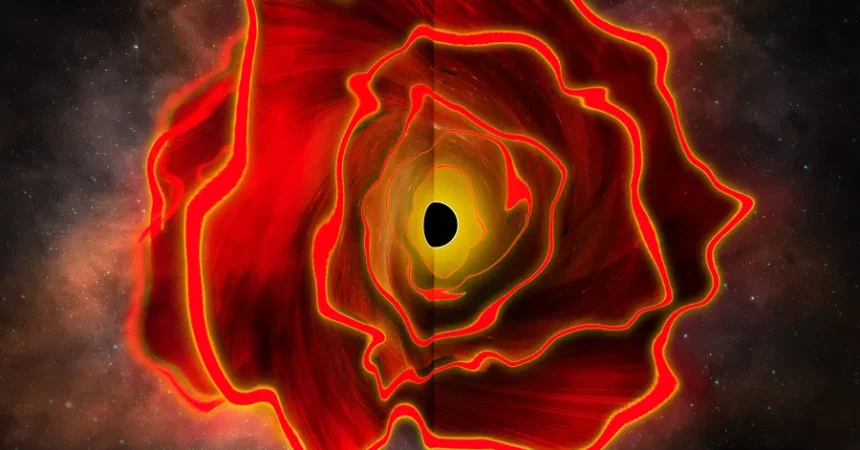
When Soundgarden released “Black Hole Sun” in 1994, it was not meant to be a scientific statement. It was a grunge-era fever dream, a song about a sky transforming into something terrible and gorgeous, with lyrics that felt more like a hallucination than a description of the cosmos. A black sun should be impossible: a sun is the source of light, and a black hole is the prison of light. Yet the image lodged itself in popular culture because it captured something real—the universe is full of objects that hide their true nature. Now, with the James Webb Space Telescope, that truth has returned in a strikingly literal form. In a paper published Wednesday in Nature, a team of astronomers reports evidence for an object that looks like a gigantic star, glows an intense red, and is perhaps the size of our entire solar system. The object, designated MoM-BH*-1, sits so far away that its light has been travelling for more than thirteen billion years. It comes from a time when the universe was only 660 million years old, a relatively short while after the Big Bang. In the images produced by JWST, it appears as one of those small, bright reddish spots that have become famous for turning up everywhere in the early universe. But this particular red spot is deeply strange. It radiates far too much energy, and its light contains gaps that cannot be explained by an ordinary stellar atmosphere. The team argues that the object is a black hole star: a black hole at the center, wrapped in an extremely dense and luminous envelope of gas, shining with a light that mimics a star—a thing that looks like one kind of celestial body while being, at heart, another.
One of the most surprising lessons of the James Webb Space Telescope is that the early universe was not a quiet, empty nursery. It was crowded with glowing anomalies, many of which appear in the telescope’s images as compact red dots. They are so faint and so far away that they seem simple, but their light reveals enormous complexity. The object at the center of this new paper belongs to that family. Because its light left the object when the universe was less than 5 percent of its current age, the universe has expanded dramatically since then. That expansion stretches light, pushing it toward longer, redder wavelengths, which is why so many early objects look red to JWST. But not all red objects are the same. The little red spots that JWST keeps finding are unusually small, unusually luminous, and surprisingly common. Astronomers have proposed all sorts of explanations for them. Some may be extremely compact galaxies, packed with far more stars than the Milky Way in a much smaller volume. Others could be black holes hiding behind thick veils of dust, their bright accretion disks dimmed and reddened by the material around them. Still others might be something completely different, objects that no longer exist in the universe today and have names we have not yet agreed on. The new study offers a way into that mystery. By focusing on one particularly well-observed object, the researchers have made a detailed case that at least some of these red spots are black hole stars. That doesn’t mean every red dot in the early universe is one. But it means the ones that are can no longer be explained away as ordinary galaxies or dusty black holes. They deserve a category of their own.
What made the astronomers suspect this particular red spot was hiding something unusual? The first clue was its brightness. MoM-BH-1 produces roughly one hundred billion times more energy than any star could possibly generate through nuclear fusion. Stars, for all their immense power, are limited by the physics of fusion: the energy they release is tied to the rate at which they can burn fuel, and there is a ceiling to how luminous a stable, fusion-powered object can be. This object blows through that ceiling without even trying. Even by the standards of the early universe, an era known for enormous black holes and hyperactive star formation, this is an extreme source of light. The second clue was the way some of its light vanishes. In astronomy, when light passes through a gas, the atoms in that gas absorb specific colors or wavelengths, producing recognizable dark gaps in the spectrum. This is a familiar effect, and it is one of the main ways astronomers learn what stars are made of. The atmospheres of ordinary stars absorb light in narrow, predictable patterns. But in MoM-BH-1, the absorption is not narrow and it is not predictable. It is brutal. Part of the object’s light simply disappears, swallowed so completely that a normal stellar atmosphere cannot account for it. The only way to explain such a deep and powerful absorption, the researchers argue, is to have an enormous amount of extremely dense gas sitting between the source of the light and the outside universe. That gas is the shroud. And the shroud is part of the object itself.
The black hole star hypothesis brings these clues together into a coherent picture. At the center, the theory suggests, there is a black hole feasting on matter. As matter falls toward the black hole, it doesn’t simply disappear. It spirals inward, heats up through friction and gravitational stress, and releases a torrent of radiation. That radiation is so great that it outshines entire galaxies, let alone ordinary stars. But the black hole is not naked. It is surrounded by a monstrously large and dense envelope of gas. The energy from the black hole’s accretion has to pass through this envelope before it can escape into space. Along the way, the gas absorbs some of that energy, re-emits it, distorts it, and leaves its own fingerprints on it. By the time the light finally breaks free, it no longer looks like the raw, high-energy radiation you would expect from a black hole’s accretion disk. It looks like the light of a giant star. In other words, the black hole star is a cosmic disguise. The whole assembly—black hole plus gas envelope—behaves like a single object, and that object radiates the way a very large, very odd star would. It would be warm in color, heavy with absorbed wavelengths, and huge in scale, perhaps as wide as our solar system. From far away, it would be almost impossible to tell that the flame-like brilliance at the center of that red glow is actually a black hole. It would simply be another bright dot in a sea of bright dots. But look closely at its spectrum, at the way its light disappears and reappears, and the true nature of the beast begins to show.
This hypothesis could also solve a larger problem that has been building ever since JWST’s first deep images arrived. The telescope keeps finding small red spots in the early universe with surprising frequency, and their true nature has remained a point of fierce debate. They don’t fit neatly into the usual categories of cosmic objects. They are not clearly galaxies, because they are so small. They are not clearly stars, because they are far too bright. They are not clearly black holes, because they look too red and star-like. Scientists have put forward several explanations, including compact galaxies bursting with stars, black holes buried in thick dust, and systems unlike anything we see in the modern cosmos. The black hole star interpretation adds another layer to that discussion. If MoM-BH*-1 is genuinely a black hole star, then some of the other little red dots might be the same kind of object. They could be ancient hybrids from an era when black holes and stars were not as cleanly separated as they are today. The researchers are careful to say that this is not a closed case. The evidence is strong enough to be published in Nature, but the future will bring more observations. Time-varying spectra could reveal a black hole’s changing appetite. Better imaging could catch other objects with the same signature. More examples would turn a promising hypothesis into a whole new population of objects. The James Webb Space Telescope has been doing that for astronomy in general—taking things that once seemed exotic and turning them into something that has to be taken seriously.
There is something deeply human about wanting to put the universe into categories. We look at the night sky and we want to know which objects are stars, which are planets, which are galaxies, and which are black holes. We like our cosmic characters to carry clear labels. But the deeper astronomers look, the more the labels blur. A black hole star is the perfect emblem of that confusion. It is neither one thing nor the other, and yet it is both. It generates light like a star but is powered by a black hole. It consumes matter like a black hole but is wrapped in an atmosphere that makes it look stellar. It belongs to an era long before our own, a time when the universe was still learning how to organize itself, and it may have existed for only a limited window before the black hole consumed or destroyed the envelope that gave it its disguise. When Soundgarden wrote about a black hole sun, they were reaching for an image that captured both creation and destruction, light and darkness, something beautiful at the edge of annihilation. The real universe has now offered something along the same lines: a red, sun-sized phantom, burning with impossible brightness, hiding a black hole at its core. It is not a metaphor. It might be an actual object. And it reminds us that the cosmos is still stranger than our imagination, still capable of creating things that sound like poems and turn out to be real.