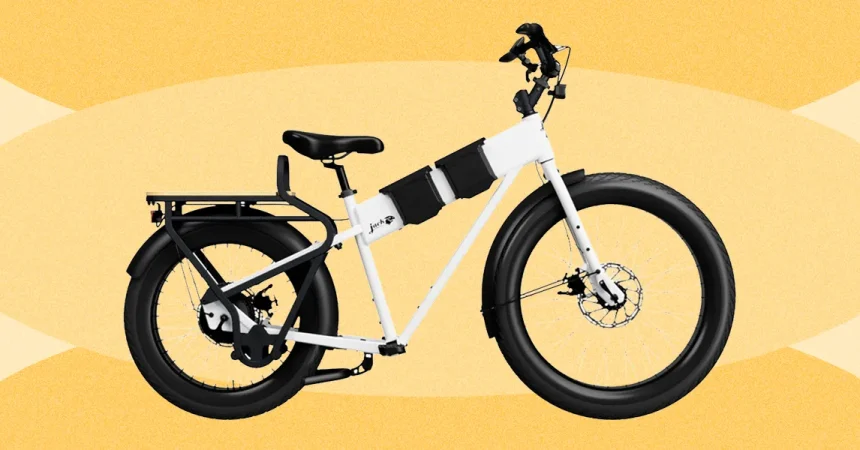
JackRabbit has carved out a niche in the world of electric micromobility by refusing to take itself too seriously. Its machines look less like standard commuter bikes and more like BMX trick bikes that somehow discovered a battery and a throttle. They are small, playful, and almost impossible to walk past without wanting a ride. That is a dangerous formula if you are actually trying to get somewhere on a schedule, because every JackRabbit I have tested has tempted me to take the long way home. The XG Pro, in particular, won me over last year. It was light, zippy, and genuinely fast for its size, and I gave it an 8/10 rating with a WIRED Recommends badge without hesitation. The easy mobility and high-speed capability made it feel like a pocket-sized escape vehicle. So I will admit to feeling skeptical when the MG Cargo arrived for review. On paper, it seemed to betray the brand’s minimalist spirit. It weighs 18 pounds more than the XG Pro and is nearly a foot longer, and those might not sound like huge numbers, but in the world of small electric rides they can make the difference between a toy you carry up stairs and a machine you worry about parking. I was worried that all that extra size would sap the MG’s enthusiasm and leave me with a chunky, lifeless workhorse. I needn’t have worried. From the moment I thumbed the throttle, the MG felt every bit as spirited as its sibling. It still flies off the line, still steers with a flick of the wrist, and still has that delicious trick-bike energy. The extra length gives it a touch more stability, especially over rough ground, and the extra weight seems to disappear once you are moving. It rides like an off-road bike when you are not hauling a big load, which is a wonderful surprise for something that looks like a BMX bike with a cargo rack bolted on.
On the road, the MG Cargo proves that a tiny vehicle can have a big personality. There are three throttle speeds to choose from, and they are not just cosmetic options. The slowest mode tops out at roughly 7 mph, which is perfect for sidewalk cruising and crowded areas; it lets you weave through pedestrians without feeling like a menace. The middle mode is a sensible 15 mph, ideal for neighborhood streets and relaxed laps around the block. Then there is the fast mode, which is the real reason to buy this thing. It accelerates up to about 20 mph, and on flat ground it reaches that ceiling within roughly 50 feet, as long as you are not carrying a lot of extra weight. That is not a blistering number compared with a full-size electric motorcycle, but from a vehicle this small, 20 mph feels gloriously quick. At 200 pounds, with a confessed heavy thumb, I still found the acceleration genuinely exciting. The bike surges forward with a smooth but insistent pull that makes you feel as though you are being launched. And the off-road manners are equally impressive. I took it on packed dirt trails, through loose gravel, and over patchy grass, and it never once felt sketchy. The short wheelbase and fat-ish tires make it turn sharply and grip enough to inspire confidence. There is no real suspension to speak of, so you feel bumps, but they come through as playful thuds rather than jarring impacts. You sit upright with your feet on pegs and hands on wide BMX bars, and the riding position is comfortable for short bursts and surprisingly good for longer joyrides. It is impossible not to smile. The MG is not trying to be a serious fitness machine or a hardcore trail bike; it is trying to make every trip feel like recess, and it succeeds.
Range is where reality and marketing tend to separate. JackRabbit advertises 48 miles on a charge, and I am willing to believe that number under ideal conditions—rider weight low, throttle gentle, pavement flat. But as a 200-pound man with a heavy right thumb, I managed only about 25 miles on a full charge, and that was with minimal cargo. I did not push it to absolute zero because I got nervous when the battery indicator started dropping faster than expected. That indicator is one of the MG’s quirks. It displays as at least half-full for the vast majority of the ride, which gives you confidence that you have plenty of range left. But it is not entirely honest. The gauge seems to hold its charge until it suddenly does not, and near the end the bars fall like a stone. If you ride with that happy half-full bar in mind, you will eventually be caught off guard. The solution is to learn your own personal range the way you might learn the quirks of a new pet: take a few aimless exploratory rides, pick a destination that does not require you to get home on a strict timeline, and pay attention to how the battery behaves under your weight and riding style. Once you know your limits, the MG is plenty practical for shorter trips. I would not call it a 48-mile bike, but I would absolutely call it a 20-mile bike, and for most daily errands that is more than enough. The faster you ride and the more aggressively you accelerate, the sooner you will need to plug in. That is true of all electric vehicles, but the MG’s deceptive battery indicator makes it more noticeable. Still, the range is in line with the bike’s overall character: it is not meant for marathon tours, it is meant for joyful spins around town, and if you treat it accordingly, you will not be disappointed.
One thing I had to think about was where the MG Cargo is allowed to ride. Because JackRabbit bikes do not have working pedals, they occupy a strange technical gray area in many states. Traditional ebike laws are built around pedals—a Class 2 electric bicycle is generally throttle-operated but still has fully functional pedals and is limited to 20 mph. The MG has a throttle and a 20 mph top speed, which makes it look and quack like a Class 2 ebike, but it completely lacks pedals. That means some lawmakers and trail managers might not know quite what to do with it. I am not a lawyer and I do not want to give legal advice, but I can tell you how it worked in practice: I rode it on bike lanes and bike paths, and I was treated as just another electric bike rider. Nobody questioned it, and the bike’s approachable, non-threatening looks seemed to help. There is also a hidden jailbreak mode that, on the honor system, unlocks a top speed of around 24 mph for off-road riding. I did not use it much, but its existence shows that JackRabbit is aware of the legal lines people might want to cross. If you are considering the MG, you should check your local and state rules before relying on it for commuting, especially if you plan to ride on trails with strict ebike regulations. But in the real world, the MG Cargo rides so much like a Class 2 ebike that most people will assume it is one. It is not a motorcycle, it does not feel like a moped, and it is small enough to fit through gaps that would stop a full-size vehicle. It is a friendly little machine, and that friendliness helps it slide through the cracks.
Then there is the cargo side, which is where the MG earns its name. The standard rear mounting rack is sturdy, and JackRabbit sells side racks for $75 each that bolt on in minutes. Once installed, they allow you to hang pannier bags on both sides, transforming the little bike into an unexpectedly capable hauler. I used it for a small grocery run, a beach excursion, and even a quick trip to a coffee shop with a laptop bag, and every time the MG handled the burden with confidence. The panniers add a bit of bulk, but not so much that they ruin the bike’s playful character. If you prefer a more old-school utility look, there is also a rear basket that can swallow a backpack or a small cooler. The accessory attachment process is refreshingly simple—no need for special tools or clever workarounds. Everything clicks together and stays put, even over rough pavement. The extra weight from cargo does change the ride, but not badly; the rear end feels more planted, and the bike’s peppy acceleration, while slightly muted, is still more than adequate for city speeds. One thing I appreciated is that the MG Cargo does not feel like a compromise. It does not force you to choose between having fun and carrying stuff. You can keep the racks on all the time and still throw the bike around corners, still accelerate eagerly from red lights, and still park it in a narrow space that would be impossible for a bigger cargo bike. It is a rare combination of utility and joy, and it made me want to find excuses to run errands. If you are the kind of person who hates the feeling of strapping bags to a vehicle, this one might actually change your mind.
In the end, the MG Cargo exceeded my expectations in every way that mattered. My initial concern—that the extra weight and length would ruin the JackRabbit magic—turned out to be completely wrong. The MG still has that light-on-its-feet, BMX-inspired energy, but it adds a layer of practical usability that the XG Pro never pretended to offer. It is not as tiny or as minimal as its sibling, but it is far more flexible. You can take it to the grocery store, to the beach, to work, or just around the block for the pure joy of riding. It makes you forget you are doing something useful. The range is optimistic, the battery indicator is quirky, and the legal classification could be clearer, but those issues are easy to live with if you understand them before you buy. This is a machine that wants to be ridden, not studied. For anyone who wants a small, fast, friendly electric vehicle that can also haul a bit of cargo, the MG Cargo might just be the perfect middle ground. It will not carry a week of groceries, and it will not replace a car for long-distance commuting, but it will make your daily short trips measurably more fun. It is the kind of vehicle that draws curious glances from strangers and questions from friends, and it is the rare piece of micromobility hardware that feels both toy-like and genuinely useful. I gave the XG Pro an 8/10 and a stamp of approval last year, and I would happily offer the MG Cargo a similar endorsement, with one caveat: know your route, know your battery, and be prepared for the fact that you may never want to ride a boring bike again.