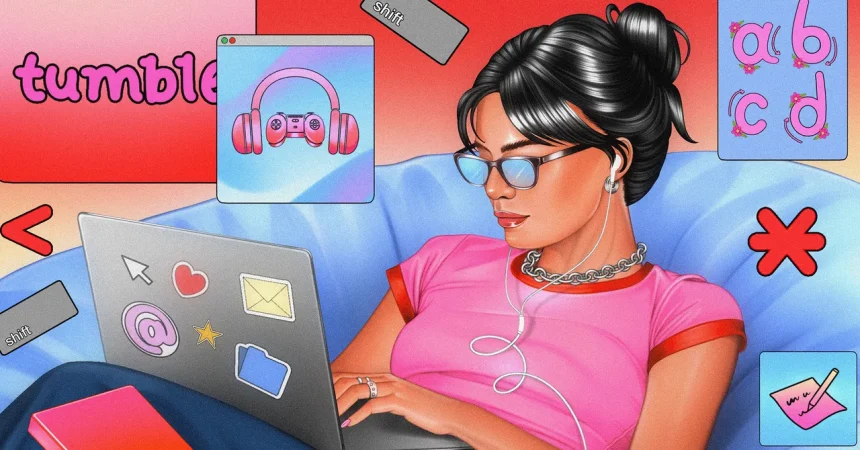
1. There’s a strange quietness to lowercase text, a kind of digital whisper. When someone sends a message without capitals, without the firm punctuation of a period or the proud height of an uppercase I, the words arrive softly, as if they don’t want to be noticed too much. Over the past decade, that quietness has become a style — especially among young women on Tumblr, where lowercase is less an accident and more a deliberate aesthetic. Adam Aleksic, an internet linguist who runs the popular account @etymologynerd, has thought about this a lot. Sitting in a swanky coffee shop in SoHo, tapping on his phone between sips of something overpriced, he makes a point that cuts against the easy assumption that lowercase is just laziness: “I’m willing to believe that is more deliberately aestheticized among young women on Tumblr,” he says, “but none of the mega online communities use regular punctuation.” To demonstrate, he pulls up 4chan. The screen fills with all-lowercase musings — some rancid, some mundane, some genuinely funny — but if you look closer, there’s a whole layer of punctuation that most outsiders would miss. There are greater-than signs used as quote markers, angle brackets doing conversational work, asterisks framing words like yes to add emphasis, slashes wrapping around phrases to signal irony. There’s nothing lazy about it. In fact, it’s a kind of typographical choreography, developed because 4chan never supported rich text — no italics, no bolding, no underlines. So users invented their own markup language, a set of visual cues squeezed out of an ASCII keyboard. The lowercase isn’t a rejection of punctuation; it’s part of a much older system of making plain text feel expressive. It’s a habit, a tradition, and a tool — and it predates any aesthetic movement on Tumblr by decades.
2. That’s the thing about the internet: it is endlessly nostalgic, but its nostalgia is often invisible. We tend to think of lowercase as a modern affectation, a marker of youth culture, a way for young people to signal nonchalance or intimacy. But sites like 4chan remind us that the digital world has been typing in lowercase for a very long time. The callback goes back much further than any Gen Z social-media persona. It goes back to hardware. It goes back to the physical limits of machines that could barely handle the alphabet. “lower case? it started with single-case tty model 33. now, it is habit,” writes Ken Thompson, the legendary computer scientist, in an email politely declining an interview. Notice how he spells it: lower case, as two words. Before lowercase was a cornerstone of identity politics, it was just a lower case of the alphabet — an ordinary, technical, unglamorous fact. Thompson’s email itself is a little artifact of that history. He’s 83 years old, one of the seminal figures who helped build the foundations of modern computing, and he writes in lowercase without ceremony. It isn’t a fashion statement. It isn’t an attempt to seem casual or cool. It’s simply the way a generation of scientists learned to communicate with computers. The Teletype Model 33, which Thompson mentions, was a popular terminal that debuted in 1963. It was a machine designed for telecommunications, but it became one of the most influential pieces of hardware in computing history. It had a single case. It could only output uppercase letters. And because of that limitation, the early programmers who used it grew up thinking in capital letters, not as a style choice, but as the only option. When you’ve been shouting at machinery your whole working life, lowercase is a luxury — and once you’ve had it, you never go back.
3. To understand how we got here, you have to go back to the 1950s, when computers were less like personal devices and more like enormous, fussy bureaucrats that filled entire rooms and demanded to be spoken to in very strict terms. Back then, terminals could support only 64 unique characters. Counting numbers, punctuation, and other special symbols left no room for both uppercase and lowercase letters. There simply weren’t enough slots in the character set to accommodate both. So early programming languages like Fortran, Pascal, and Lisp were written exclusively in uppercase. Imagine that: a whole generation of programmers hunched over flickering screens, typing IF and THEN and GOTO in all caps, because the lowercase alphabet might as well have been a rumor. It wasn’t until the 1960s and 1970s that hardware manufacturing began to mature and memory costs started to fall, making it possible to store more characters, to include lowercase letters, to refine the ways humans could talk to machines. By the time the Teletype Model 33 arrived, lowercase was becoming possible on some systems, but the habits had already sunk in. The people who learned to code in uppercase carried that style with them. It was practical, yes — but it was also cultural. It was the way things were done. And this is the crucial part: those early habits didn’t just stay in programming languages. They leaked out into the broader digital world. When you type in lowercase today, you are not just making a choice — you are inheriting the residue of a technological limit. The keyboard you use is a descendant of those early terminals. The flat, unadorned text of social media is a distant cousin of the teletype’s single-case output. The lowercase aesthetic, so often associated with softness and nuance, is built on machine-age hardness.
4. There is a poignant irony in the fact that something born from scarcity became so expressive. For a long time, lowercase was not a choice; it was a constraint. But constraints have a strange way of becoming culture. When you look at the way lowercase is used on Tumblr, you see something that has absolutely no relationship to the Teletype Model 33 — and yet it is intimately connected to it. On Tumblr, lowercase is often a way of performing intimacy. It lowers the volume of the message. It says: I don’t need to prove anything to you. It’s the typographic equivalent of wearing sweatpants at a party, or leaning in close to whisper something instead of shouting it across the room. It can also be a way of navigating emotional complexity. A lowercase message can make a serious confession feel lighter. A lowercase apology can seem more sincere because it resists the performative weight of capital letters and exclamation points. It’s almost as if, by refusing the formal apparatus of writing, people are trying to get closer to speech — to the messiness of real conversation, where tone lives in pauses and gestures and the exact angle of a shared glance. But here’s the twist: the lowercase style, which feels so organic, so internal, so of the moment, actually has its roots in one of the most rigid and mechanical eras of human communication. The apparent absence of style is actually a rich and complicated style. It is a sign of belonging. It tells other people who you are, or at least who you want to be, in the same way that every subculture has its own uniform, its own slang, its own way of turning ordinary objects into badges of identity. The lack of capitals, the deliberate flatness, the refusal to punctuate — these are not just the absence of grammar. They are grammar itself.
5. When we talk about the internet, we love to talk about generations. Young people have their own language, we say. They’re ruining punctuation, we say. But the truth is more layered and more interesting. Lowercase is not a generational accident, and it is not a single thing. On 4chan, it’s part of a subtle system of markup, a way of signaling that you understand the platform’s peculiar grammar — the way a line beginning with a greater-than sign tells readers to imagine a text image, the way an asterisk acts as surrogate italics, the way the entire performance depends on a shared understanding that you are all trapped in the same plain text box. On Tumblr, it’s an aesthetic of dreaminess and inwardness, a way of making words feel less like writing and more like thinking. On Reddit, it can be a marker of earnestness or irony, depending on the thread. On Instagram, it’s a way to make captions feel disposable and intimate, even when they are meticulously crafted. And in the wider world, it has become a kind of atmosphere — the default mode of digital speech, the voice we use when we don’t want to hear ourselves echo. But none of these uses would exist without the peculiar history of the machinery. The lowercase voice you use in a text message is the same voice that early computers spoke when they were forced to shout. It is the voice of the Teletype Model 33, the voice of Ken Thompson writing a polite email, the voice of a million programmers who learned to view capitalization as a luxury rather than a rule. When young people write lowercase to signal coolness, they are participating in a much longer tradition than they know. They are echoing machines that most of them have never seen. They are continuing a conversation that began decades ago, in glass rooms full of noisy terminals and flickering phosphor.
6. So what do we make of lowercase now? Perhaps the best way to understand it is not as a loss of formality, not as a sign of decline, but as another layer of meaning in the vast, strange world of internet language. It is a style with a history and a material foundation. It is a habit with a memory. It is a tool that has outlived the conditions that created it. The next time you see a text message written entirely in lowercase, or a social media post that abandons punctuation, try to see the whole story in it: the early computers that couldn’t handle two cases of the alphabet, the engineers who adapted to their machines, the programmers who preserved those adaptations, the evolution of hardware and memory and price, the emergence of new platforms with their own constraints and rituals, and finally the teenagers and young adults who inherited all this and gave it a new face, turning a technical limitation into an art of quietness. In a sense, lowercase is the perfect symbol of the internet: born from practical constraints, layered with unspoken conventions, deeply communal, and profoundly misunderstood by outsiders. It doesn’t mean what it seems to mean. It isn’t simply careless; it’s carefully careless. It isn’t the absence of expression; it is a different kind of expression, one that has learned to do more with less, to find nuance in the absence of capital letters, to build intimacy out of flatness. And if you look closely, you can see the whole history of human-machine interaction in a few small letters and a missing period. The internet has always been a place of improvisation, a space where people invent new languages out of the tools they have. Lowercase is one of those inventions — a constant in a world of constant change, a subtle code that everyone speaks but hardly anyone stops to translate. It is, at bottom, a reminder that the most ordinary choices are never truly ordinary. They carry the weight of everything that came before them. So the next time you press the shift key, or don’t, know that you are doing something human: you are taking a piece of old technology and making it new with your own voice, your own feeling, your own quiet way of saying what matters.