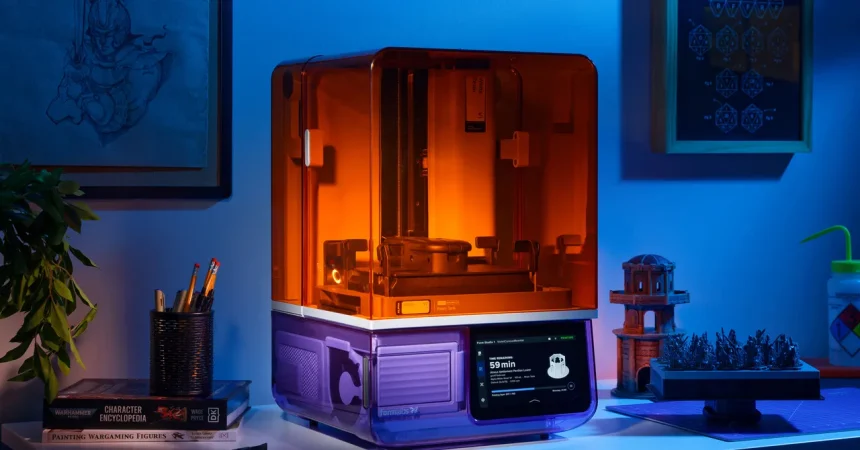
Fourteen boxes are piled in front of my desk, stacked around me like a cardboard fort. Inside one is a Form Studio 1, the new, affordable, consumer-focused 3D printer Formlabs just announced. The rest of the boxes contain the necessary paraphernalia that accompanies any serious desktop fabrication project: resin bottles, a wash unit, scrapers, gloves, and an array of accessories I didn’t entirely expect to be shipped along with the printer itself. I’ve been reviewing gadgets for years, so I’m used to receiving evaluation units in sleek, compact packaging. But this was different. This was a dozen-plus cubes of varying weights and densities, some rattling with parts, others suspiciously heavy with liquid. The whole scene looked less like a tech review and more like the aftermath of an IKEA delivery for a tiny architectural model workshop. David Lakatos, chief product officer at the 3D printer manufacturer, assured me that the Form Studio 1 has a very economical size. “It doesn’t take a lot of space,” Lakatos said. “If you have a desk, then I think you should be good to go.” I have a desk. It’s covered in boxes sent by his company. Apparently, the printer itself is compact, but the ecosystem surrounding it is not.
The story of the Form Studio 1 begins with the company’s identity. Formlabs is one of the biggest 3D printer producers, with nearly 200,000 printers in service. The company’s customers are primarily professional businesses, like assembly shops or dentists, able to shell out $2,500 or more for a printer. (Its last affordable printer was $2,300.) These aren’t hobbyist toys; they’re precision tools for creating dental aligners, custom hearing aid shells, jewelry patterns, and engineering prototypes. The Form 3 and Form 3L are workhorses, found in workshops, labs, and clinics where reliability and accuracy are paramount. For over a decade, Formlabs has made its name on delivering a premium experience at a premium price, with professional support and a dedicated ecosystem of resins tailored for specific applications. So when rumors began swirling that they were about to release a $699 machine aimed squarely at consumers, it was a seismic shift in strategy. It’s not that the company hasn’t tried to lower costs before—the Form 2, launched in 2015, came in at $3,499, and the first “affordable” Form 1 was $3,299. But the Form Studio 1 represents a true departure: a mass-market device designed for makers, educators, and curious amateurs who want to print miniatures, figurines, or replacement parts without needing a business justification. The price point is a deliberate move to reach a much wider audience, but it also raises the question: can a professional-grade company translate its expertise into a consumer-friendly package without sacrificing quality? The first impression, at least in terms of packaging and accessories, suggests they’re taking the plunge seriously, but the real test is in the experience of living with the machine.
The Form Studio 1 is built around SLA (stereolithography) technology, a method that uses a UV laser to cure liquid resin into a solid plastic, layer by layer. It’s a far cry from the fused-filament printers (like those from Prusa or Bambu Lab) that melt plastic filament and extrude it through a nozzle. SLA printers have a reputation for producing incredibly detailed, smooth prints, but they’re also known for being messier and pricier to run. The Studio 1 uses Formlabs-branded products or third-party resins, which gives it a certain flexibility, but it also means you’re dealing with liquid photopolymer—a gooey, pungent substance that requires careful handling. Individual resin bottles start at $29, which sounds reasonable until you realize you’ll go through a bottle or two per moderate project. The machine itself, as Lakatos said, doesn’t take up a lot of space. It’s roughly the size of a minifridge—actually, more like a minifridge on a diet. You could place it on a sturdy desk, and it would sit there without cramping your workspace. But that’s just the printer. To actually use it, you’ll likely also need a wash unit, sold separately for $199, with a similar footprint. This device is essential because it removes uncured liquid resin from the surface of your prints—a step that’s both necessary and messy. Without it, you’d be hand-washing your parts in isopropyl alcohol, which is a process that smells and often leaves a sticky residue. So now you’ve got two machines side by side, each about the size of a small refrigerator. Then you’ll need room for all the tools and resin cartridges: gloves, paper towels, disposable containers, a scraper, perhaps even a dedicated area to work. Getting all that stuff can pile up. Or at least it did when Formlabs sent more than a dozen boxes to the WIRED office for testing. Your pileage may vary.
The unboxing experience is a study in controlled chaos. The main box contains the printer, beautifully packed with foam inserts, but the satellite boxes hold the wash unit, a set of wash buckets, various tools, and a few bottles of resin. It feels like the ecosystem is expanding in front of you. The moment you realize that the $699 printer is only the tip of a financial iceberg, you also realize that this is part of the bargain when you enter the world of resin printing. For comparison, a budget FDM printer can cost $200 and use $20 spools of filament, with a minimal footprint—just the machine and a spool of plastic. Resin printing, on the other hand, is inherently messier. You need to keep the resin in a vat (which is included), you need to level the build plate (a process that can take a few minutes), and you need to perform post-processing steps: washing, curing, and, ideally, sanding or applying a clear coat to finalize your print. The wash unit alone adds a second device to the equation, and if you’re planning to use your desktop for the printer, you’ll need a separate space for the washing station. That’s not to say the Studio 1 isn’t designed well—it is. The build chamber is enclosed, and the resin comes in cartridges that are easier to pour and manage than the open bottles used by cheaper printers. But the reality is that the whole workflow demands more than just a desk. It demands a dedicated workbench, or at least a corner of a room where you can tolerate the occasional chemical smell (though the new resins are much less odorous, they’re not scentless) and where you don’t mind potentially spilling a bit of uncured plastic.
Humanizing the experience means acknowledging the learning curve. The Form Studio 1 is not a plug-and-play device. You need to read the manual, or watch the excellent video tutorials Formlabs has posted online. You need to understand how to attach the build plate, how to load the resin cartridge, how to run the test print, and how to remove the finished print without damaging it. The first time you peel that fragile, rubbery sheet of printed layers off the plate, you’ll likely make a mess. But the joy of creating something with your hands—even if it’s a miniature chess piece or a keychain—is addictive. The Studio 1 prints at a resolution of 100 microns, which is about the thickness of a human hair, so the details are astonishing. You’ll find yourself printing things you couldn’t buy at a store, like a replacement part for a broken toy, a custom bracket for your bike, or a perfectly scaled dragon figure that no other printer could produce with such smoothness. The human side of the equation is the mess, the cost, the space, but also the triumph. The boxes stacked around my desk eventually get opened, one by one, and the contents are assembled. The printer hums to life, its lasers tracing shapes in the murky green resin. I’m standing there in my office, surrounded by cardboard, trying to figure out where to put the wash unit—and I realize I’ve become part of a growing community of makers who are rediscovering the thrill of physical production in a digital age.
In the end, the Form Studio 1 is a milestone in the democratization of advanced manufacturing. It brings a technology that was once the preserve of industrial labs into the living rooms of curious hobbyists. And yet, the boxes remind me that no piece of technology exists in a vacuum. It brings with it a whole ecosystem of consumables, accessories, and rituals. The “pillage” of progress, if you will (a playful nod to “pileage”). The company has clearly thought about the consumer experience: the printer’s software is streamlined, the resin cartridges are designed to be less messy, and the price is a significant step down from their pro models. But the physical footprint is not just the printer; it’s the entire accompanying kit. If you have a dedicated workbench, a spare shelf for the wash unit, and a drawer for gloves and tools, you’re good to go. If you only have an average desk in a dorm room or a small apartment, you might be surprised by how much gear you’ll acquire. Yet there’s a certain charm to this material accumulation. The boxes become a testament to your commitment to the craft. They tell a story of a device that asks for a little more investment—both in money and in space—than a typical gadget. And that’s okay. Because when you peel off that printed part, carefully clean it, and hold it up to the light, the fourteen boxes that once crowded your workspace suddenly feel worth it. They’re not just packaging; they’re the foundation of a new hobby, a new skill, and a new way of seeing the world. And soon enough, you’ll be telling your friends that they really should get one, and that it doesn’t take up much space—you just have to make room for the boxes.