The Hidden World in My Backyard
Even though I’ve been a bird-watcher for most of my life, nothing prepared me for the experience of witnessing—on my phone—the entire process of birds being born in my own backyard. For years, I’ve maintained a regular, unassuming nest box, a humble wooden structure that has served as the birthplace for generations of black-capped chickadees. I’ve seen them flitting in and out, carrying bits of moss and fur, but what happened in that mysterious little house was always a secret. That all changed a few autumns ago when I opened the box for its annual cleaning and discovered a small, heartbreaking tragedy: five tiny, fully-feathered fledglings lying still at the bottom. I was devastated, and my mind spun with unanswered questions. How could this have happened? It was with this question burning in my mind that I decided to try a modern solution. Thanks to the Birdfy Nest Duo smart nesting box and its built-in thermometer and hygrometer, I now at least have an educated guess about that tragedy. The poor things likely overheated during an early-season heat wave. But while that was a sad lesson, the real revelation came from being able to watch the entire nesting operation from all angles, starting with excavation and egg-laying and ending in hatching and fledging. This experience has been one of the most educational and entertaining bird-watching experiences I have ever had, and something I’d recommend to anyone interested in birds, nature, or just life science in general.
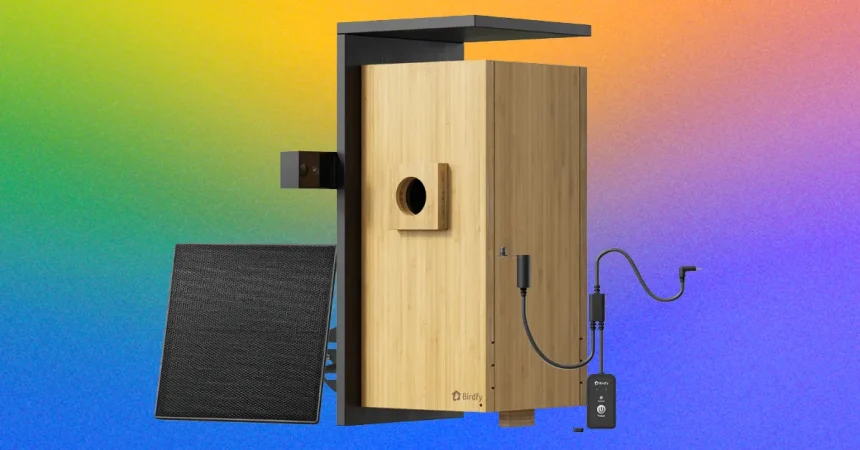
Before we dive into my personal journey, let’s talk about the tool that made it all possible. Birdfy makes three smart nest boxes in addition to the Duo. The original, the Birdfy Nest, has one camera—located inside the box—and can only hang from a hook screwed into the top of the box. There’s also a version made out of solid fir in contrast to the others’ lightweight bamboo. I have also tested Birdfy’s artful Polygon, but persistent connection issues prevented me from using it this season. I have not personally tested the first two single-camera versions, but I can’t imagine not having a second camera outside the hole to see who’s unexpectedly poking their head in. At one point in my testing, it was a confused flicker; another, a curious starling—and this is when I learned that chickadees can hiss like snakes to scare off intruders. It’s also critical to be able to pole-mount the box to keep it away from predators like cats and raccoons. Even more compelling than the predator reveal, the really useful thing about the Nest Duo is its substantial design. It stands 16 inches tall and weighs about 8 pounds, with one 1080p HD camera facing the nest entry hole on the exterior and another tucked discreetly inside the nest box itself. There’s also an internal hygrometer (or humidity sensor) and thermometer (temperature probe) that show readings on the live view. The app itself is user-friendly. Each screen capture appears as a split-screen image, which you can tap to view 20-second videos (with audio) of both the inside and the outside of the box. These videos are immediately downloadable and shareable—no subscription is needed. The camera also works with a smart AI that labels and categorizes the birds, but I’ll get to that later.
However, no piece of technology is perfect, and my experience was no exception. In March of this year, at the beginning of nesting season on the West Coast, I installed the Duo on a pole stand and mounted the included solar panel below the box with hose clamps. I put in the 1-inch entry hole, thinking it would be perfect for the chickadees. And they were interested! Black-capped chickadees were consistently interested, popping in and looking around, but something was preventing them from staking a claim. They’d peek in and fly away, which was frustrating. After weeks of this, it was almost frustrating to watch. It took me a while to realize they were looking askance at the holes on the metal tray “floor,” which is perforated for drainage. The idea is that this tray can be inserted into one of a series of slots to increase or decrease the nest cavity depth, depending on your local species’ preference. But it was just a piece of metal with a bunch of holes, and I started to wonder if I was overcomplicating things with all this tech and customization. Finally, after a few weeks, a pair of determined chickadees decided they would make it work. They started to build a nest. And this is where the magic really began. The split-screen might seem like a gimmick, but it becomes essential. In the app, each screen capture appears as a split-screen image, which you can tap to view 20-second videos (with audio) of both the inside and the outside of the box. I found the screen captures work much like one of Birdfy’s smart bird feeders, with images shunted to sections labeled “Prelude,” “Nesting,” “Brooding,” “Nestling,” “Fledgling,” and “End.” There seemed to be no rhyme or reason for what process the app thought was happening at the time (for example, if a nestling was simply turned around, the app asked if it should label it as “Fledgling”), but this story format was easy to ignore, and in its own way, it was easy to overlook the flaws because the reward was so great.
What was the reward? The privilege of watching life unfold. I made the chickadees’ nest. The female laid a clutch of six perfect eggs, so delicate and clean. I watched the parents take turns warming them, and then, after a few weeks, the tiny, wriggling, almost alien-looking hatchlings emerged. The parents were tireless, working in tandem to feed their hungry young, and my smart app was keeping score. I could watch the inside feed the family insects, and I could watch the outside screen for signs of predators and even track which parent was going where. It wasn’t just entertainment, either. It was a lesson in mortality and resilience. I could see the biggest and strongest chicks in the way I’d guess was normal, but I also saw the largest and weakest get pushed to the side. I watched one egg fail to hatch. It was difficult, but it was the truth. You don’t get this with a “dumb” nest box. I learned how the parents would seek out a very specific place to dispose of the egg shells once the chicks were all hatched, carrying them far from the nest. I got to be there for the moment when the first little bird, looking like a grumpy old man with wisps of fluff, emerged from its birth shell. I was even there when the world changed for the first time as they opened their one eye. The best part was when the young, after weeks of seeing nothing but box walls, finally got a glimpse of the outside world through the entrance hole.
Finally came the moment I was waiting for. Fledging. It’s not a synchronized departure as you might imagine. It’s, in fact, the opposite. It’s a time of tremendous pressure and vulnerability. I was able to watch the nervous parents try to lure the young birds out of the box, showing them the source of all good things, the food, the trees, the all. The combination of being alerted to activity by the app’s constant video notifications meant I was always aware of when something was happening. The screen captures worked as a kind of tl;dr of my day. I’ve seen birds fledge in real time, but I’ve never needed to witness this jittery, heart-wrenching, and triumphant time at close quarters with splits-screen. I watched the first chick pop its head out, look around at the world outside, and think better of the idea. It took them several hours, perhaps even an entire day, to get the courage to fly. When they finally did, the sense of pride I had was immense. I felt like I’d been part of the whole project, and in a way, I had. I was the landlord of the perfect tiny house, the guardian of the food sources, and the a guy.
Now that the bird family has left for the big, wide world, I find myself thinking about my tiny contribution. I think about the second-generation chicks. I think about my bird feeders and the way they bring in life. The Birdfy Nest Duo has given me a new sense of understanding about the bird world. I’m living in this world where the line between the living world and the digital one is blurring more and more all the time. But this piece of tech soothes my heart. I don’t think it makes bird-watching easier, but it’s a chance to be an invisible, unobtrusive, and observant presence in a world we usually don’t see. That spring, the mystery of the five dead babies was resolved. The nestlings I’d lost were probably overheated. This year, the temperature data from the hygrometer and thermometer allowed me to adjust my setup, and I was able to see a batch of flying birds succeed. And while the app and its “stories” are clunky, the experience is anything but. It’s a window into a world that’s right under our noses, that we’re normally too big and too slow to even notice. I don’t think I’ll ever get tired of steps with my with the black-capped chickadees and their daily dramas. I just have to figure out where to control the smart camera to make sure they’ll be born in a place that’s safe and sound, a place where I can watch them learn to spread their wings. From my living room, from my phone, I see that I have a lot more in common with the two black-capped parents than I ever thought. The struggles, the joys, the fear, and, ultimately, the letting go. I think about that this year, when I saw that a new chickadee line was taking shape in the world, and I was one of the few people—or creatures—lucky enough to see it happen.