Paragraph 1
“URGENT: Immediate Action Required” blasts into my eyeballs as I scroll through the impossibly giant email inbox looming directly in front of my face. I’m not sitting at a desk, though. I’m reclined way back in a chair, wearing a pair of Xreal smart glasses. Tethered to my laptop via a USB-C cord, these glasses mirror the laptop screen and project it into a virtual display. The virtual screen is gigantic, equivalent to a 170-inch TV that feels about a foot away from my nose. I’m the only one who can see it, and so I’ve got this massive display all to myself. With this technological marvel, I conjure the most riveting view imaginable: five workplace training modules about business principles and cybersecurity that my boss has repeatedly reminded me are very overdue. The text on the screen is blurry, but I complete them all within my virtual display. It takes several hours. By the time I’m done, the glasses have overheated, my forehead is sweaty, and I’m still not sure I can actually recognize a phishing email. This is the reality of virtual display glasses—a strange, promising, and imperfect way to bring a screen directly to your face. They promise to free you from the tyranny of hunching over a laptop, but they also present their own unique set of quirks, annoyances, and existential questions about how we consume content in the modern age.
Paragraph 2
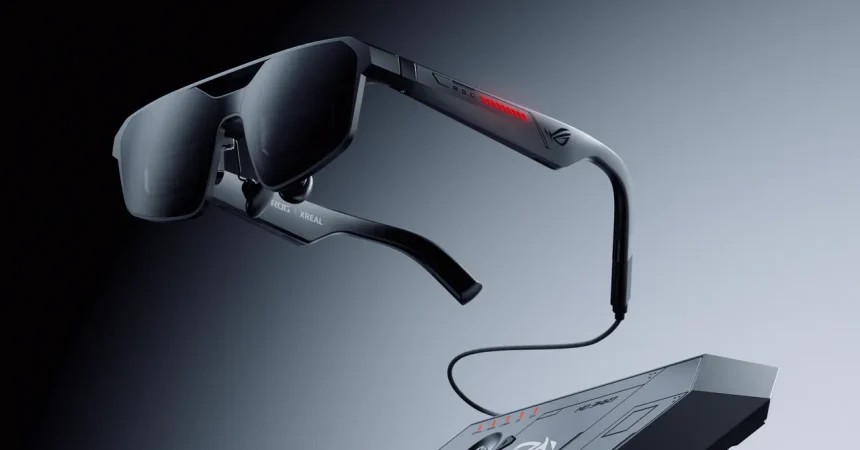
Virtual display glasses are a much more niche category of mixed-reality smart glasses than the camera-equipped, AI-powered frames that have dominated the product market—namely, Meta’s Ray-Ban glasses. Made by companies like Xreal, Viture, and Rokid, these glasses aim to bring a screen directly to your face. Like a portable monitor, plug the USB-C cable into the arm of the glasses, then stick the other end into the port of just about any laptop, phone, tablet, or handheld gaming console. Slap ’em on, and that screen mirrors in a holographic VR-style projection, right in your center of vision. Wearing them, you can chill out in an airplane seat, lie prone, even dangle upside-down if you like, and the big screen stays right there with you. (No tech neck!) Yup, you’re basically cosplaying the lazy humans in Wall-E. Hooray. The concept is genuinely compelling: a private, portable, and enormous display that travels with you, freed from physical constraints. Need to finish a report on a cramped train? Want to watch a movie while lying on your back in bed without holding a tablet over your face? Need to game on a long flight without wrestling with your neck? These glasses promise to solve all of that and more. They turn any surface—or no surface at all—into a personal theater, a floating office, or a gaming station that hovers in the air like a hologram from a sci-fi movie. The experience is disorienting at first, but it quickly becomes clear that this is not just a gimmick; it is a genuinely different way of interfacing with digital content, one that prioritizes ergonomics, mobility, and immersion in equal measure.
Paragraph 3
What makes these glasses stand apart from the competition, and what makes them somewhat easier to love from a privacy standpoint, is what they don’t do. Virtual display glasses don’t get the heat of privacy issues that Meta’s “pervert glasses” do. No cameras, no recording—just sweet, sweet content consumption beamed out an inch from your eye holes. If you’re feeling generous, the Xreal glasses could even be lauded for their privacy protections, at least for the user. Got sensitive documents or embarrassing videos you’re trying to watch on a plane? A virtual display is one only the wearer can see. There’s something genuinely liberating about having a massive screen that prying eyes simply cannot see. In an era where our every glance is being tracked, monetized, and algorithmically manipulated, there is something almost subversive about a pair of glasses that simply shows you your own screen, with no cloud upload, no facial recognition, no microphone listening in on your conversations, and no camera snapping candid shots of everyone around you. Of course, there is a caveat: the Xreal glasses also have speakers in the frames that do leak sound, so be careful with your audible content consumption. The privacy of your visual world is intact, but the privacy of your audio world is not. That little quirk may not ruin the experience, but it does serve as a reminder that even the most thoughtfully designed gadget has its imperfections, and that our desire for privacy must always be balanced against the practical realities of hardware design.
Paragraph 4
The experience of using virtual display glasses is not always as seamless or enchanting as the marketing suggests. In my own attempt to complete those overdue training modules, I found that the text on the screen was blurry, and no amount of adjusting the glasses or squinting could make it entirely sharp. The image floats in front of your eyes, but it is not quite like looking at a physical monitor; there is a subtle shimmer, a slight ghosting, a need to find the sweet spot where the projection aligns perfectly with your pupils. After a while, my eyes began to strain, and the glasses themselves started to overheat, their tiny electronics working hard to keep up with the demands of the digital projection. Beads of sweat formed on my forehead, and I found myself longing for the simple, dumb, reliable laptop screen I had left behind. By the end of the marathon session, I had completed the modules, but I was not confident I had actually absorbed the lessons. Had I learned to spot a phishing email? Probably not. But I had learned something about the limits of these devices. They are not replacements for traditional screens—not yet, anyway. They are experimental, young, and full of flaws. They work beautifully for short bursts of consumption, like watching a movie or playing a game, but they can become uncomfortable and fatiguing during prolonged, text-heavy work sessions. That is okay, perhaps. The technology is still evolving, and every generation gets better, but for now, it is important to be honest about what these glasses are: a fascinating glimpse of the future, with all the rough edges that a glimpse usually brings.
Paragraph 5
Despite the blurry text and sweaty forehead, there is something undeniably captivating about virtual display glasses that goes beyond just the specs. They invite us to rethink the very nature of screens, and to imagine a world where a display is not a physical object but a floating layer of light that follows us wherever we go. No longer are we chained to a desk chair, a clunky monitor, or a smartphone held at an uncomfortably awkward angle. Instead, we can move our bodies freely, adjust our posture, and still remain connected to the digital world. The glasses represent a kind of philosophical shift: from us adapting to machines, to machines adapting to us. They are a step toward a future where the boundaries between the physical and the digital blur even further, where our personal media is literally an extension of our own eyes. It is easy to imagine a world where these glasses are as common as wireless earbuds, where commuters wear them to watch movies on the subway without bothering anyone, where surgeons use them to view patient data during operations, where architects walk through blueprints rendered in the air before them. But it is equally easy to imagine a world where they remain a niche toy for early adopters, too expensive, too uncomfortable, and too socially awkward for the average person. The potential is there, but the execution is still catching up to the idea.
Paragraph 6
In the end, my several hours spent completing overdue training modules through a pair of Xreal smart glasses was not a complete success, but it was not a failure either. I emerged with a sore forehead, warm glasses, and a nagging doubt about whether I would ever truly understand the difference between a legitimate email and a malicious one. But I also emerged with a deeper appreciation for what this technology is trying to achieve. It is trying to set us free from the physical limitations of screens, to give us a giant display in our own private theatre, to let us recline, lie prone, or dangle upside-down without losing our connection to the digital world. It is not perfect; the text is blurry, the glasses overheat, and the sound leaks out of the tiny speakers. But it is a start. It is a bold, imperfect, and strangely human attempt to reimagine how we interact with media. Perhaps, in a few years, the glasses will be lighter, sharper, cooler, and quieter. Perhaps they will become as essential as the smartphone itself. Or perhaps they will remain a curious footnote in the history of wearable technology, remembered as a quirk of the mid-2020s. Either way, I am glad I tried them. They gave me a few hours of quiet, private concentration, a massive virtual screen all to myself, and a reminder that the future is always a little bit blurry, a little bit overheated, and a little bit more wonderful than we expect. And that is exactly what makes the journey worth taking.