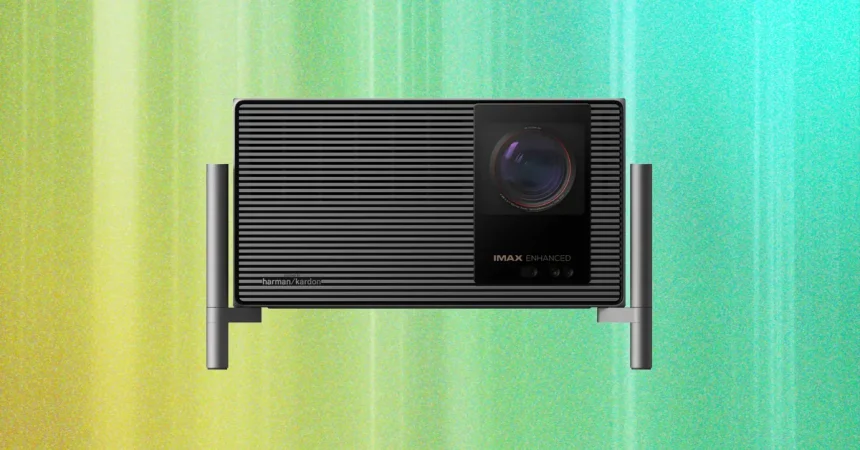
The Twilight Virtuoso: Navigating the BenQ W4100i
When you step into the world of home cinema projectors, you are immediately confronted by a delicate balancing act between ambient light, color fidelity, and sheer brightness. The BenQ W4100i is a remarkable contender in this arena, delivering a visual feast that genuinely captivates—provided you set the stage correctly. My experience with this model was akin to discovering a secret weapon: it shines brightest when the lights go down and the world outside fades to black. In the harsh glare of a sunlit living room, however, its magic diminishes significantly. It’s not a failing of the hardware, but rather a characteristic of its design philosophy. This projector is not meant for casual daytime viewing; it is a creature of the night, thriving in controlled darkness where its contrast ratios can stretch their legs. Yet, even in its preferred habitat, I noticed a distinct absence of the dynamic iris—a feature found on the much pricier Titan Noir Max. For the uninitiated, a dynamic iris physically adjusts the aperture in real-time to improve contrast between bright and dark scenesantrophes, but its absence here is a gentle reminder of the price point, forcing the projector to rely on its static contrast capabilities, which are still formidable in a dark room.
The Unexpected Price-to-Performance Champion
Perhaps the most startling aspect of the BenQ W4100i is its price tag. I found myself checking the retail listing multiple times, convinced there had been a clerical error. In an industry where premium projectors often command prices rivaling small automobiles, this model undercuts the competition so aggressively that I assumed it was a budget flavor with buried compromises. Yet, after weeks of extensive testing alongside some of the most expensive units on the market, the W4100i has cemented its place as my top “Best Budget” pick. The sheer value proposition is staggering. It manages to deliver 90% of the experience of its $5,000-plus rivals for a fraction of the cost, making it an irresistible option for cinephiles and gamers alike who are looking to build a dedicated home theater without needing to sell a kidney. The secret lies in its priorities. BenQ clearly focused on the core pillars of a projector—ease of use, responsiveness, and a solid baseline image—rather than spending money on flashy extras or niche technical specifications. This judicious allocation of resources results in a projector that feels premium in the hands, performs admirably on the wall, and leaves your wallet breathing a sigh of relief.
A Setup Experience Devoid of Headaches
Setting up projectors has historically been a chore fraught with menu diving, geometric grid adjustments, and remote control frustration. The W4100i shatters that stereotype with a setup process that is refreshingly straightforward. Interestingly, it still relies on the older Android TV operating system, which might initially seem like a drawback given the pace of the tech industry. However, in practice, the older OS proved to be a non-issue holistically. The integration of the onboard Google Assistant was surprisingly smooth; I simply uttered a command to initiate the installation routine, and within a few minutes, the entire system was operational—a stark contrast to the 30-minute struggles I’ve endured with other smart projectors. Beyond the software, I developed a deep appreciation for the hardware design. The dark gray enclosure is understated, avoiding the garish, sci-fi aesthetics that plague some high-end models. But the real joy was tactile: the analog levers mounted on top of the projector for adjusting focus and throw distance. In an age of digital menus and tiny motorized focus rings, these physical levers felt satisfyingly intuitive. I could glide the projector into perfect alignment, adjusting the sharpness with a crude but effective mechanical precision that simply felt right in a way digital controls often don’t.
Honest Limitations in a Sea of Giants
It is crucial to contextualize the W4100i’s performance within its price bracket. It does not attempt to dethrone the titans of the industry, such as the Hisense XR10, which occupies an entirely different financial stratosphere. Those flagship models offer updated color gamuts like DCI-P3, which produce swaths of red and green so vibrant they seem to bloom, while the W4100i adheres to the older Rec.709 standard. For most home viewers, this difference is negligible—Rec.709 is still the standard for Blu-ray movies—but for the purist who demands the widest possible color volume, it is a notable omission. Similarly, the lumens rating stands at 3,200, a figure dwarfed by the Titan Noir Max’s 7,000-lumen output. This power difference means the W4100i simply cannot fight against ambient light the way its more expensive cousin can. In a blacked-out theater room, the 3,200 lumens are more than sufficient to paint a vivid, detailed picture, but if you intend to watch with lamps on or windows uncovered, the image will wash out. This is not a compromise so much as a clear definition of its intended use case: a dedicated dark space.
Buried Treasure: Unlocking the Gaming and Motion Prowess
What truly elevated the BenQ W4100i from “great budget buy” to “extraordinary tool” were the unexpected perks hidden beneath its unassuming exterior. As someone who appreciates the subtle nuances of film presentation, I was thrilled to discover the dedicated mode that matches the 24p frame rate of standard cinematic content. This feature eliminates the dreaded judder—that stuttering motion artifact that plagues many projectors when displaying 24 frames per second content—resulting in a buttery-smooth, fluid look that makes movies feel exactly as the director intended. But the real surprise came when I switched gears to gaming. Cranking the refresh rate up to a blistering 240 Hz, I loaded up the fast-paced game NTE on my gaming laptop. The experience was transformative. In chaotic battle sequences, where a single frame can mean the difference between victory and defeat, the projector’s low latency rendered my controller flicks with instantaneous precision. There was no perceptible input lag, no ghosting on fast-moving objects. I found myself leaning into the screen, completely absorbed in the action, realizing that this budget-friendly projector was secretly a gaming powerhouse.
The Honest Trade-Offs of a Budget Hero
It’s crucial to temper expectations when discussing the W4100i’s technical specifications. It isn’t designed to compete with the “Titans” of home cinema, such as the Hisense XR10. In fact, when placed side-by-side with such monsters, its limitations become apparent. The W4100i adheres to the older Rec.709 color gamut standard, which means it covers a narrower spectrum of colors than the newer DCI-P3 standard used in cinema. For the average viewer, this translates to colors that are slightly less saturated and rich than what high-end projectors produce, particularly in greens and reds. Furthermore, its peak luminance is rated at 3,200 lumens—a respectable figure, but a far cry from the 7,000 lumens output of the Titan Noir Max. Mathematically, that’s less than half the raw brightness, which explains its reliance on dark rooms. However, I gently remind myself that these are unfair comparisons. The Titan Noir Max costs several times as much, and its brightness is designed for massive screens and high ambient light environments that most residential users will never encounter. The W4100i is built for a dedicated media room, and within that environment, its 3,200 lumens are more than adequate to produce a punchy, detailed image on a standard 100 to 120-inch screen.
The Secret Weapon: A Gamer’s Delight
Where the BenQ W4100i truly separates itself from the pack—and justifies its existence amidst budget competitors—is in its movie and gaming features. There is a dedicated mode that matches the native 24p frame rate of cinema film, eliminating the dreaded judder that plagues projectors when they apply inconsistent 3:2 pulldown. The result is a fluid, silky-smooth panning motion during movies that feels authentically cinematic, stripping away the soap-opera effect that ruins many home theater setups. However, the crown jewel of this projector is its performance for low-latency gaming. Diving into a fast-paced title like NTE, which demands split-second reactions, I was blown away by the responsiveness. With the refresh rate cranked to a staggering 240 Hz, the projector transitions into a different beast entirely. The input latency becomes virtually negligible; my controller flicks were rendered onto the screen with zero perceptible delay, even during chaotic battle scenes filled with explosive particle effects and rapid camera movements. This 240Hz mode transforms the projector into a massive gaming monitor, allowing me to react to enemy fire with the speed of a native PC display. It is a feature typically reserved for expensive e-sports monitors, and seeing it implemented so effectively in a budget-friendly projector was a welcome surprise that completely changed my perception of the device.
The Quirks and The Verdict
No product is without its eccentricities, and the W4100i has a few. The most puzzling is BenQ’s insistence on using an external dongle for the streaming operating system. It feels like a relic of an older design philosophy, forcing users to plug in a separate device to access smart features. It adds clutter, introduces another point of failure, and requires an additional HDMI port. However, this quirk is easily circumvented. If, like me, you prefer a dedicated external streaming box or a Blu-ray player, you can simply ignore the dongle entirely and use the projector as a pure display monitor for your HDMI-equipped devices. This flexible approach actually proves useful, preventing the projector from becoming obsolete as smart TV interfaces age and software updates lag. In the final analysis, the BenQ W4100i isn’t just a budget projector; it is a testament to smart engineering and prioritized spending. It forgoes the bragging rights of astronomical brightness and cutting-edge color spaces to deliver what matters most: a responsive, easy-to-use, and surprisingly affordable gateway into serious home cinema. Its quirks—the dongle-based OS, the inherent brightness limitations—are minor footnotes in a story dominated by exceptional value attachment for a slower, less-responsive OS, or someone who simply wants a plug-and-play device, bypassing the smart features entirely in favor of an external streamer or Blu-ray player.
Ultimately, my verdict on the BenQ W4100i is overwhelmingly positive. It’s not a projector for the enthusiast who demands every last spec sheet box be ticked, nor is it a device suited for a bright family room. Instead, it is a masterclass in focused engineering—a product that knows exactly who its audience is. It offers a low-latency, high-performance gaming experience that rivals dedicated monitors, a cinematic 24p mode that purists will adore, and a setup so painless that you’ll be watching content within minutes of unboxing. The minor quirks, like the external dongle for the operating system, are easily overlooked when you consider the price tag. You can bypass the dongle entirely by plugging a streaming stick or a Blu-ray player directly into one of the readily available HDMI ports shed the complexity. Ultimately, the BenQ W4100i represents a philosophy of focus: it does the things that matter most—visual clarity in darkness, responsive gaming, and user-friendly installation—with flying colors, while gracefully skipping the extravagant extras that inflate the cost of its competitors. That combination of affordability, performance, and practicality is precisely why it has earned its place as my definitive budget pick.