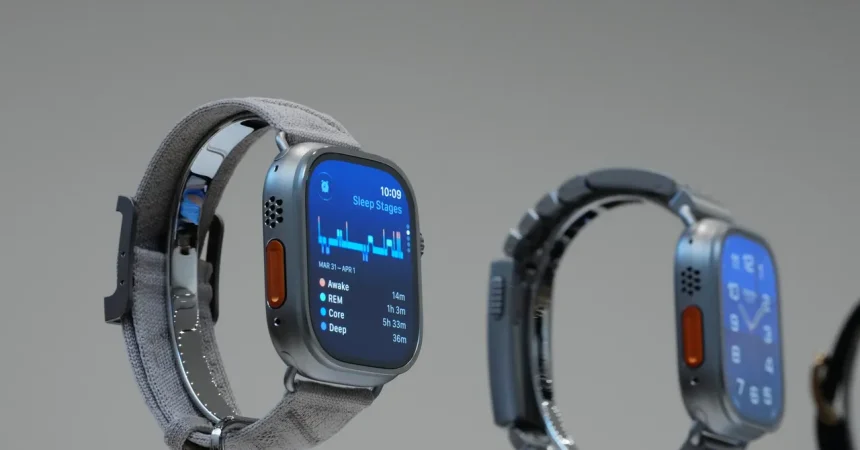
There is something almost reassuring about the Apple Watch Ultra. It is not a subtle device, and it has never tried to be. Since its debut in 2022, it has stayed true to the same larger-than-life identity: a massive titanium case that dominates your wrist, a dazzlingly bright screen that’s easy to read in direct sunlight, and a toolbox of emergency features that makes you feel like you could handle a sudden alien invasion or a lost trek through the wilderness. It is a watch that says “I’m prepared,” even if your most dangerous adventure is a crowded airport terminal. And honestly, there’s a strange comfort in that. But after three years of incremental tweaks and updates, the Ultra hasn’t fundamentally changed. It is still huge, still tough, and still designed for the kind of person who thinks a normal smartwatch is a little too fragile, a little too ordinary. The latest model, the Ultra 4, continues that tradition, and in many ways it’s the best Ultra yet. But after spending time with both the Ultra 4 and the new Series 12, I couldn’t shake the feeling that the two Apple Watches are becoming more alike than ever. Each year the gap between them shrinks just a little bit more, and this year it feels smaller than it ever has.
That raises a question that’s hard to ignore: why would you spend $799 on the heavier, tougher, more rugged watch when a regular Apple Watch can do so much of the same magic? The Series 12 now shares many of the health and safety features that used to be Ultra territory, and for most everyday people, the experience of wearing the two watches is far more similar than you might expect. You get the same notifications, the same heart rate alerts, the same workout tracking, the same sleep insights, and the same general sense of having a mini health lab strapped to your wrist. The Ultra’s biggest selling points, however, are still very real. It has a battery that can comfortably last for days, especially in low-power mode. It has a dedicated Action button that you can customize for workouts, shortcuts, timers, flashlights, and more. And it has satellite messaging, which allows you to send text messages from places where your phone has absolutely zero service. Those are genuinely impressive features, but they’re also features aimed squarely at people who actually go off the grid. If you are a trail runner, a hiker, a diver, or someone who regularly finds themselves in the middle of nowhere, the Ultra 4 is an absolute companion. But if your daily routine involves going to the office, hitting the gym, cooking dinner, and scrolling your phone on the couch, many of those capabilities sit idle. You might appreciate them in theory, but you’ll rarely need them in practice.
Does that make the Ultra 4 a bad watch? Not at all. In fact, it’s more specialized than ever, and that’s both a strength and a weakness. For the people who are truly part of its target audience, it’s an incredible piece of equipment. It’s built to survive extreme conditions, it’s easier to use with gloves, it has better water resistance for diving, and it gives you the confidence to rely on a single device for navigation, communication, and tracking when you’re far from civilization. But for the rest of us, the Ultra 4 is a tougher sell than it used to be. The Series 12 offers the same core smartwatch experience for $400 less, and when you look at them side by side, the difference in price becomes harder to justify. Even more importantly, if you already own a previous Ultra, the Ultra 4 doesn’t give you all that many reasons to upgrade. It’s a refined version of the same idea, not a reinvention. There are no new colors, no fresh finishes, and no dramatic redesign. It is very much the same watch you already know, only a little more polished. That’s not a bad thing, but it’s also not exactly a compelling reason to open your wallet.
The most significant upgrade in the Ultra 4 is found under the hood, in Apple’s new health sensing system. Powered by the faster S11 chip and improved optical and electrical heart rate sensors, this new system tracks your heart rate every five seconds throughout the day. It also measures something called heart rate variability, or HRV, as often as every five minutes. That’s a massive leap compared to the older generation, which only checked HRV a fraction as often. If you’re not familiar with HRV, it’s basically a way of measuring your body’s stress response and recovery. Think of it like a dashboard light that tells you whether your engine is running smoothly or whether things are starting to overheat. The new system logs two different kinds of HRV: Recovery HRV, which is meant to help you identify daily stressors, and overall HRV, which gives you a broader look at how your cardiovascular system is doing. In plain English, this means the watch is paying much closer attention to your body’s signals throughout the day, not just when you happen to be sitting still or sleeping. It’s like having a coach who’s always watching, always paying attention, always noticing when something seems off.
For people considering the Ultra 4 as a serious fitness tracker, this is a genuinely meaningful improvement. The higher-frequency tracking allows the watch to create a much more complete picture of how your body is responding to the ups and downs of life. A tough workout, a stressful meeting, a late night of bad sleep—all of these things can show up in your HRV readings, and the Ultra 4 is better equipped than ever to catch those changes. Overnight Vitals, one of the newer features, now compares your Recovery HRV against your personal baseline, which helps you understand when your body is coping well and when it might need extra rest. There’s also a new daytime view that lets you look at the differences between how your body behaves during the day and how it behaves at night. For data lovers, this is a goldmine. You can finally see the full story of your stress and recovery, not just a small piece of it. It makes the Ultra 4 feel less like a simple activity tracker and more like a genuine wellness companion. But here’s the catch: the Series 12 has the exact same health sensing system. That’s not a reason to choose the Ultra. It’s just another reminder that the two watches are sharing more and more of the same DNA, and that the Ultra’s advantages are no longer about everyday health tracking. They’re about ruggedness, battery life, and the extra physical controls that only matter in specific situations.
In the end, the Apple Watch Ultra 4 is an excellent product, but it’s also an increasingly narrow one. It’s a specialized tool for a specific kind of person, and for that person, it’s probably worth every penny. If you regularly spend time beyond cellular coverage, if you dive to depths most people never see, if you run on remote mountain trails where an injury could leave you stranded, then this watch is not overkill. It’s a lifeline. But if you’re like most of us—wandering from your bed to your kitchen to your desk and back again—the Series 12 will give you the same brilliant screen, the same fast performance, the same health insights, and the same daily experience for significantly less money. And if you already own an Ultra, the Ultra 4 is less of a must-have upgrade and more of a reassuring reminder that you made a great choice the first time around. You’re not missing out on anything revolutionary. There’s a certain beauty in that, actually. The Ultra hasn’t felt the need to chase every trend or reinvent itself every year. It knows what it is: a big, tough, dependable watch that whispers (or maybe shouts) that you’re ready for whatever comes. But as the regular Apple Watch grows into the same kind of health-focused device, the Ultra’s secret superpower is no longer being the best Apple Watch for everyone. It’s being the best Apple Watch for someone who truly needs it. And for the rest of us, it remains a lovely, expensive, apocalypse-ready dream—one that’s probably best left on a shelf, while the lighter and more affordable Series 12 quietly does everything we actually need.