Owning What’s Yours: A Night with Louis Rossmann and the Fight for Repair
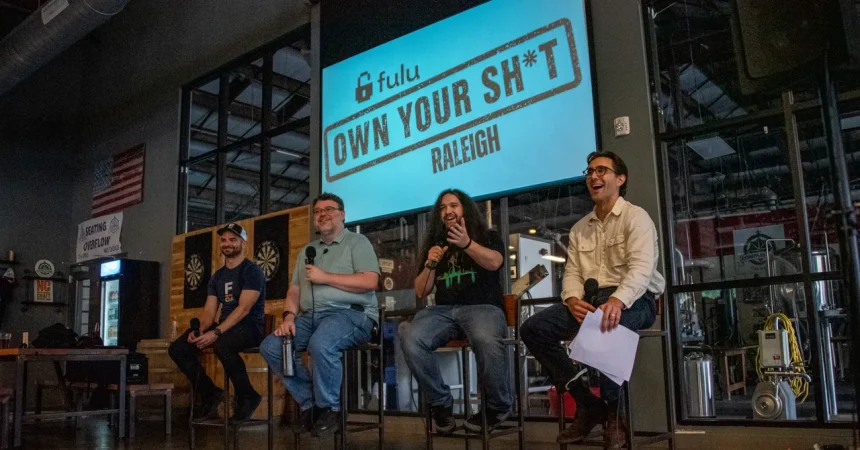
The train blasts through right as Louis Rossmann starts to speak, and it’s clear this is just the rhythm of the evening. We’re crammed into the narrow side porch of a brewery in San Jose, California, on a warm Friday night, and every few minutes the nearby tracks deliver another roaring freight train, horn blaring, as if to punctuate the speeches. Every speaker before Rossmann has politely paused, waiting for the noise to pass before continuing. But Rossmann is mid-sentence, delivering his rapid-fire manifesto with the feral energy of a man who has been wanting to say this for decades, and he simply refuses to stop. He raises his voice, shouting over the mechanical thunder without missing a beat, his eyes locked on the eighty or so people packed shoulder to shoulder in the cramped space. There’s something almost theatrical about watching him fight to be heard over a literal train — it’s a perfect metaphor for what he’s actually doing: trying to make himself heard above the machinery of corporate power, above the noise of an industry that would rather you just shut up and buy a new device. The crowd laughs at the absurdity of it, but they’re with him.
This is the penultimate stop of the Own Your Shit tour, an American odyssey this summer organized by Rossmann — YouTuber, repair guru, and founder of the advocacy nonprofit Fulu — alongside his collaborator Kevin O’Reilly. They’ve been traveling across the country, holding free events designed to rally people around the right to repair and the basic human principle that if you bought something, it should be yours, period. The final stop will be in Silver Springs, Maryland, in early October, but tonight is about building momentum, about finding the people who are angry enough to act. Before Rossmann took the stage, the evening featured a remarkable array of speakers who made the issue feel deeply human rather than abstract. There was an advocate from the Electronic Frontier Foundation calmly laying out the legal landscape. There were students from San Jose State University’s Fixit workshop, fresh-faced young people who spend their weekends repairing neighbors’ broken appliances and electronics, keeping perfectly good gadgets out of landfills. And there was a leader of the Fisker Owners Association, a group of electric vehicle owners who have banded together to refuse to let their cars die after the company went bankrupt, swapping parts, sharing know-how, and building a community around keeping their vehicles alive against all odds. The message was the same in every iteration: you are not alone in your frustration, and there are tools to fight back.
The central villain of the evening is a specific piece of legislation that most people have never heard of but that affects nearly every object they own: Section 1201 of the Digital Millennium Copyright Act, or DMCA. Enacted in 1998 on the theory that it would protect device security, this obscure legal text has become the wall that prevents ordinary people from repairing their own property. In essence, it makes it illegal to bypass digital locks and restrictions that manufacturers install on their devices — and manufacturers have exploited it ruthlessly. They put software locks on tractors, wheelchairs, laptops, cars, and medical devices, then turn around and charge owners for the privilege of accessing hardware they already paid for. Rossmann and O’Reilly launched Fulu specifically to challenge this, offering bounties to people who can disable these digital locks on their own devices, even if it means facing legal consequences. It’s a form of civil disobedience administered through a nonprofit, an attempt to flood the system with examples of people who simply refuse to be treated like tenants in their own homes. The strategy is elegant: force the courts to confront real humans choosing to break a bad law, rather than lobbyists pontificating about hypotheticals.
Rossmann itself is a character — a slim, energetic man in his late thirties with an unkempt beard and a fervent delivery that lands somewhere between a stand-up comic and a Pentecostal preacher. At one point he asks the crowd, “How many people here enjoy it when they get threats of lawsuits? Raise your hand.” A few go up, including a grinning Rohit Chopra, the former director of the federal Consumer Financial Protection Bureau, who has clearly come to enjoy the theater. “I enjoy when people try to sue me,” Rossmann declares. “When they send me threats, I literally frame them.” And it’s not bluster — Rossmann has spent years accumulating documented cases of corporate overreach against ordinary consumers, many of which he’s faced personally. His presentation is a relentless whistle-stop tour through the indignities that corporations have visited upon their customers: Amazon, which remotely deleted books from people’s Kindles; Roost, a home pipe leak detector company that shut down its stand-alone Wi-Fi products, stranding users who had bought hardware that now depended on dying servers; Apple, Sony, and various wheelchair manufacturers who routinely defend practices that prioritize profit over people; and BMW, which recently ran advertisements for the new Spider-Man movie directly on their customers’ dashboard screens, turning expensive purchases into billboards. Rossmann’s rhetorical genius is his framing of these practices as a form of “ransomware” — companies adding paid subscriptions to products after customers have already bought them, holding features hostage until users agree to pay more.
The frustration in the room feels deeply personal and increasingly universal. People are angry about Sony ending physical disc support for their media, about Google remotely deleting a user’s purchased copy of The Lord of the Rings, about Amazon abandoning perfectly functional older Kindles. There’s a sense that the digital age has made ownership worse, not better — that we used to own our books and movies and appliances as physical objects we could hold, lend, fix, and pass down, and now we own licenses that can be revoked at a whim. With inflation squeezing budgets and devices getting ever more expensive, people desperately want to hold onto what they have, to make things last, to resist the endless upgrade cycle that manufacturers push. And beneath the specific grievances is a broader anxiety: the feeling that the world is being rearranged around us to serve corporate interests, and that the things we thought were ours are, in fact, merely rented from companies who reserve the right to change the terms whenever they want. The crowd cheers and calls out their own horror stories, trading tales of being locked out of their own devices and charged absurd fees to get back in. The energy is somewhere between a support group and a political rally, and Rossmann, standing at the front, seems to be channeling all of it.
Toward the end of the evening, Katharine Trendacosta, a director of policy and advocacy at the Electronic Frontier Foundation, steps up to deliver the closing argument. She zeroes in on one of the most insidious developments in modern consumer life: the transformation of nearly everything into a subscription service. “They get the subscription and our data,” she says, her voice carrying across the packed porch. “It’s a win-win for them and a lose-lose for us.” The words land like a hammer. Because that’s what the fight is ultimately about — not just repair, but the entire architecture of ownership in the 21st century. As the evening winds down and the crowd lingers, talking in small groups about strategies and local organizing, you get the sense that something has shifted. These eighty people, crammed into a brewery porch in San Jose, will go home and tell their friends. They’ll bring broken devices to repair cafés. They’ll write letters to their representatives. And they’ll spread the word that you don’t have to accept a world where the things you own aren’t really yours. The train thunders by one last time, and everyone just keeps talking. After all, there’s too much to say, and they’ve learned not to wait for the noise to pass.