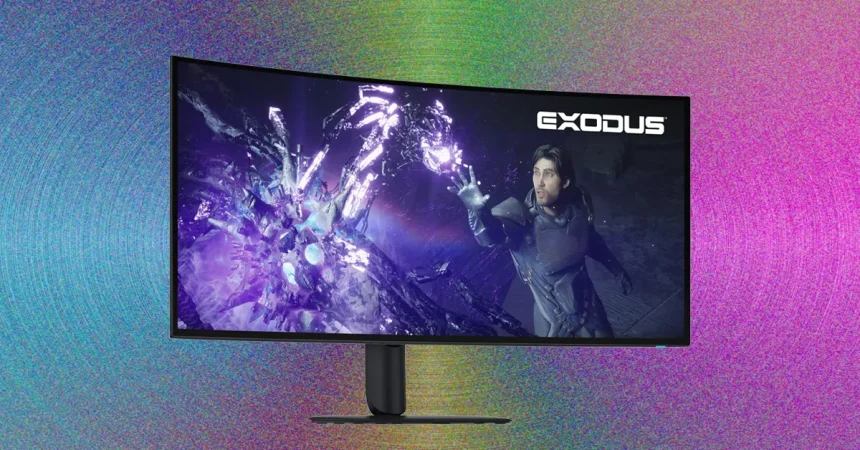
Here is a summarized and humanized breakdown of the Alienware AW3926QW, written in a conversational style across six paragraphs.
There’s a lot of exciting stuff happening in the PC monitor world right now, but nothing had me quite as giddy as pulling the Alienware AW3926QW out of its box. This is a 39-inch ultrawide that’s carrying some genuinely revolutionary tech under the hood: an RGB Stripe Tandem OLED panel. Now, if you’re not deep into the tech forums, let me break that down in plain English. First, we have the RGB Stripe part. Traditional OLED panels, especially the first-gen ones used in TVs, often employed a WRGB layout—that’s White, Red, Green, and Blue—where a white sub-pixel did the heavy lifting. The problem? It caused text to look blurry and fuzzy, because the white pixel was always on, washing out the crisper edges of the neighboring color pixels. By switching to a strict red, green, and blue stripe arrangement, Alienware (and LG, who makes the panel) have solved that issue almost entirely. Text on this screen looks as sharp as on a high-end IPS display—no more halos or color fringing around letters. Then there’s the Tandem part. That essentially means there are two layers of OLED material stacked vertically. Why do that? Well, two layers roughly double the brightness output and spread the heat and electrical stress over a larger area, which dramatically improves the panel’s lifespan. That’s a win-win. Right now, this exact technology is a rarity. It’s in the LG UltraGear Evo GX9, which costs a fortune, and it’s in this Alienware. I also recently had hands-on time with the Asus PG27UCWM, which uses the same RGB Strip OLED array but crammed into a boring standard 16:9 aspect ratio. Don’t get me wrong, the 27-inch Asus looks phenomenal, but the Alienware takes it to a whole new level by stretching the panel out to a massive 21:9 ultrawide format. The sheer immersion of having that 39 inches of width wrapping around my peripheral vision in a racing game is something you just don’t get from a boxy 16:9 screen. Plus, the 3440×1440 resolution at this size gives you a crisp pixel density (around 110 PPI), which means no visible screen-door effect and plenty of desktop real estate for side-by-side windows. It feels like the pinnacle of modern display tech, and getting to review it was a total treat.
Let’s get straight to the numbers, because brightness is always the first concern when people hear “OLED.” The AW3926QW spec sheet lists a typical SDR brightness of 300 nits, which is perfectly usable for an office with decent lighting. But the real magic happens when you flip on HDR. The panel is rated for a peak brightness of 1,000 nits in a small, localized window. So I grabbed my colorimeter, set up a 10% white window, and let it rip. What did I see? I recorded a peak measurement of 1,011 nits—essentially dead-on spec. Now, you won’t get that across the entire screen simultaneously; that would fry the organic materials. That’s where the Automatic Brightness Limiter (ABL) kicks in. When the whole screen is white, it drops to around 250 nits to protect itself. But that’s fine, because HDR content is rarely full-screen white. It’s about highlighting vivid specular details. Let me tell you, those highlights are absolutely spectacular. I loaded up Cyberpunk 2077 and drove into the badlands at noon; the sun burning overhead looked so intense I actually squinted. In a dark scene, like the rain-slicked streets of Night City, the neons reflected on the asphalt with a piercing, almost electric glow. I watched Blade Runner 2049 on it, and the striking brightness of the orange sky against the black silhouettes was breathtaking. The secret sauce is the tandem layer structure—it allows the panel to push these high nits without crashing into the severe 200% brightness drop that you see on older single-layer OLEDs, which would often throttle down after just a few seconds. Even in SDR mode, the 300 nits is bright enough to overcome glare in a sunny room, but low enough that it won’t cause eye strain in a dimly lit gaming cave. It’s a masterclass in brightness management.
Moving on to color, and this is where the AW3926QW absolutely eviscerates the competition. I ran my SpyderX colorimeter through a full calibration suite, and the results coming straight from the factory are nothing short of outstanding. I measured a staggering 99% coverage of the DCI-P3 cinematic color space and a very respectable 93% of AdobeRGB. To put that into context, a majority of premium IPS gaming panels—think Asus ROG or MSI—typically top out around 90% DCI-P3 and often dip below 70% AdobeRGB. This monitor hits those numbers out of the box, in preset mode, before any manual tweaking. Even better, the Delta-E color difference average was less than 1.0, which is the gold standard for professional monitors. It means the reds are exactly red, the greens exactly green, and the blues exactly blue—there’s zero tinting or banding. I spent an afternoon editing RAW photos in Adobe Lightroom, and the skin tones rendered with a lifelike warmth that I rarely see outside of dedicated $3,000 pro displays. I also did some video editing in DaVinci Resolve, and the gradient transitions, especially in the sky and shadows, were buttery smooth with absolutely no color banding or posterization. The RGB Stripe layout further helps here by ensuring that fine details and thin lines remain crisp and clear. And let’s not forget the viewing angles. I stood up and looked at the screen from a severe 45-degree angle, and the color didn’t shift, wash out, or invert. It maintains its stunning color fidelity from nearly any angle you can view it, which makes it great for sharing your screen with a friend or just leaning back in your chair during a movie.
Alright, let’s talk about the elephant in the room: the price. You can purchase the Alienware AW3926QW right now for about $1,100. That’s a phenomenal price for a 39-inch OLED. But to truly appreciate the value, you have to look at its sibling. The LG UltraGear Evo GX9, which sports the exact same 39-inch Tandem OLED panel, originally launched with a brutal $1,800 MSRP. Even after months of being on the market, the LG still commands around $1,500 to $1,600 on sale. So, by choosing the Alienware, you are literally saving $400 to $500 for the exact same panel technology—the same pixel response times, the same brightness, the same color gamut, the same HDR performance. It’s almost absurd. When I consider the broader market, a good 34-inch IPS ultrawide from LG or Dell will run you somewhere between $700 and $900. Spending an extra $200 to $300 to jump into the premium OLED club feels like a no-brainer, especially when you factor in the perfect blacks, infinite contrast ratio, and near-instant 0.03ms response times that OLED provides. For competitive gamers, that response time is a competitive edge. For media consumers, the contrast is a cinematic revelation. There are other OLED options like the Samsung Odyssey G8 OLED, but those often lack the DP 2.1 ports or have lower peak brightness. The AW3926QW genuinely harpoons the value proposition of the entire high-end monitor market. It’s the kind of price-to-performance ratio that makes me wonder how Alienware is making a profit on this thing. If you have a capable GPU (something like an RTX 4080 or better), this is arguably the single best upgrade you can make to your gaming setup right now.
Beyond the gorgeous panel, the connectivity suite on the AW3926QW is a modern connectivity dream come true. For video, you get two HDMI 2.1 ports that support the full 48Gbps bandwidth. That means you can plug in a PlayStation 5 or an Xbox Series X and enjoy smooth VRR (Variable Refresh Rate) gaming without any hiccups. But the standout feature is the inclusion of a single DisplayPort 2.1 input running at the highest UHBR20 speed. Why is this so important? Because it allows the monitor to run at its native 3440×1440 resolution and up to 240Hz refresh rate (which is the max on this panel) without using Display Stream Compression (DSC). DSC can sometimes introduce slight visual artifacts, like occasional flickering in certain content or weird texture issues on desktop backgrounds. With DP 2.1 UHBR20, you get a perfect, uncompressed, pixel-perfect signal with absolutely zero artifacts. It’s an incredibly future-proof connection that will easily handle the next generation of GPUs. Then there’s the USB-C port, which is an absolute productivity powerhouse. It supports DisplayPort Alt Mode (so you can use it as a second monitor for a laptop) and delivers a substantial 90W of Power Delivery. I plugged in my 16-inch MacBook Pro, and it charged to full capacity while simultaneously sending a 3440×1440 video signal to the screen. It effectively replaces a docking station. And the data hub is equally impressive: you get three USB-A 5 Gbps ports and one USB-C 5 Gbps port. I hooked up my wireless mouse dongle, my mechanical keyboard, my gaming headset, and a portable SSD, and everything was recognized instantly with no lag. If you like to switch between a desktop and a laptop, you can even use the USB upstream ports to function as a rudimentary KVM switch, sharing your mouse and keyboard between the two machines. A 3.5mm audio jack, a Kensington lock slot, and a 100×100 VESA mount complete the package, giving you all the options you need for a clean and efficient desk setup.
So, with all this outstanding performance, there has to be a catch, right? Well, the catch is in the physical design and build materials. Alienware, in recent years, has totally abandoned their flashy, aggressive, sci-fi aesthetic in favor of a very clean, minimalist, and honestly a bit “basic and demure” design language. The AW3926QW is a predominantly matte-black plastic chassis. There is no RGB lighting anywhere, save for the small, subtle Alienware logo on the stand. The plastic feels a little hollow if you knock on the back panel, and while it’s sturdy, it lacks the premium brushed-aluminum and textured fabric finishes you find on Asus ROG or even some LG UltraGear offerings. The stand is fully adjustable—offering tilt, swivel, and about 5 inches of height adjustment—so ergonomics are decent, but the base is a wide, flat plastic foot that eats up a lot of desk real estate. The curve is also worth a detailed discussion. It sits at a moderate 1800R curve. This is subtle enough that it doesn’t cause major distortion when you’re doing text work or spreadsheets, but it’s still noticeable enough to wrap around your field of view and pull you into the game. I actually prefer this to the extreme 1000R curves of some Samsung Odyssey displays, which can make the edges of the screen feel warped when scrolling through documents. The on-screen display (OSD) is controlled via a responsive joystick on the bottom right, but the menu interface itself is a bit plain and utilitarian—not nearly as polished or feature-rich as Asus’s GamePlus or LG’s Game Optimizer suites. However, none of these aesthetic shortcomings take away from the core function of the monitor. If you want a no-frills, gaming/creation powerhouse that delivers a pixel-perfect image for a fraction of the cost of its rivals, you’d be hard-pressed to find anything better. Just be prepared to hide the stand behind your monitor or mount it on a VESA arm if you care about the looks of your battle station.