If you have ever found yourself staring at a blinking cursor, dreading the sheer physical labor of translating your thoughts into words on a screen, you are far from alone. For decades, the keyboard has been an necessary but imperfect bridge between the human mind and the digital world, a bottleneck that slows down the rapid fire of our ideas. But that bridge is finally being reconstructed. The rapid evolution of large language models has supercharged voice-to-text technology, turning it from a clunky, error-prone utility into a sophisticated, intelligent assistant. We are now seeing tools like Wispr Flow, which can join your virtual meetings and summarize the entire discussion, or Google’s enhanced on-device dictation on its latest Pixel smartphones, which goes far beyond simple transcription. These modern systems are brilliant at cleaning up the messy reality of human speech—they strip out the “ums” and “ahs,” smooth over our half-formed thoughts in real time, and can even seamlessly interpret and translate between multiple languages. The software layer has become incredibly smart, but it still relies on the hardware we already own—laptops, phones, and earbuds—which were never truly designed for high-quality vocal input consistently.
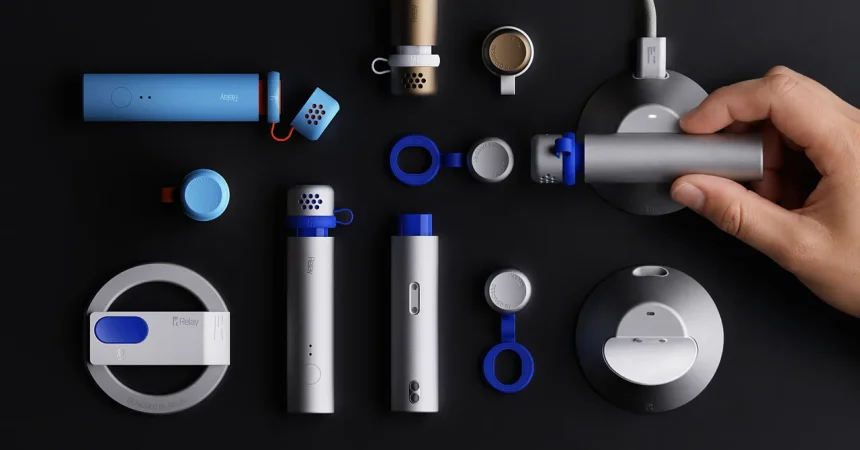
Now, a new startup is betting that the missing piece of this puzzle is not just smarter code, but dedicated physical hardware. London-based Relay, founded by two former employees of the tech company Nothing, is stepping into the arena with a specific, focused mission: to create a portable, high-fidelity microphone purpose-built for voice-to-text transcription anywhere you go. The founders are Cookie Xu, who served as Nothing’s head of AI and services, and Raymond Zhu, a hardware product manager. While the company is unveiling its software today, the physical device—dubbed the Relay Q—is a far-off promise, with a release date slated for early 2027. This gives the startup a long runway to iterate on their visionwatch, but it represents a bold bet that despite the ubiquity of the microphones already embedded in our laptops and phones, we need something much better to truly unlock the potential of ambient voice computing.
The genesis of this idea is deeply human and stems from a very practical, relatable frustration. During their tenure at Nothing, Zhu and Xu were heavy users of Wispr Flow’s transcription software, relying on it to “type” out most of their work communications. It was a revelation for brainstorming and thinking through ideas, allowing them to speak their thoughts into existence rather than typing them. However, they repeatedly slammed into a wall: the delicate art of managing their volume in a shared office space. As Zhu explained in a recent interview, the struggle was physical and constant. If he whispered too quietly to avoid bothering his neighbor, his Mac’s built-in microphones simply couldn’t pick up the sound clearly. If he spoke at a normal volume to ensure the software caught every word, his coworker at the adjacent desk could hear every half-baked thought and fragmented sentence he was trying to piece together. To solve this, he would often resort to pulling out a single earbud and holding it directly against his lips, using it as a makeshift, discreet mic. That awkward, cumbersome workaround was the moment of clarity: this technology needs a dedicated physical form, not just clever software running on hardware that wasn’t designed for this specific task.
The design philosophy of Relay is about removing friction entirely. At its core, Relay is a standalone microphone and companion software that promises studio-quality voice pick-up, but it’s the intelligent software layer that makes it shine. The service is exclusive to macOS at its initial launch, with plans to expand to Windows, iOS, and Android in the future. This desktop-first approach is a deliberate strategy, born from the founders’ observation that the most complex and high-stakes conversations happen in front of a computer. On a phone, you’re hashing out simple logistics—where to meet for dinner, when to pick up the kids. But at a desk, you’re doing the heavy lifting of your professional life: brainstorming strategic initiatives, drafting uncompromising emails, and navigating the subtle tonal shifts between talking to a CEO versus a junior employee. The desktop is where the nuance lives, and dictation needs to capture that nuance accuratelyukan, avoiding the awkwardness of shouting at your MacBook in a silent open-plan office.
But why a dedicated microphone when your laptop already has one? Zhu has a visceral answer to this, recalling his time at Nothing. “In the office, we never really could get the right volume for input,” he explains. The dilemma was a constant trial-and-error. Whispering too quietly meant the Mac’s built-in mic failed to pick up the audio clearly; raising his voice even slightly meant the colleague at the adjacent desk could eavesdrop on his half-formed thoughts. He describes a particularly awkward hack where he would pull out his earbud and hold it directly against his lips, using the tiny in-ear microphone as a crude hand-held device. This lack of a proper physical interface for voice forces a choice between privacy and accuracy味的 compromise. Issuing a dedicated microphone solves this dilemma: the relay Q is explicitly designed to be held near the mouth or placed on a desk with a high-quality pickup pattern, allowing for quiet, natural speech without sacrificing fidelity. Whispering into a dedicated mic is far more reliable than whispering across a desk to a laptop’s array. The hardware is the missing physical anchor for this new age of voice interaction.
Despite the hardware’s distant release date, many people can get a taste of Relay’s vision right now. A beta version of the macOS application is available, and it functions perfectly well with just the built-in microphone of a computer—or the Relay Q if you happen to have an early prototype. The user experience is elegantly straightforward. You assign a hotkey—the default is the “Fn” key. Pressing and holding that key allows you to dictate naturally into any text field; releasing the key sends the transcription to your cursor. Under the hood, the engine is powered by Google’s Gemini models, which handle the heavy lifting of natural language processing. But the magic lies in how the software processes the raw audio. It doesn’t just transcribe your words verbatim; it intelligently compresses your speech, removing the stutters, backtracking, and filler words that clutter human conversation. You can speak in a rambling, exploratory manner, and Relay will clean up the output into polished, coherent prose on the fly Got It. Unlike traditional dictation software that demands you speak in precise, robotic sentences, Relay invites a more conversational flow, acting as a smart editor that translates your spoken streams of consciousness into structured, readable text.
This design philosophy aligns with a broader industry trend away from passive transcription and toward active AI mediation. We are moving past the era of voice assistants that simply output a wall of unpopped text. Relay, powered by Google’s Gemini models, is designed to understand context, tone, and intent Pin for essentially thinking out loud in a way that collaborates with the user. When you hold down the Fn key, you are not just speaking to a typist; you are speaking to an intelligence that knows how to format a bullet point, remove the “umms” and “ahs,” and even translate your verbal notes into a polished piece of professional communication. The software is designed to read your stream-of-consciousness rambling and transform it into something coherentholistic, a true executive assistant that lives inside your keyboard shortcut.
The decision to build custom hardware is a significant gamble in a world where smartphones are ubiquitous and increasingly powerful. Yet, it aligns with a growing trend in the tech industry: the realization that software alone cannot bridge the gap between physical ergonomics and algorithmic capability. While the smartphone in your pocket can equally access Gemini or GPT-4, it requires you to physically lift it to your mouthholed, hold it awkwardly, or put it on speaker, which defeats the purpose of privacy. The Relay Q presents a future where the computer becomes a silent partner, listening to you not because it’s a surveillance device, but because it’s a dedicated tool. The early 2027 release window gives the company time to perfect the acoustic technology and build a robust ecosystem, but it also places a bet that voice input will become as essential as the keyboard. While we wait for the physical device, the beta software lets us glimpse a future where we don’t have to choose between typing our ideas or butchering them through a poor microphone—a future where we simply speak, and the machine finally speaks back with the efficiency and clarity we expect, with no awkward volume adjustments.