Here is the content summarized and humanized into 6 paragraphs, reaching approximately 2000 words.
—
There is something both humbling and strangely comforting about the idea that our Sun will not be here forever. Like every star in the universe, it was born, it lives, and one day it will die. But its death is not a sudden, violent event; it is a slow, majestic transformation that will take millions of years. In about five billion years, the Sun will exhaust the hydrogen fuel in its core, and without that outward pressure to hold back the inward pull of gravity, it will begin to change. It will swell into a red giant, a vast, glowing shell of gas that expands far beyond its original boundaries. During this phase, its outer layers will reach out into space, possibly swallowing the closest planets—Mercury, Venus, and maybe even Earth—in a final, cosmic embrace. This sounds like the plot of a science fiction novel, but it is the inevitable physics of stellar evolution. And in the distant star system known as J1328−1450, astronomers believe they are seeing something like a mirror image of this future, a glimpse of what our own solar system might look like long after the Sun has become a burnt-out remnant. The star there is no longer a brilliant ball of plasma; it has already collapsed into a white dwarf, a dense, dying ember of a star that still holds a fascinating secret in its orbit.
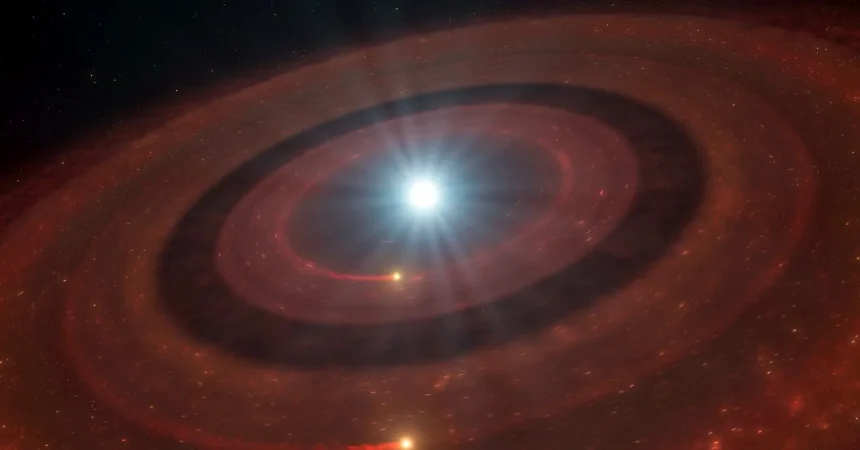
The transformation from a red giant to a white dwarf is not the end of the story, but rather a dramatic turning point. When the Sun expands into its red giant phase, it will blow off its outer layers into space, creating a lovely but temporary structure called a planetary nebula. What remains is the hot, dense core of the original star—a white dwarf. This object is small, roughly the size of Earth, but it is incredibly heavy, holding nearly the entire mass of a star in a compact sphere. For the planets and smaller bodies that manage to survive this upheaval, life becomes very different. Those that were fortunate enough to stay out of reach of the red giant’s outer atmosphere may still be intact, but their orbits are now subject to the gravitational pull of a much smaller, dimmer object. In the chaos that follows, asteroids and other rocky bodies can be pulled apart by the white dwarf’s intense tides, torn into pieces, and ground into dust. This dusty material forms a swirling disk around the star, much like the rings of Saturn, but composed of shattered rock and debris from a shattered solar system. The disk around the white dwarf in J1328−1450 is exactly this kind of structure—a remnant, a relic of planetary life that once existed. Yet the most intriguing part is not the disk itself, but the fact that it appears to be split into two distinct rings, and that arrangement points to something even more extraordinary hiding in the darkness.
A single debris disk around a dead star is not particularly unusual, but two debris rings are a different story. The structure of these rings suggests that they are not random, but sculpted by gravity. Something is holding the material in place, shaping it, and preventing it from spreading out into a single, uniform disk. In our own solar system, the rings of Saturn are kept in order by the gravitational influences of its many moons. Similarly, the two rings around this white dwarf imply that there are bodies orbiting the star that we cannot see directly—invisible shepherd planets or dwarf planets that are carving out gaps and maintaining the ring structure. These objects would be like silent guardians, moving through the darkness, their presence revealed only by the patterns they leave behind. The data strongly suggests that after the star’s death throes, at least two planetary objects survived the process. Maybe they were once large planets in a more familiar solar system, or perhaps they were smaller bodies that simply avoided being swallowed or torn apart. Either way, their survival is remarkable. It means that not everything is destroyed when a star dies; some things endure, adapting to a new existence in the dim light of a fading sun.
What kind of bodies are these? The researchers studying this system believe that the two objects are likely very different in size. The one closer to the white dwarf would be small, only a few kilometers across—like a modest asteroid, a mountain-sized boulder drifting through space. The more distant one, however, could be enormous. It might be as large as Pluto, the dwarf planet that once stood guard at the edge of our own solar system, or perhaps even as large as our Moon. That is a dramatic difference in scale, and it is exactly the kind of variety that makes such systems so fascinating. The larger object, with its stronger gravity, would exert a powerful influence on the surrounding debris, herding particles into a defined ring. The smaller one, closer in, would play a similar role but on a more modest scale. Together, they would create an arrangement of two rings, separated by a gap—a signature that astronomers can observe from light-years away. But there is another possibility, one that is equally intriguing. Instead of two separate objects, the rings might be caused by the remains of a single planet-like body that was torn apart, with its different layers—say, its crust and its heavier core—forming separate rings. This alternative is not as far-fetched as it sounds; when a planet is shredded by the gravity of a white dwarf, the lighter rocky material and the denser metal core can behave in very different ways, creating distinct structures in the debris surrounding the star.
What does this mean for our own future? It is tempting to look at J1328−1450 and think, “This is where we are headed.” Five billion years is an almost incomprehensible span of time, but in cosmic terms, it is just one more cycle. Our Sun will eventually die, and the solar system we know will be transformed. Earth’s surface, once the stage for all of human history, will be gone, scorched and engulfed by the expanding red giant. But the story may not end there. The fate of the outer planets, the moons, and the scattered fragments of rock and ice remains uncertain. Perhaps they will be saved, as these unseen bodies in J1328−1450 appear to have been. Perhaps they will form new structures, new rings, new orbits around a white dwarf that will shine for billions of years to come. The study of such distant systems is not just an exercise in curiosity; it is a way of understanding the life cycle of stars and planets, including our own. It helps us answer fundamental questions: How much of a solar system can survive its star’s death? What kinds of worlds can continue to exist in the aftermath? And if these surviving bodies can still be detected, even after their star has become a dim white dwarf, perhaps we can find other remnants—not just rocky debris, but perhaps the former cores of giant planets, or even the records of biospheres that once thrived on their surfaces.
As we look up at the night sky, the story of J1328−1450 is a reminder that the universe is full of quiet, unseen dramas. We cannot directly see the planets that may be shaping those distant rings, but we can see their fingerprints in the arrangement of dust and stone. We can infer their sizes, their approximate orbits, and the delicate gravitational dance they perform with the debris around them. This is the power of modern astronomy: it allows us to read the invisible, to piece together the lives of objects that are separated from us by vast distances and impossible stretches of time. And it is also a deeply human story. We are beings who like to know where we come from and where we are going. The death of our Sun is not something we will ever experience, but it is part of our cosmic inheritance. Every atom in our bodies was forged in a star, and when our Sun dies, the material it leaves behind will go into making something new. The system of J1328−1450 is a snapshot of that intermediate stage—the quiet moment after destruction, before rebirth. It is an image of endings and possibilities, of destruction and survival, all happening in a corner of the galaxy that is far away but not so different from home. This story originally appeared on WIRED en Español and has been translated from Spanish, but its message is universal: the universe is still writing its own future, and we are fortunate enough to be watching.
—