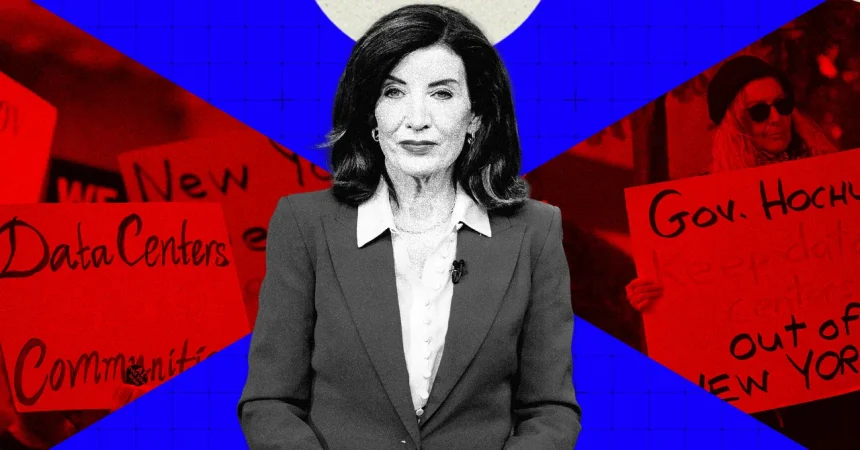
Welcome back to Power Play, our weekly look at the strange and tangled role data centers are playing in this midterm season. I’m Molly Taft, and every week we try to cut through the hype and the talking points to see what’s really happening in communities where these giant buildings are either going up or being stopped. This week, we’re zooming in on a place that has become something of a bellwether for the entire country: New York, the first state to pass a moratorium on data center development. And we’re starting not in Albany, but in the rural western corner of the state, where a mom of three named Adrienne Yocina has spent the last two years doing something she never expected to do—organizing against a 600-megawatt data center proposed for a site right next to the Tonawanda Seneca Nation’s reservation and a federal wildlife refuge. When Governor Kathy Hochul signed the moratorium in July, Yocina felt a wave of relief. Finally, she thought, somebody in power was listening. But now, almost four months later, that relief has curdled into something closer to dread. She’s watching the governor’s actions, and she’s not convinced Hochul actually has her back. “I feel like she’s just trying to shut us up,” Yocina told me when we spoke, her voice carrying the exhaustion of someone who has spent too many nights at public meetings and too many hours reading environmental review documents. She’s not just tired—she’s nervous. And her nervousness tells us something important about what happens after election season, when all the promises about regulating data centers must either be kept or quietly abandoned.
To understand why Yocina is so worried, you have to understand what has happened to data centers in the last few years. They have become the backbone of the digital world, the warehouses where the cloud lives, and they are eating electricity and water at astonishing rates. In communities across the country, they’ve been sold as economic engines, bringing construction jobs and tax revenue to places that desperately need them. But the people who actually live next to these projects often tell a different story. They talk about the noise of backup generators and cooling fans, about massive amounts of water going to chill servers instead of crops, about power lines carved through farmland and roads clogged with construction trucks. They worry about property values, about environmental contamination, about the character of their towns being changed forever. The 600-megawatt facility proposed in Genesee County would be enormous, and for Yocina, it felt like an invasion. The location wasn’t just any rural spot; it was near land that matters deeply to the Tonawanda Seneca Nation, and next to a wildlife refuge that supports delicate ecosystems. She and her neighbors organized, showed up at hearings, and tried to get anyone in government to ask hard questions. For a long time, it felt like no one was listening. Then, in a surprise move that made national headlines, New York became the first state in the country to say “not so fast.” The moratorium was a victory for activists, but as Yocina is learning, a victory on paper doesn’t always translate into real protection on the ground. The one-year pause is not a defeat of the project, and it isn’t even a permanent block on future data centers. It’s just a breath, and the question is who gets to use that breath—the community or the industry.
The story of how New York’s moratorium came to be is a masterclass in political compromise, and that’s exactly why Yocina is uneasy. In May, Governor Hochul had dismissed the whole idea of a moratorium, saying it wasn’t necessary. Then, in June, the state legislature passed an omnibus bill that would have imposed a one-year halt on data center development across the entire state. That bill was tough. It included stricter limits on the size of data centers and, crucially, mandated that the Department of Environmental Conservation conduct a thorough environmental impact review of data center operations before any new ones could be built. For activists like Yocina, that DEC review was the real prize. It would have forced developers to answer for their water use, their energy consumption, their pollution, their effects on nearby communities. It would have treated data centers less like a sacred industry and more like any other facility that needs to prove it won’t ruin the land and water around it. But rather than sign that bill into law, Hochul issued her own executive order. Her order also paused development, but it was narrower, weaker, and left out the key provisions that activists had fought for. The governor’s order did not mandate the full DEC environmental review. It did not set the same strict limits. It gave her administration more control over the process, which is precisely what makes Yocina suspicious. She and her fellow organizers worry that Hochul’s moratorium was never meant to be a real pause—that it was designed to give the appearance of action while actually allowing the industry to keep doing what it wants behind the scenes. The governor still has until the end of the year to sign the legislature’s stronger bill, and her office says they’re still looking at it. But Yocina has heard that kind of vague reassurance before. She doesn’t trust it. She’s seen too many politicians smile at activists and then do exactly what the developers want once the cameras turn off.
What’s particularly striking is that not everyone who helped push the stronger bill sees Hochul’s order as a betrayal. State Senator Kristen Gonzalez, a Democrat who sponsored the omnibus bill in the State Senate, has been publicly supportive of the governor’s moratorium. She says Hochul’s office reached out proactively after the bill passed and worked with her to design an executive order that would provide quicker relief for New Yorkers than waiting for the legislative process to grind through. In some ways, that’s true. An executive order can be signed in days, not months, and the moratorium did stop some projects that were imminent. Gonzalez’s position reflects a tricky political reality: dealing with data centers is not a simple good-versus-evil story. There are powerful forces on both sides. On the one hand, you have a booming industry that many believe is essential to the country’s digital future, and that creates real jobs and brings real money to local governments. On the other hand, you have residents who say they will reject data centers no matter what those benefits are, because their homes and their health and their land matter more than tax revenue. Politicians like Hochul are caught in the middle, trying to keep everyone happy, and the result is often a half-measure that satisfies no one entirely. But for Yocina, the political calculus doesn’t excuse what she sees as a failure to protect the people who need protecting. She argues that the DEC should have been at the center of the moratorium from the very beginning. If you’re going to pause data center development, she asks, why wouldn’t you take the time to actually study what these facilities do to the environment? Why wouldn’t you use the pause to gather facts, so that when the moratorium ends, you have a solid, science-based foundation for future regulations? Without that foundation, she says, the moratorium is just a delay, not a solution. It lets politicians claim they’re doing something while the developers simply wait out the clock. And when the pause lifts, the data center could come back, bigger and more unstoppable than before.
Yocina’s story is not just a local curiosity. It’s a preview of what’s going to happen across the country in the wake of this year’s midterm elections. Data centers have become one of the biggest issues in races at every level, from statehouse seats to congressional districts. Candidates from both parties have been making promises about data centers, often promising to regulate them, restrict them, or even outright ban them, because they can see how angry voters are and they know the political wind is blowing. In some cases, those promises are genuine. In many others, they are calculated. Either way, once the ballots are counted and the newly elected officials take office, the hard part begins. They will have to decide whether to break their word or follow through, and they will be under enormous pressure from the data center industry, which has deep pockets and serious lobbying power. They will also face pressure from residents like Yocina, who are organized and passionate and absolutely determined to prevent these projects from happening. These officials won’t be able to hide behind campaign slogans. They’ll be forced to make specific decisions about permits, about environmental reviews, about where to draw the line between economic development and quality of life. And when they do, they’ll discover that there is no perfect compromise. No matter what they choose, someone will be angry. The question is whether they have the courage to choose the side of the people who elected them, or whether they will cave to the moneyed interests that will be knocking on their doors from day one. New York’s moratorium is a test case, but it’s also a warning: a weak compromise can leave everyone feeling betrayed. It can give activists just enough to keep fighting, but not enough to win. And it can allow the industry to keep building while the public believes it is being protected.
As the years go by, it’s likely that more states will follow New York’s example, and each one will have to figure out its own version of the data center fight. But if Yocina has anything to say about it, the lesson won’t be lost. She knows that the moratorium is temporary. She knows that her fight is far from over. She’s already thinking about what happens after the one year is up, and she’s not just waiting for politicians to save her. She’s telling her story, rallying her neighbors, and demanding that decision makers actually listen. Her frustration with Governor Hochul is not about partisanship; it’s about respect. She feels like she has been treated as an annoyance, a problem to be managed, rather than as a constituent with legitimate concerns about her home and her family. She wants the strongest possible protections, and she doesn’t understand why the state wouldn’t want to give them to her. The truth is, data centers are not going away. We all rely on the internet, and the infrastructure that powers it has to exist somewhere. But the fact that something is necessary doesn’t mean it has to be built in a way that harms vulnerable communities. There are better designs, better locations, better regulations, and better ways to share the benefits. The question is whether our political leaders are willing to demand those things or whether they will continue to let the industry write its own rules. Adrienne Yocina is doing her part. She is holding her governor accountable, she is refusing to be silenced, and she is reminding us that behind every data center moratorium, behind every election promise, behind every corporate press release, there are real people whose lives and land hang in the balance. And those people are tired of being shut up. So if you’ve got a question about data centers, or a story about how they’re affecting your community, reach out. We want to hear from you. Because this fight is only just beginning.