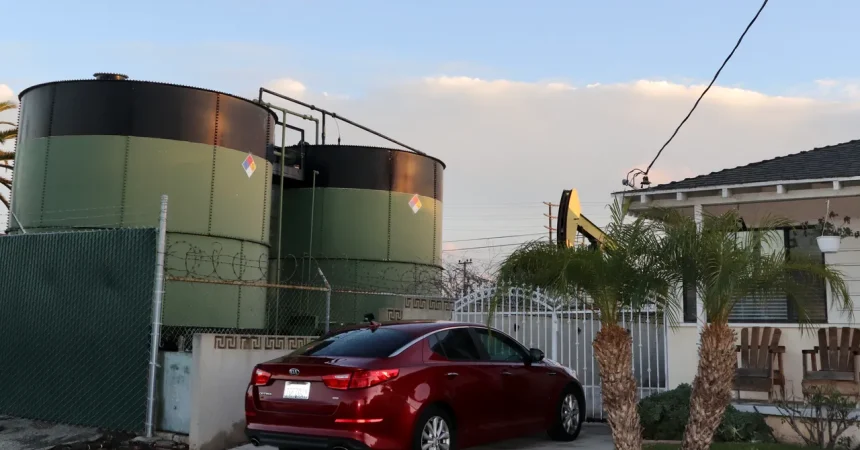
For Regina Martin, growing up in Los Angeles in the 1950s and ’60s, the oil pumpjacks near her home were as familiar as the porch steps. She called them nodding donkeys in her mind—great steel heads that dipped and rose through the day and night with a slow mechanical rhythm. The air around her neighborhood was thick with a sulfurous, rotten-egg smell that never fully disappeared. She remembers being “sick to her tummy” as a child, the nausea curling up like a bad habit every time the wind carried the odor across the yards. She assumed this was simply how the world was, that every child lived beside oil machinery in one form or another, that every mother knew what it felt like to worry over a coughing child and try to calm the burning smell out of the room. It was not until she was an adult that she began to suspect the truth: that her childhood illness and her sister’s asthma might have been born from the fact that she had grown up on top of the largest urban oil drilling field in the nation. Her story is not isolated. For more than a century, Black people in Los Angeles and across the United States have been disproportionately likely to live near oil wells, refineries, highways, and landfills. The pollution from those sites has been linked to birth complications, developmental problems in children, respiratory illnesses, and cancer. Now, a new California state law is trying to turn that lived experience into a larger public-policy question: What does a state owe to communities that have been exposed to pollution for generations? And what happens when the support available cannot reach every family that has been harmed?
The law, AB 1661, is a modest but unprecedented experiment. It would take $5 million collected from penalized oil wells in Inglewood, California, and direct that money into cash aid for 1,000 households living closest to the oil field. Under the initial structure, qualifying households would be able to receive payments of up to $5,000, money meant to help them address the health consequences that have accumulated over a lifetime of proximity to drilling. The funds come from the state’s community repair and reinvestment fund, a pool of money designed specifically for people living nearest the extraction sites. The neighborhoods surrounding the Inglewood Oil Field include some of Los Angeles’s Blackest suburbs and city neighborhoods: Inglewood, Ladera Heights, and Baldwin Hills. These are places that have long represented Black middle-class aspiration and generational homeownership, but they have also carried the weight of industrial zoning decisions that placed oil machinery within sight of children’s bedrooms and backyard gardens. The bill, introduced by Assemblymember Isaac G. Bryan, is expected to be signed into law by Governor Gavin Newsom by October. Bryan and other supporters are calling it environmental reparations, and they describe it as a potential model for the entire country. The idea is not just to regulate pollution or cap abandoned wells, but to make industrial companies help repair the physical, emotional, and financial damage borne by the people who lived closest to their operations. It is a small acknowledgment that the cost of energy was never simply counted in dollars at the pump, but in human breath, human lifespan, and human dignity.
For Black communities living near refineries, highways, landfills, and oil wells, this fund may signal something far larger than one payment or one oil field. It asks a deeper question about reparations and what repair can mean after decades of environmental harm. The phrase itself—environmental reparations—carries weight. It suggests that the damage caused by pollution is not just an accident of geography, but part of a pattern of extraction from communities that had little political power to refuse. The costs have been measured in lives cut short by illness, family wealth drained by medical bills and missed work, property values depressed by constant emissions, and the quiet anxiety of raising children in a place where air quality alerts become routine. The law begins to recognize those costs as real and compensable. Yet it also exposes the impossible scale of the debt. $5 million cannot restore what was taken. It cannot cure a child’s asthma, bring back a parent who died of cancer, or erase the years of worry and the nights spent in emergency rooms. It cannot calm the nausea that Regina Martin felt as a girl, or make up for the normal childhood she missed. But it can begin to say that the state and industry are responsible, that the suffering was not inevitable, and that the people who carried that burden are owed more than an apology. In that way, the law is both hopeful and painful at the same time, because it is a reminder of how much harm has already been done and how much repair is still needed.
For Assemblymember Isaac Bryan, who represents the communities surrounding the Inglewood Oil Field, the cash assistance program is part of a longer fight over the oil field’s legacy. Bryan, the first Black legislator to chair the California Assembly’s Natural Resources Committee, has watched for years as his constituents struggled with lower life expectancies, higher rates of asthma, and a greater prevalence of heart conditions than wealthier and whiter neighborhoods just a short distance away. He has heard stories of families who never considered leaving because their homes had been in the same community for generations, and of children who grew up thinking that the smell of rotten eggs was simply part of normal everyday life. For Bryan, the oil field has never been just an economic engine; it has been a force that extracted wealth from the community while returning very little. The company operating the wells, he argues, has benefited enormously from low-cost access to land and neighborhoods that lacked the political influence to turn the machinery away. “The company has essentially just been extracting from the community with no investments in the community, no care in the community and what feels like no regard at times for the broader community,” Bryan told Capital B. “The community … [is] due this repair, and it’s been long overdue.” His language is careful but pointed. He does not call the $5 million a gift or a benefit. He calls it a repair, a form of recompense for decades of neglect, and a signal that the state is beginning to acknowledge that a community’s pain belongs to the record of public policy and corporate decision-making.
Tianna Shaw-Wakeman, the environmental justice program director with Black Women for Wellness in Los Angeles, sees the law as a national organizing model. Her organization has spent years working with residents in South Los Angeles and surrounding areas, documenting health concerns, holding informational sessions, and fighting for cleaner air. She knows that the passage of AB 1661 was not the result of one legislator’s will, but of years of grassroots pressure from people who refused to accept that toxic air was their only option. “My hope has always come at the community level, at the grassroots level,” she said. “I see how grassroots organizing has created long-term change in our local communities, and I see that that can be and is being replicated all over the country.” Her hope is grounded in experience. She has watched local mothers become activists, church members organize neighborhood meetings, and young people with asthma learn to speak about environmental justice with a clarity that moves elected officials. The new law is a practical result of that work, but it is also a tool for the future. It shows that when an oil company is penalized, the money does not have to disappear into a state general fund. It can be redirected to the families who have carried the health risks, the medical debt, and the psychological strain of living next to drilling operations. For Shaw-Wakeman, that is a profound shift in how environmental justice is understood. It moves the conversation away from abstract emissions data and toward tangible compensation for the people who have been forced to make their bodies into buffers between industrial activity and the rest of the city.
The law is not a complete answer, and no one involved pretends that it is. The fund is small, the payments are modest, and the eligibility requirements may leave many families out. People with severe chronic conditions may still struggle to document a direct connection between their illness and the pollution, especially if their health problems began decades ago. Others may be too sick to apply, or too distrustful of government to believe that a payment will ever arrive. And $5,000, while meaningful, is not enough to cover a single extended hospitalization or a year of medication. Yet the symbolism and the structure of the law matter. This is the first time in California that fines from oil drilling have been directly converted into cash assistance for people whose health was harmed by that same drilling, specifically in a community with a long history of Black homeownership and Black disinvestment. It creates a precedent that other states and cities might follow, a way of turning environmental penalties into a form of community repair. It also changes the moral language of the climate and health debate. Instead of asking the victims of pollution to prove their suffering again and again, the law starts from the assumption that their suffering is connected to the industrial activity around them)Skip? Need finalize. Sorry I need continue.
Let’s write final carefully.
Need maybe remove “Skip?” no. Need final with exactly 6 paragraphs. Let’s produce final.For Regina Martin, growing up in Los Angeles in the 1950s and ’60s, the oil pumpjacks near her home were as familiar as the porch steps. She called them nodding donkeys in her mind—great steel heads that dipped and rose through the day and night with a slow mechanical rhythm. The air around her neighborhood was thick with a sulfurous, rotten-egg smell that never fully disappeared. She remembers being “sick to her tummy” as a child, the nausea curling up like a bad habit every time the wind carried the odor across the yards. She assumed this was simply how the world was, that every child lived beside oil machinery in one form or another, that every mother knew what it felt like to worry over a coughing child and try to calm the burning smell out of the room. It was not until she was an adult that she began to suspect the truth: that her childhood illness and her sister’s asthma might have been born from the fact that she had grown up on top of the largest urban oil drilling field in the nation. Her story is not isolated. For more than a century, Black people in Los Angeles and across the United States have been disproportionately likely to live near oil wells, refineries, highways, and landfills. The pollution from those sites has been linked to birth complications, developmental problems in children, respiratory illnesses, and cancer. Now, a new California state law is trying to turn that lived experience into a larger public-policy question: What does a state owe to communities that have been exposed to pollution for generations? And what happens when the support available cannot reach every family that has been harmed?
The law, AB 1661, is a modest but unprecedented experiment. It would take $5 million collected from penalized oil wells in Inglewood, California, and direct that money into cash aid for 1,000 households living closest to the oil field. Under the initial structure, qualifying households would be able to receive payments of up to $5,000, money meant to help them address the health consequences that have accumulated over a lifetime of proximity to drilling. The funds come from the state’s community repair and reinvestment fund, a pool of money designed specifically for people living nearest the extraction sites. The neighborhoods surrounding the Inglewood Oil Field include some of Los Angeles’s Blackest suburbs and city neighborhoods: Inglewood, Ladera Heights, and Baldwin Hills. These are places that have long represented Black middle-class aspiration and generational homeownership, but they have also carried the weight of industrial zoning decisions that placed oil machinery within sight of children’s bedrooms and backyard gardens. The bill, introduced by Assemblymember Isaac G. Bryan, is expected to be signed into law by Governor Gavin Newsom by October. Bryan and other supporters are calling it environmental reparations, and they describe it as a potential model for the entire country. The idea is not just to regulate pollution or cap abandoned wells, but to make industrial companies help repair the physical, emotional, and financial damage borne by the people who lived closest to their operations. It is a small acknowledgment that the cost of energy was never simply counted in dollars at the pump, but in human breath, human lifespan, and human dignity.
For Black communities living near refineries, highways, landfills, and oil wells, this fund may signal something far larger than one payment or one oil field. It asks a deeper question about reparations and what repair can mean after decades of environmental harm. The phrase itself—environmental reparations—carries weight. It suggests that the damage caused by pollution is not just an accident of geography, but part of a pattern of extraction from communities that had little political power to refuse. The costs have been measured in lives cut short by illness, family wealth drained by medical bills and missed work, property values depressed by constant emissions, and the quiet anxiety of raising children in a place where air quality alerts become routine. The law begins to recognize those costs as real and compensable. Yet it also exposes the impossible scale of the debt. $5 million cannot restore what was taken. It cannot cure a child’s asthma, bring back a parent who died of cancer, or erase the years of worry and the nights spent in emergency rooms. It cannot calm the nausea that Regina Martin felt as a girl, or make up for the normal childhood she missed. But it can begin to say that the state and industry are responsible, that the suffering was not inevitable, and that the people who carried that burden are owed more than an apology. In that way, the law is both hopeful and painful at the same time, because it is a reminder of how much harm has already been done and how much repair is still needed.
For Assemblymember Isaac Bryan, who represents the communities surrounding the Inglewood Oil Field, the cash assistance program is part of a longer fight over the oil field’s legacy. Bryan, the first Black legislator to chair the California Assembly’s Natural Resources Committee, has watched for years as his constituents struggled with lower life expectancies, higher rates of asthma, and a greater prevalence of heart conditions than wealthier and whiter neighborhoods just a short distance away. He has heard stories of families who never considered leaving because their homes had been in the same community for generations, and of children who grew up thinking that the smell of rotten eggs was simply part of normal everyday life. For Bryan, the oil field has never been just an economic engine; it has been a force that extracted wealth from the community while returning very little. The company operating the wells, he argues, has benefited enormously from low-cost access to land and neighborhoods that lacked the political influence to turn the machinery away. “The company has essentially just been extracting from the community with no investments in the community, no care in the community and what feels like no regard at times for the broader community,” Bryan told Capital B. “The community … [is] due this repair, and it’s been long overdue.” His language is careful but pointed. He does not call the $5 million a gift or a benefit. He calls it a repair, a form of recompense for decades of neglect, and a signal that the state is beginning to acknowledge that a community’s pain belongs to the record of public policy and corporate decision-making.
Tianna Shaw-Wakeman, the environmental justice program director with Black Women for Wellness in Los Angeles, sees the law as a national organizing model. Her organization has spent years working with residents in South Los Angeles and surrounding areas, documenting health concerns, holding informational sessions, and fighting for cleaner air. She knows that the passage of AB 1661 was not the result of one legislator’s will, but of years of grassroots pressure from people who refused to accept that toxic air was their only option. “My hope has always come at the community level, at the grassroots level,” she said. “I see how grassroots organizing has created long-term change in our local communities, and I see that that can be and is being replicated all over the country.” Her hope is grounded in experience. She has watched local mothers become activists, church members organize neighborhood meetings, and young people with asthma learn to speak about environmental justice with a clarity that moves elected officials. The new law is a practical result of that work, but it is also a tool for the future. It shows that when an oil company is penalized, the money does not have to disappear into a state general fund. It can be redirected to the families who have carried the health risks, the medical debt, and the psychological strain of living next to drilling operations. For Shaw-Wakeman, that is a profound shift in how environmental justice is understood. It moves the conversation away from abstract emissions data and toward tangible compensation for the people who have been forced to make their bodies into buffers between industrial activity and the rest of the city.
The law is not a complete answer, and no one involved pretends that it is. The fund is small, the payments are modest, and the eligibility requirements may leave many families out. People with severe chronic conditions may still struggle to document a direct connection between their illness and the pollution, especially if their health problems began decades ago. Others may be too sick to apply, or too distrustful of government to believe that a payment will ever arrive. And $5,000, while meaningful, is not enough to cover a single extended hospitalization or a year of medication. Yet the symbolism and the structure of the law matter. This is the first time in California that fines from oil drilling have been directly converted into cash assistance for people whose health was harmed by that same drilling, specifically in a community with a long history of Black homeownership and Black disinvestment. It creates a precedent that other states and cities might follow, a way of turning environmental penalties into a form of community repair. It also changes the moral language of the climate and health debate. Instead of asking the victims of pollution to prove their suffering again and again, the law starts from the assumption that their suffering is connected to the industrial activity around them. For Regina Martin, now grown and looking back on the pumpjacks beside her childhood home, the law may provide one answer to a question she did not know she was allowed to ask: why did my family get sick? The answer is complicated, but the law says, at least, that this was not normal and should not have been accepted. It says that the nausea, the asthma, the fear, and the lost years are seen and acknowledged. It says that repair is not a pardon but a beginning, and that the communities who lived beside the machines are no longer invisible. They are owed something, and finally, the state has begun to pay.