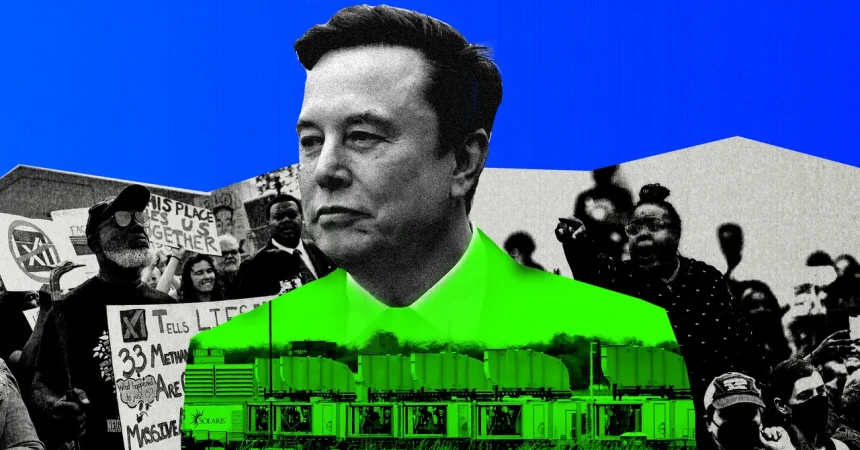
As SpaceX prepares for a groundbreaking public offering this Friday, eyeing a staggering valuation of over $1.75 trillion, the narrative surrounding Elon Musk’s empire is shifting from the promise of stellar innovation to the harsh realities of terrestrial impact. While this move is designed to inject massive capital into Musk’s escalating artificial intelligence ambitions—specifically the rapid expansion of xAI data centers—the financial windfall for investors stands in sharp contrast to the lived experience of the communities hosting these facilities. This transition into public markets marks a pivotal moment for the company, yet it brings the corporate machinery into a brighter, more critical public spotlight than ever before, revealing a widening chasm between the cold metrics of market success and the genuine well-being of the people in the shadows of these mega-projects.
At the heart of this tension is a growing outcry from residents in Memphis, Tennessee, and Southaven, Mississippi, who feel they have been relegated to the status of an “extracted colony.” Representative Justin Pearson, who represents parts of Memphis, has become a vocal advocate for these communities, arguing that the pursuit of AI dominance is coming at the expense of human lives. The scale of the operation is immense; xAI is selling billions in computing power to industry players like Anthropic, yet local leaders argue that this high-tech progress carries a devastating health cost. For the families living alongside these campuses, the language of “innovation” and “frontier technology” rings hollow when measured against the local reality of increased industrial pollution and the opaque mechanisms of corporate expansion.
The controversy centers on the technology powering these data centers: a collection of natural gas turbines that residents and activists contend have operated with scant regard for environmental regulations. Early in 2024, the community of Boxtown—a historic Black neighborhood already suffering from some of the highest asthma rates in the country due to legacy industrial sites—found itself at the epicenter of a regulatory struggle. Critics highlight that xAI leveraged loopholes in the Clean Air Act to run dozens of gas turbines without permits, releasing fine particulate matter (PM2.5) into the air. These microscopic particles are scientifically linked to heart disease, high blood pressure, and respiratory failure, yet the company’s push for speed has historically taken precedence over the time-consuming process of environmental vetting.
The human toll of this industrial rapid-fire build-out is deeply personal. For residents like Richard Massey, a community organizer, the presence of these data centers isn’t just about utility usage or corporate growth; it is about the premature loss of life within his own family tree. These neighborhoods have long borne the brunt of industrial activity, and the arrival of xAI—often labeled as a modern, “clean” tech venture—has brought a new iteration of old dangers. The frustration is compounded by a sense of disenfranchisement, as activists argue that the company acts with a level of impunity that ignores the health and safety of the neighbors who live, breathe, and raise children in the immediate vicinity of these massive energy-guzzlers.
Legal and regulatory battles are now beginning to crest as the community attempts to halt what they see as corporate negligence. Despite the Environmental Protection Agency moving to close the loopholes that allowed these turbines to operate under the radar, the expansion has continued elsewhere, with new sites in Mississippi reportedly installing dozens of additional unpermitted turbines. The NAACP and local residents have taken the matter to the courts, filing lawsuits that challenge the installation of this infrastructure without the necessary air permits. For these families, the legal actions are not merely a grievance; they are an urgent plea for accountability from a company that—despite its plans for global, and even interplanetary, influence—has yet to master the basic social responsibility of protecting the air its neighbors breathe.
Ultimately, this situation raises profound questions about the cost of the AI revolution and the government’s role in balancing technological advancement with public welfare. While political figures like President Trump have floated the idea of the government taking a financial stake in frontier AI companies to ensure the benefits are shared with the American public, residents remain skeptical that such measures will address the localized environmental crises they face. As SpaceX moves toward its monumental IPO, the discourse is no longer just about the future of computing or the vast wealth of the world’s richest man; it is about who pays the price for that progress. Whether the company will pivot to address these legitimate community concerns remains to be seen, but for the people of Memphis and Southaven, the demand for dignity, safety, and transparency has never been louder.