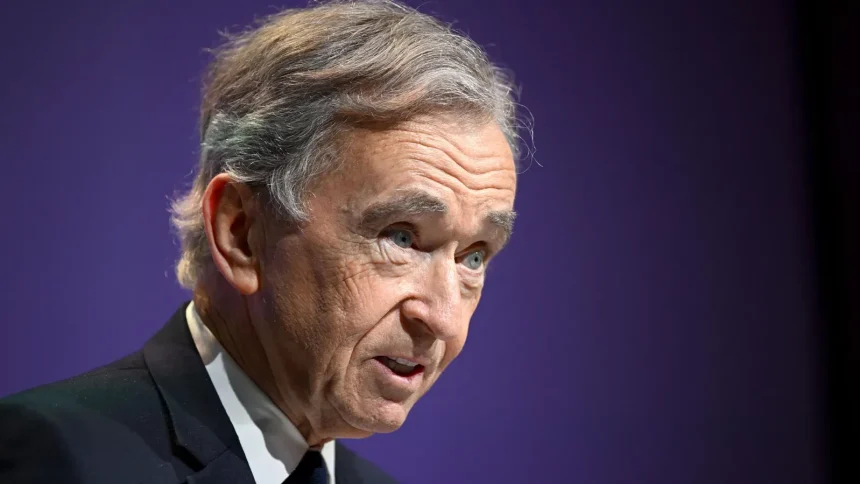
For decades, Bernard Arnault, the architect of the sprawling luxury empire known as LVMH, has operated with a characteristic air of quiet, formidable distance. As the wealthiest individual in France and a titan of industry whose portfolio includes icons like Louis Vuitton, Dior, and Tiffany & Co., Arnault is accustomed to his business moves being analyzed and scrutinized. However, when the venerable French newspaper Le Monde recently wrapped a massive, six-part investigative series—culminating in a bold claim that “poisonous” succession rivalries between his five children were threatening the future of his $142 billion company—Arnault finally broke his silence. In a move that surprised pundits and the public alike, the mogul bypassed traditional PR intermediaries and took to social media to fight back directly, marking his debut on the platform with a sharp, public rebuttal.
The situation is as complicated as the complex corporate structure of LVMH itself. Le Monde devoted six months of deep investigation into Arnault’s influence, touching on everything from his political reach and taxation to the private dynamics of his family life. The newspaper’s narrative centered on a provocative premise: that at age 77, Arnault has created a high-stakes environment where his five children—Delphine, Antoine, Alexandre, Frédéric, and Jean—are effectively competing against one another for his throne. Le Monde suggested this internal rivalry has left shareholders feeling uneasy and created fractious alliances among the heirs. Adding a layer of dramatic irony to the conflict is the fact that the primary shareholder of Le Monde is none other than Xavier Niel, who happens to be the long-term partner of Arnault’s daughter, Delphine.
Arnault’s response, a three-page letter released via LVMH, was nothing if not characteristic of his dry, uncompromising wit. Rather than offering a clinical corporate denial, he chose to lean into the absurdity of the situation. He mocked the newspaper for labeling his family the “last royal family of France” and pointedly thanked them for dedicating such vast, expensive journalistic resources to his life. He dismissed the theories of internal “poisonous” competition as pure fiction, arguing that while his children hold significant leadership roles across his brands, they remain a family rather than a collection of warring factions. He also accused the newspaper of having a double standard, suggesting they write much more favorable coverage for other wealthy dynasties, such as the Chanel-owning Wertheimer family.
Perhaps the most humanizing, albeit stinging, moment in his response was his final sign-off. While the media and market analysts were dissecting the future of his empire with grave seriousness, Arnault curtly ended his rebuttal by noting that, regardless of the controversy, he intended to keep solving the newspaper’s crossword puzzles—noting, with a touch of sarcasm, that the crosswords are the only part of their reporting he finds truly “excellent.” By re-sharing this letter on his social media accounts, he signaled a shift in strategy: he is clearly no longer content to let others define his narrative, even when that narrative appears in the most prestigious papers in his home country.
This public clash comes at a particularly sensitive time for LVMH. The post-pandemic luxury boom has leveled off significantly, and the company is navigating a difficult global landscape. Revenue has dipped, and the stock price has faced a roughly 30% decline this year as consumer spending—particularly in China, once a massive engine for growth—has cooled. The pressure of these macro-economic headwinds, combined with concerns over tourism spending dips due to regional conflicts, creates an environment where investors are hypersensitive to any news regarding leadership stability. The last thing a conglomerate wants in a down-market is a public narrative suggesting that the CEO’s children are in a power struggle.
Ultimately, this episode offers a rare, human look at the man behind the world’s most recognizable luxury brands. It exposes the tension between a private mogul who traditionally avoids the arena and a changing media landscape that treats wealthy dynasties with increasingly tabloid-esque scrutiny. Whether or not Arnault’s decision to engage on social media will quell rumors of a succession battle remains to be seen. For now, the billionaire has proven that while he may be juggling the management of dozens of global brands and a $140 billion+ fortune, he is just as interested in protecting his family’s reputation as he is in protecting his stock price—and he isn’t afraid to use a sharp tongue, or a social media handle, to do it.