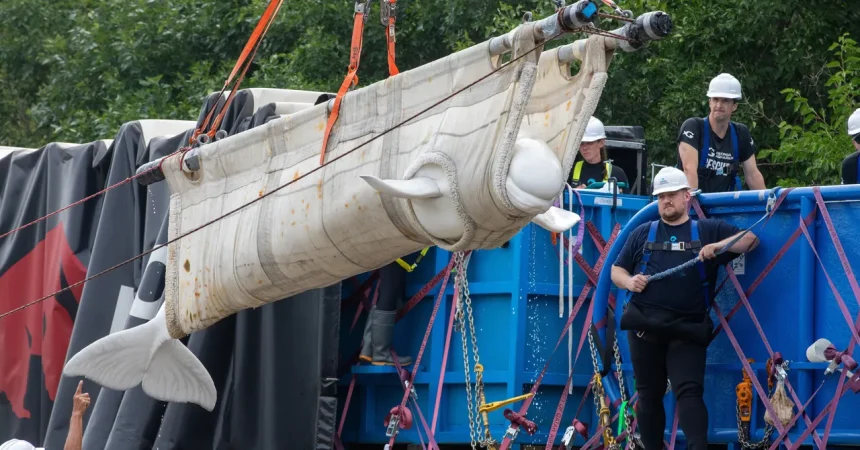
The relocation of four beluga whales—Acadia, Lillooet, Osiris, and Sierra—from the defunct Marineland in Niagara Falls to the Shedd Aquarium in Chicago represents a landmark achievement in marine conservation, characterized less by the immense logistics of the move and more by a profound, almost invisible, level of care. For Karina Tang, the lead veterinarian at the Shedd, the mission’s success was defined by a single, paradoxical objective: that the whales be as oblivious to the journey as possible. Moving thousand-pound marine mammals across international borders is a feat of engineering and biology, but for the team of experts involved, the priority was not efficiency or speed. Instead, it was the psychological comfort of the animals, ensuring that these intelligent creatures perceived their transit not as a frightening displacement, but as a calm, seamless transition from one environment to another.
The backstory of these whales is a sobering reminder of the volatility found in the captive animal trade. Marineland, a facility long plagued by controversy and financial instability, faced a tragic turning point when it declared bankruptcy and announced the potential, gut-wrenching prospect of euthanizing its animals due to a lack of resources to sustain them. This threat ignited an urgent, global coalition of marine biologists and aquarium specialists who realized that the window to save these animals was rapidly closing. The resulting rescue mission was as delicate as it was massive; it required months of rigorous assessment, international cooperation, and an unprecedented level of coordination between facilities in Canada, the United States, and eventually Spain. It was not merely a relocation of cargo, but a race against time to rescue lives that had been caught in the crosshairs of a corporate collapse.
The physical operation itself was a masterpiece of specialized planning. Accompanying the four whales to Chicago, and two others headed for San Antonio, was a dedicated team of trainers and veterinarians who remained in constant, intimate contact with their charges throughout the flight on a chartered Boeing 777. Charlie Jacobsma, the Shedd’s director of animal behavior, described the journey as remarkably smooth, emphasizing that the human touch was the most important variable in the equation. While sensors and pilots monitored the aerodynamics of the aircraft, the human team stood over the whales, keeping their skin hydrated and monitoring their stress levels, providing a constant presence that signaled safety in an otherwise alien environment. The goal was to maintain a sensory lull, ensuring the whales felt the consistent, soothing rhythm of their caretakers rather than the turbulence of the world around them.
This mission was singular in its complexity; while individual belugas have been moved in the past, the sheer scale of this transition demanded a degree of precision never before attempted in the history of marine biology. It was a logistical puzzle that spanned months of preparation, requiring the creation of custom slings and transport environments that could support the weight of these animals while keeping them in a stable, hydrated state. The success of the transport, characterized by a smooth takeoff and a soft landing, was a testament to the months of rigorous training and the deep trust that had been built between the humans and the whales. It serves as a blueprint for future rescue operations, proving that with enough dedication and expertise, even the most daunting international relocations can be executed without inflicting trauma on the animals involved.
Today, if you walk through the Sun-drenched Oceanarium at the Shedd Aquarium, the atmosphere is noticeably different—a quiet, intentional hush that speaks volumes about the level of stewardship currently underway. Signs posted throughout the exhibits ask guests to lower their voices, a subtle reminder that the newest residents of the facility are still in the delicate process of adjusting to their new surroundings. Behind the scenes, the whales are under twenty-four-hour, round-the-clock surveillance by a team of veterinarians and behaviorists. They remain sheltered from public view, not because they are fragile, but because they are being given the time and space to acclimate, explore, and find their rhythm in a habitat that has been meticulously designed for their long-term health and comfort.
This relocation ultimately highlights a shifting philosophy in how we treat animals that reside in human care. By moving these four whales from a neglected, bankrupt environment to a space where their psychological and physical needs are the absolute priority, the teams involved have demonstrated a commitment to ethics that transcends the business of public exhibition. Acadia, Lillooet, Osiris, and Sierra are no longer just representatives of a park or a business; they are survivors of a systemic failure, now resting under the watchful, compassionate eyes of professionals who prioritize the whales’ quality of life above all else. Their journey, from the uncertainty of a closing park to the stability of their new home in Chicago, reflects a broader, necessary evolution in our relationship with the natural world—one where we listen more closely to the needs of the animals we stewards and act with a newfound sense of quiet, gentle responsibility.