For decades, astronomers have been captivated by a profound cosmic paradox: almost every massive galaxy in the universe houses a supermassive black hole at its heart, yet these gravitational titans seem to defy the logic of fuel consumption. Logic suggests that a black hole, while ravenously consuming matter, also unleashes violent energy jets that should blow away the very gas it needs to survive. By heating the surrounding interstellar medium, these jets act like a gale-force wind, pushing the “fuel” toward the cold, distant edges of the galaxy. Scientists have long struggled to understand why these objects don’t eventually starve and fall dormant. Instead, they remain active, growing to sizes millions or even billions of times larger than our sun, suggesting that some invisible mechanism keeps their kitchen fully stocked despite their own destructive tantrums.
The mystery appears to have been solved by a process that feels remarkably like an ecological cycle on Earth: cosmic recycling. Researchers have long hypothesized that the vast clouds of gas blown away by a black hole’s jets do not simply vanish into the void. Eventually, in the cold, thin reaches of space, this gas cools and condenses into fragile, thread-like structures known as filaments. Driven by gravity, these filaments eventually lose their equilibrium and drift back toward the galactic center. This hypothesis suggested that the black hole’s death-dealing energy is actually part of a self-sustaining loop. By pushing gas out, it creates the very clouds that will eventually return as nourishment, ensuring the black hole maintains its central role in the life of the galaxy.
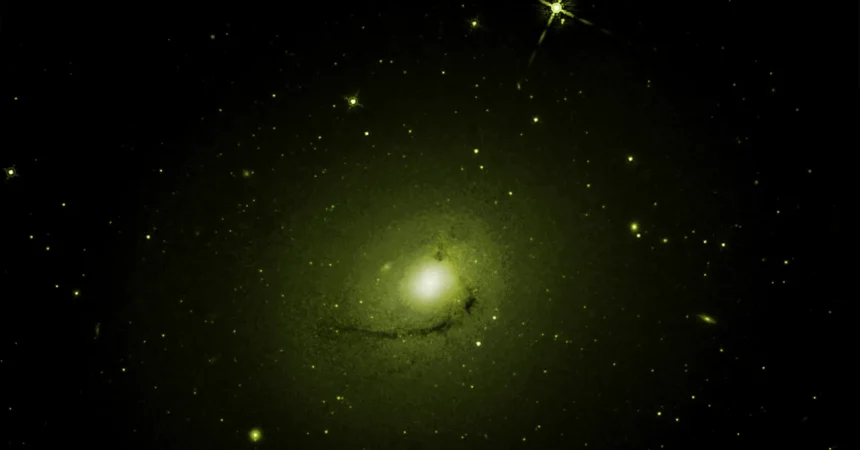
A landmark study led by Professor Julie Hlavacek-Larrondo of the University of Montreal has finally moved this theory from the realm of mathematical speculation to observable fact. Using the James Webb Space Telescope (JWST), the team turned their lens toward NGC 4696, a galaxy located 145 million light-years away within the Centaurus Cluster. The precision required for this task was mind-boggling; the telescope’s Near-Infrared Spectrograph (NIRSpec) allowed the team to distinguish structures as small as 30 light-years across. To grasp the enormity of this technological achievement, imagine sitting on a soccer field and spotting a single marble from 50 kilometers away. With this unprecedented clarity, the team was able to map the complex movements of gas in the absolute heart of the galaxy.
What the team discovered was a stunning celestial dance. The “S-shaped” spiral structure previously spotted by the Hubble Space Telescope was revealed to be a massive, rotating disk of gas, spanning some 800 light-years in diameter. Triggered by the black hole’s immense gravity, this gas whirls at blinding speeds, with a velocity difference of 600 kilometers per second between the edges of the disk. Most importantly, the JWST captured the movement of gas filaments flowing directly into the edge of this disk. For the first time, humanity has visual proof of the supply chain: the hot, energetic output of the black hole cools, drifts back as delicate strands, and is funneled into the disk to be consumed, completing an elegant, terrifyingly efficient cycle.
Reflecting on these findings, Professor Hlavacek-Larrondo noted that black holes might well be the universe’s ultimate recyclers. This self-sustaining system explains far more than just how a black hole stays “fed”—it explains how galaxies themselves evolve. By pumping energy outward and then re-absorbing cooled matter, the black hole acts like a cosmic thermostat. This balance dictates which parts of a galaxy are warm enough to prevent star formation and which parts are cool enough to allow new stars to be born. It is a fragile, intricate feedback loop that ultimately controls the growth, shape, and destiny of the entire galactic host. We are witnessing the heartbeat of the cosmos, a rhythm of consumption and replenishment that has been playing out for billions of years.
To validate their observations, the team supported their work with complex computer simulations that explain how this gas overcomes the physical forces that might otherwise disperse it. They discovered that as the filamentary gas approaches the black hole, magnetic fields within the galaxy act like physical ropes. These fields exert a force known as torque, which strips the gas of its angular momentum, effectively “braking” it and allowing it to fall into the feeding disk rather than flying off into space. It is a masterful display of physics, where the raw, chaotic energy of a black hole is harnessed and disciplined by magnetic geometry. As we continue to study these gravitational giants, we move closer to understanding how such destructive forces can act as the architects of the orderly, star-filled galaxies we inhabit today.