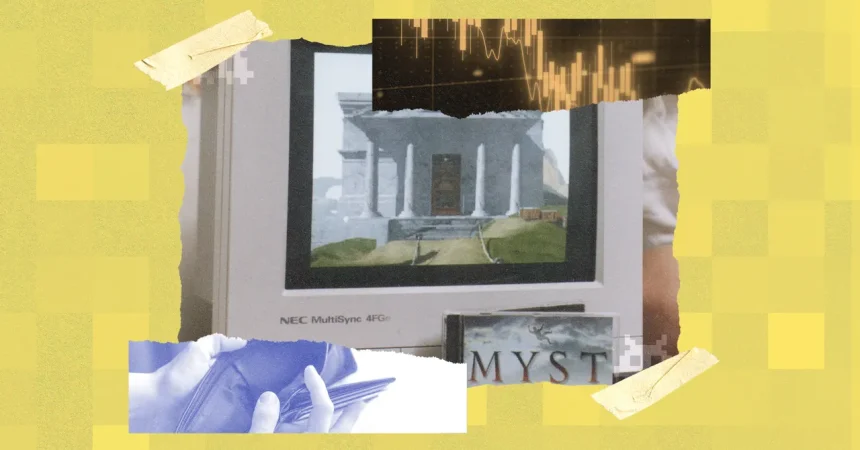
The story of Myst is one of the most storied chapters in gaming history. Back in the 1990s, this surreal puzzle-adventure didn’t just sell six million copies; it fundamentally changed how we interacted with computers, essentially forcing the average consumer to go out and buy a CD-ROM drive just to experience its wonder. For over a decade, it sat on the throne as the best-selling PC game of all time, a beacon of what was possible in interactive storytelling. Now, decades later, the creators at Cyan Worlds are looking to return to that legacy. They recently teased a new project codenamed Anglerfish, a darker, more psychological take on the Myst universe where players find themselves held hostage by an unstable, volatile writer. With a powerhouse performance by Noshir Dalal—whose credits include Red Dead Redemption 2 and Ghost of Yōtei—the trailer sent waves of excitement through the community. The fans were ready, the vision was clear, and the pedigree was undeniable.
Yet, there is a haunting irony behind this reveal: Anglerfish is a project that essentially died before it was ever truly born. Despite being the oldest surviving independent game studio in America, Cyan Worlds found itself unable to secure the necessary backing to bring this vision to life. After spending months pouring their souls into a fully playable, high-quality demo, the team spent last year’s major industry conferences—the Game Developers Conference and the D.I.C.E. Summit—knocking on doors, pitching their hearts out to over a dozen publishers. They weren’t asking for the world; they were seeking a modest budget between $1 million and $10 million to complete the game. Despite receiving genuine, glowing praise for the demo, they walked away with nothing but empty promises. The financial reality of the modern industry was so unforgiving that, shortly after, Cyan was forced to lay off half of their staff.
The frustration felt by the team at Cyan is echoed by industry veterans like John Eternal, a former lead at PlayStation who helped steer these pitches. He points to a harsh reality: the “double-A” sector—the middle ground of the gaming market—has all but evaporated. Only a few years ago, a project from a legendary studio like Cyan would have been a “no-brainer” for a publisher. Today, however, that middle-market space is a graveyard for ambition. The industry has become aggressively polarized, creating a landscape that resembles the decline of mid-budget cinema or mid-list literature. It is a world where only the massive, multi-hundred-million-dollar behemoths or the shoestring-budget passion projects seem to survive.
Looking at the current ecosystem, the divide is stark. At the top of the food chain sit the “triple-A” giants—studios like Rockstar or Naughty Dog—who regularly burn through budgets exceeding $200 million for a single title. They operate on a scale that minimizes risk through sheer volume and marketing muscle, but at a cost that makes their projects fragile, high-stakes gambles. On the other end of the spectrum, we have the “micro-indie” developers. These are the scrappy, solo creators who rely on personal savings, day jobs, or niche side-hustles to fund their dreams. A perfect example is the creator of the indie hit Blue Prince, who only approached publishers once the game was finished, having funded the entire process himself through ad revenue from a card-game website. For them, the dream is attainable, but only because they have bypassed the traditional financial system entirely.
The tragedy is that the “middle-market”—the space where games cost anywhere from $2 million to $15 million—was once the engine room of creativity. Publishers like EA Originals or Adult Swim Games used to nurture these titles, providing the bridge between experimental indie art and massive commercial blockbusters. But that support has systematically dried up. As major platforms like Xbox and PlayStation shifted their strategies and publishers pivoted toward either hyper-cheap experiments or “safe” mega-hits, the mid-tier projects were left in the cold. It has become a brutal environment where even a studio with the prestige of Cyan Worlds cannot find a patron willing to take a chance on a medium-sized budget.
Ultimately, the plight of Anglerfish serves as a sobering cautionary tale for the future of artistic expression in gaming. When the financial structures of an industry favor only the absolute biggest and the absolute smallest, we lose the “middle ground”—the very place where innovation, personality, and sustained excellence often reside. By starving studios of the resources needed to create mid-sized, high-quality experiences, the industry risks creating a sterile environment where only two extremes exist. Cyan Worlds remains a testament to resilience, but their struggle highlights a systemic failure. Until the pendulum swings back toward supporting mid-budget creativity, we may see more brilliant ideas like Anglerfish relegated to the “what if” pile, leaving players to wonder what kind of magic could have been, had the business side of the industry simply been willing to fund it.