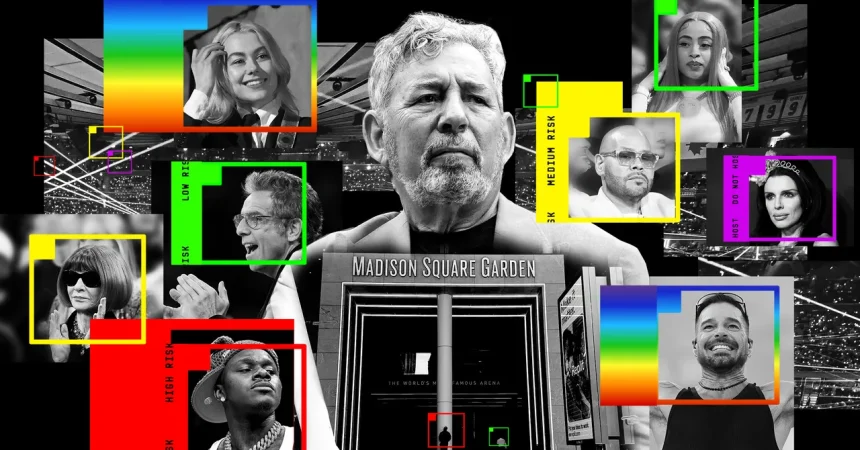
The world of New York Knicks super-fandom is often a complicated dance between unbridled passion and the boardroom realities of Madison Square Garden. Among the most vocal proponents of the franchise is the legendary rapper Fat Joe, who has consistently used his platform to champion the team and, perhaps more controversially, its owner, Jim Dolan. During the Knicks’ recent pivotal run, Fat Joe was seen celebrating alongside Dolan, brushing off the public vilification of the executive by comparing him to a “Bruce Wayne” figure in a Gotham City-style sports landscape. To the public, it appears to be a harmonious relationship built on mutual respect and a shared love for the game, as Joe has gone on record calling Dolan the “greatest team owner in the game.”
However, beneath the surface of this public camaraderie lies an internal corporate reality that reads more like a surveillance thriller than a sports partnership. Leaked documents originating from a hack by the group ShinyHunters have revealed that Madison Square Garden maintains an extensive internal database tracking thousands of high-profile individuals—including athletes, celebrities, and business leaders. While many of the nearly 40,000 people logged in this “talent” system are simply listed as contacts, a select group of about 400 figures—including loyal Knicks superfans like Edie Falco, Tracy Morgan, and even Fat Joe himself—have been assigned a specific “risk score.” This revelation has cast a new light on the behind-the-scenes policies governing who is allowed in the building and how they are monitored.
The inclusion of loyal, long-time Knicks supporters in a risk-assessment registry raises immediate questions about the criteria Garden security uses to evaluate its VIPS. While the database does not explicitly detail the exact infractions for every entry, reports indicate that MSG security monitors social media with an intensity that often borders on the obsessive. It is no secret that Dolan’s organization has a history of keeping tabs on those who voice public criticism of the franchise or its management. In extreme cases, this culture of monitoring has involved security personnel going so far as to enlist local law enforcement to confront even minor critics, such as a teenager in Colorado who felt the brunt of the state’s intimidation tactics over a single social media post.
Insiders familiar with the Garden’s security operations suggest that these risk classifications are often triggered by “SM concerns”—the shorthand for social media concerns. Even if a celebrity or a high-profile guest happens to be a recurring face at courtside, they are not exempt from the net cast by security if they have ever expressed dissatisfaction on public platforms. According to sources with knowledge of the matter, the threshold for being tagged as a “risk” is remarkably low. A post complaining about long wait times at a security gate, or a stray, frustrated comment about the team’s performance, is enough to capture the attention of the organization’s monitoring apparatus, potentially resulting in a label that stays with them in the private files of the team’s management.
The specific case of Fat Joe—one of Dolan’s most vocal protectors—highlights the cold, algorithmic nature of these internal assessments. Despite his public loyalty, Joe is officially listed in the system as “medium risk.” The irony is palpable: while the rapper is busy defending Dolan in interviews, the internal database suggests his proximity to other prominent figures has led to his own classification. Specifically, sources indicate his risk score is tied to his association with fellow hip-hop legend Jadakiss, a member of the group The Lox. Jadakiss has been openly critical of Dolan’s ownership in the past, and that association appears to have trickled down into the data-driven social mapping maintained by MSG security.
Ultimately, these revelations offer a sobering look at how elite sports organizations treat those who populate their most exclusive sections. Rather than viewing superfans as assets to be cultivated, the structure at Madison Square Garden suggests a regime of caution where loyalty is not always a shield against scrutiny. While other organizations may manage guest lists, the depth of this surveillance—trapping the very celebrities who provide the “cool factor” for the arena—reveals a management philosophy built on paranoia. For a city that treats the Knicks as a religion, the fact that one of their most devout apostles is being tracked as a “medium risk” proves that, within the halls of the Garden, no one is truly outside the reach of the owner’s digital gaze.