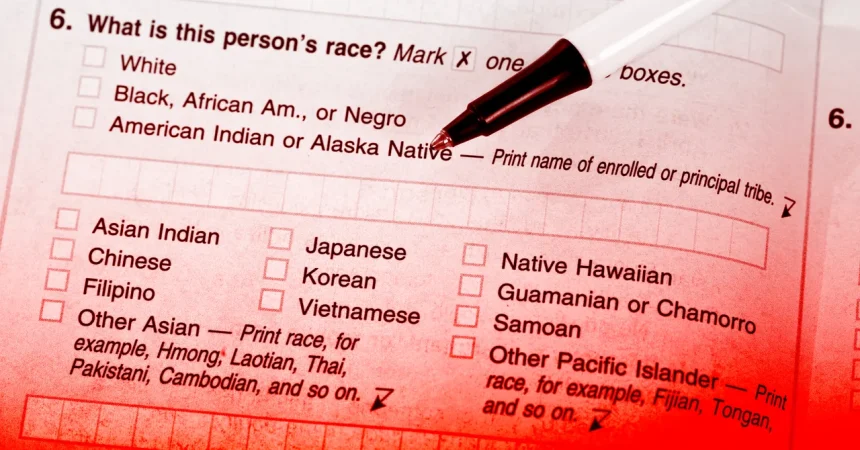
The U.S. Census is often viewed as a dry, bureaucratic chore, but it is actually the bedrock of our democratic representation and economic health. New documents obtained by WIRED reveal that the Department of Commerce is circulating a proposed rule for the 2030 census that would fundamentally reshape how the government views its citizens. The proposal seeks to strip away questions regarding race and sexual orientation, while simultaneously excluding undocumented immigrants from the final apportionment count. By framing these changes as a move to reduce “distortions,” the administration is effectively proposing to make a massive portion of the American population invisible in the eyes of the federal government, a change that would carry profound consequences for decades to come.
The logic behind these changes rests on a narrow and controversial interpretation of who constitutes a “true inhabitant” of the United States. The memo argues that individuals without legal status should not be counted as part of the body politic, signaling a desire to reintroduce a citizenship question—an effort that famously failed during the first Trump administration when the Supreme Court struck it down as “contrived.” By attempting to revive this debate, the current proposal isn’t just seeking a headcount; it is attempting to redefine the criteria for belonging. This move suggests that the administration is less interested in an accurate portrait of the nation and more interested in narrowing the scope of who receives the government’s acknowledgment and, by extension, its protection.
The potential impact of these changes on civil rights is where the gravity of the situation truly hits home. Experts like Cornell University’s Danah Boyd have pointed out that data collection is the primary tool used to enforce the Voting Rights Act and identify systemic inequality. If the government stops counting race or ethnicity, it becomes impossible to prove that a congressional district is being gerrymandered to suppress minority voices or to demonstrate that specific communities are being denied equal resources. In this light, the decision to stop asking these questions is not about “protection” or “privacy”; it is about removing the evidence required to challenge political disenfranchisement. When you delete the data, you delete the ability to speak truth to power.
Beyond the political implications, there is a very human cost to the federal budget. Census data acts as a map for where billions of dollars in federal funding flow, from building schools and roads to funding healthcare programs. An anonymous official at the Department of Health and Human Services warned that removing undocumented individuals from the count will inevitably lead to a massive drop in funding for the very localities that need it most. Furthermore, the removal of racial categories threatens to devastate Native American communities, many of which rely on census-based classifications to secure specific federal grants and support. When we strip these categories away, we are not just removing labels; we are removing the mechanisms that ensure marginalized groups receive their fair share of public resources.
The campaign against existing census methods has been a long time coming, often disguised as a concern for accuracy. For years, political figures have targeted “differential privacy”—a statistical method designed to protect the privacy of individual respondents—arguing that it creates inaccuracy. However, recent legislative efforts like the COUNT Act suggest that the goal is not to improve accuracy, but to curate a population count that aligns with a specific political vision. By framing the census as a tool exclusively for “lawful inhabitants,” some lawmakers are attempting to rewrite the social contract, moving away from the idea of the census as a count of all people residing in the U.S. and toward a count of a selected, privileged few.
Ultimately, the 2030 census stands at a critical juncture between being a transparent mirror of our diversity or a manipulated filter that hides our realities. Census questions are finalized years in advance, meaning the window to influence this outcome is rapidly closing. If these proposals move forward, the resulting data will be incomplete, creating a distorted reality that ignores the existence of millions of people who live, work, and contribute to our country every day. The choice is whether we want a census that captures the full, complex, and beautiful reality of the American experience, or one that is curated to keep the powerful in control by keeping the vulnerable in the dark.