If you have ever handed your phone to a toddler to buy yourself ten quiet minutes, you know the strange, unsettling feeling that follows. The screen fills with bright colors, frantic music, and characters that look almost familiar but not quite right. Maybe it’s a cartoon dinosaur singing about potty training, or a fake Spider-Man doing something vaguely dangerous, or a nursery rhyme remix that cuts every two seconds. This is the world of YouTube’s AI slop problem, a chaotic flood of algorithmically generated videos aimed at young children. These videos are often bizarre, hyperstimulating, and sometimes completely inappropriate, yet they sit side by side with genuine educational content, making it nearly impossible for parents to tell the difference. They autoplay in endless, algorithmically curated streams, interrupted by ads for things a three-year-old should never see. You try to intervene, but the algorithm is always one step ahead, feeding more of the same. It feels less like entertainment and more like a machine designed to capture your child’s attention and never let go. That is because, in many ways, it is. The incentives behind these platforms are built around watch time, engagement, and ad revenue, not the well-being of the child staring at the screen. Parents are left feeling guilty, exhausted, and unsure of what to do. Into this mess steps Maka, a new streaming app designed specifically for children aged zero to six, and it is making a bold promise: to be the antidote to the engagement machine.
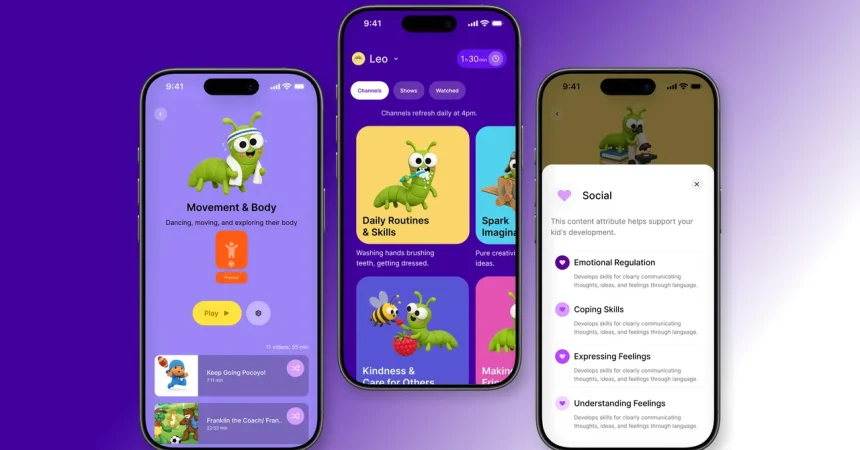
Maka is not just another streaming service with a kids’ tab bolted on. It is a platform built from the ground up with a radically different philosophy. There are zero ads. There is no autoplay, no endless scrolling, no algorithmic rabbit holes. The recommendation system is intentionally designed not to maximize watch time. Instead, it encourages stopping, choosing, and moving on. The company’s cofounder and chief product officer, Tanyella Leta, tells WIRED that the platform is purposely abandoning the mechanisms that “turn children’s media into an engagement machine.” Her cofounder and CEO, Isabel Sheinman, is even more direct about the failure of existing streamers. She says that most platforms were built to serve adults, not children, and that kids were “really the afterthought.” Sheinman wants to set a much higher bar for what quality looks like in children’s media, a bar she believes has been warped by harmful incentives. “Maka was built with child development science and children’s behavior first and foremost,” she says. Launching today, Maka’s programming slate is a mix of licensed content from global studios and independent creators. The curated catalog includes 25 shows, among them Franklin, The Wiggles, Pocoyo, Vida the Vet, and Sesame Street. It runs on a subscription model, with a $15 monthly plan and a $107 annual plan. For parents who have grown used to free but chaotic platforms, the price may feel like a commitment, but the promise is a completely different experience: one where every single episode has been vetted by people who actually understand how young minds develop, and where the goal is not to keep a child glued to the screen, but to give them something meaningful to watch, and then let them go.
The origin of Maka goes back to the Covid pandemic, when Sheinman and Leta became obsessed with the question of how to redesign kids’ media from scratch. They were not just thinking about what shows to make or which characters to license. They were thinking about the very structure of the experience: how episodes are paced, how stories are told, how a child feels before, during, and after watching. The solution they landed on is called Imprint, a framework created with researchers at the Yale Child Study Center. Every episode streamed on Maka is evaluated by child development experts using this framework. The evaluation process examines everything from scene cuts to how fast-paced the content is, and it maps young children’s development across seven core domains. It looks for things like emotional regulation, kindness, how child-caregiver relationships are modeled in a story, and whether a story might support critical thinking or language development. This is not a simple checklist. It is a deep, thoughtful analysis of what happens in a child’s brain when they watch a show. Does this episode teach a child how to name their feelings? Does it show characters resolving conflict in a healthy way? Does it move too quickly for a two-year-old to follow? Does it leave room for questions and curiosity? These are the kinds of questions that Imprint tries to answer. The result is a library of content that has been intentionally chosen and shaped to support healthy development, rather than simply to entertain. It is a far cry from the YouTube model, where a video with the word “educational” in the title might be nothing more than flashing shapes and loud noises. Maka’s founders believe that parents deserve better, and more importantly, that children deserve better. They are betting that if you give kids media that respects their intelligence and their developmental needs, they will not need the constant dopamine hits of hyperstimulating content. They will be engaged, yes, but also calm, curious, and ready to move on to the next thing in their lives.
The rise of AI-generated content has only made the problem more urgent. In recent years, YouTube has become flooded with videos that are incoherent, have no plot, or contain outright misinformation, but are packaged to look like learning. Some of it, as WIRED has previously reported, is disturbingly sexualized, featuring gore and other fetishes. This is not just a matter of low-quality entertainment. It is a genuine safety issue for children. Parents cannot be expected to watch every single second of every single video, and even when they do, it can be hard to tell what is real and what is AI-generated slop. A video might feature beloved characters like Peppa Pig or Elsa, but they are not the real characters. They are distorted, uncanny versions created by algorithms, often with no regard for narrative coherence or child safety. The algorithm does not care if a video makes sense. It only cares if it keeps a child watching. And because these videos are often designed to be as stimulating as possible, they are incredibly effective at holding a child’s attention, even as they fail to provide any real value. Michael Robb, director of research at the media literacy nonprofit Common Sense Media, says that on a platform like YouTube, slop videos that have the veneer of education sit side by side with carefully designed educational shows. He argues that YouTube and other kids’ streaming platforms have not done enough to distinguish educational content from slop, which has only made filtering content harder for parents. “Platforms have taken steps to reduce kids’ exposure to age-inappropriate content, and that matters. But ‘not inappropriate’ is a very low bar. There’s a big gulf between that and media created intentionally with kids in mind.” That gulf is exactly where Maka is trying to position itself. It is not enough for a show to be free of obvious harm. It should actually be good for children. It should be thoughtful, kind, and developmentally appropriate. It should not treat a child as a passive consumer, but as a growing human being who deserves respect.
The research backs up the concern. A 2020 study by Common Sense Media on YouTube videos watched by young kids found that 75 percent of the videos had “weak or no educational value.” That is a staggering number. Three out of every four videos that young children watch on YouTube are essentially empty calories for the brain. They might be colorful and entertaining, but they are not teaching anything meaningful. The study also found that kids frequently ended up watching ads and content intended for older audiences, despite YouTube’s supposed safeguards. This is the reality that parents are navigating every day. You sit your child down with a tablet, hoping they will watch something that helps them learn their letters or understand their emotions, and instead they end up watching a bizarre AI-generated video about a giant egg that is secretly a monster, followed by an ad for a violent video game. It is exhausting. It is frustrating. And it is deeply unfair to both parents and children. The phrase “not inappropriate” is a very low bar, as Robb points out. It is the difference between a meal that is technically edible and a meal that is nutritious and delicious. Maka is trying to be the latter. By evaluating every episode through the Imprint framework, the platform is attempting to ensure that the content it offers is not just safe, but genuinely valuable. It is a higher standard, and it is one that the children’s media industry as a whole has been slow to adopt. But Maka’s founders believe that parents are ready for it. They are tired of being treated like helpless bystanders in an algorithm-driven attention economy. They want a platform they can trust, one that aligns with their values and their children’s needs.
Of course, Maka is not a perfect solution to every problem. It is a subscription service, which means it is not accessible to every family. Its catalog is small, with only 25 shows, compared to the endless library of YouTube. And it cannot undo the broader cultural shift toward screen-based entertainment. But what Maka represents is something important: a refusal to accept the status quo. It is a statement that children’s media can be better, that it should be better, and that the people who make it have a responsibility to the children who watch it. The founders are not just building a business. They are trying to change the conversation. They want to show that it is possible to create a streaming platform that respects children’s developmental needs, supports parents, and still offers content that kids actually enjoy. The fact that they have partnered with the Yale Child Study Center and built a rigorous evaluation framework is a sign that they are serious about this mission. It is not just marketing. It is a genuine attempt to put child development science at the center of the product. In a world where children’s media has been warped by harmful incentives, that is a radical idea. It is also a hopeful one. It suggests that we do not have to accept the engagement machine as inevitable. We can choose something different. We can choose media that is calm, intentional, and kind. We can choose media that sees children as people, not as data points. Maka is a small step in that direction, but it is an important one. For parents who have spent years feeling guilty about screen time, it offers a glimmer of relief. Maybe there is a better way. Maybe we can give our children the benefits of technology without the harms. Maybe we can finally stop worrying about what the algorithm is doing to their developing minds. Maka is betting that we can, and that is a bet worth paying attention to.