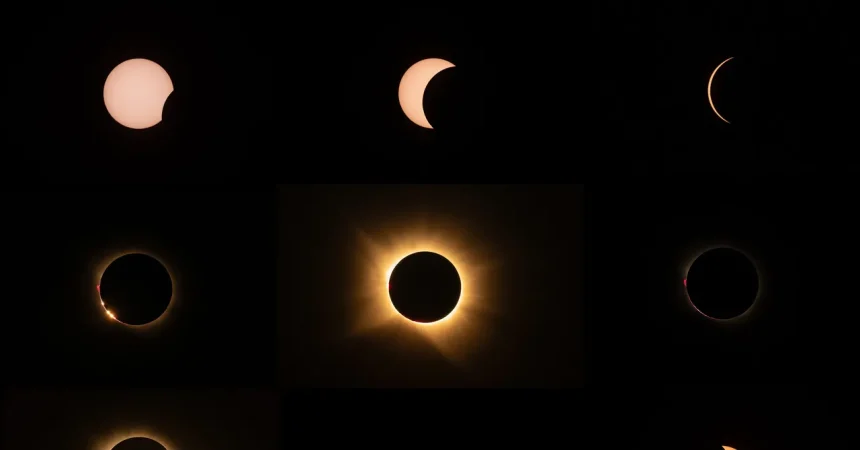
Paragraph 1: The Dawn of a Celestial Triple Feature
The recent total solar eclipse that swept across our skies on August 12th was a breathtaking spectacle, igniting a firestorm of stunning photographs and collective gasps that echoed across social media. For those who stood in the path of totality, it was a transcendent experience—the air growing cool, the birds falling silent, and the sun’s corona blazing like a crown of liquid pearl in the darkened sky. Yet, as awe-inspiring as that day was, it was merely the opening act of what astronomers are already calling a “mini golden age” for eclipse enthusiasts across Europe. Specifically, the Iberian Peninsula—that sun-bathed corner of Spain and Portugal—is about to become the epicenter of the most remarkable celestial trio of the 21st century. We are living through an extraordinarily rare (and remarkably compressed) planetary alignment that grants us two more chances to witness the sky’s most dramatic performance. It is a gift of cosmic geometry, and those who miss it will regret it for decades. The first act is done; the second and third are still to come, and both promise to outshine the one we just witnessed, offering viewers a diverse range of astronomical phenomena that will etch themselves into personal memory and collective history.
Paragraph 2: The 2027 Total Eclipse—A Record-Setting Marvel
The second act arrives on August 2, 2027, and it is already being dubbed “the eclipse of the century.” This grandiose title is not hype; it is grounded in a single, astonishing fact: the total phase of the eclipse—when the moon completely cloaks the sun and day turns to twilight—will last a stunning 6 minutes and 23 seconds at its maximum point. To put that into perspective, the recent August 12th eclipse offered a totality of approximately 2 minutes and 18 seconds, which already felt like an eternity to those who experienced it. The 2027 event triples that window of darkness, giving sky watchers nearly a full quarter of an hour of pure, eerie, breathtaking night in the middle of the day. The path of this monumental shadow begins in the southern tip of Spain, then races across the Mediterranean into North Africa, sweeping over Morocco, Algeria, Tunisia, and Libya before plunging deep into Egypt. It then continues its eastern journey across Saudi Arabia, Yemen, and Somalia. Spain will be the only European country to experience totality, but the true jewel of this eclipse lies in Egypt. There, the moon’s shadow will fall directly over the ancient city of Thebes, home to the colossal temples of Karnak and Luxor, and the fabled Valley of the Kings. Imagine standing among 3,000-year-old obelisks and crumbling pharaonic statues as darkness descends—a moment where human antiquity and cosmic eternity collide in the most poetic way possible.
Paragraph 3: Spain and Egypt—Two Faces of the 2027 Totality
For European travelers, the 2027 eclipse offers a tantalizing choice. On one hand, southern Spain provides an utterly accessible, modern thrill: hop on a flight to Seville, Cádiz, or Málaga, and you can chase totality with the comfort of tapas bars, reliable weather forecasts, and excellent infrastructure. The Spanish leg of the path is perfect for those who want to combine a bucket-list astronomical event with a Mediterranean holiday. However, for the truly devoted eclipse chasers, Egypt is the promised land. The maximum duration of 6 minutes and 23 seconds will occur deep in the Egyptian desert, likely near the modern city of Luxor. The irony of fate is stark: the majestic Pyramids of Giza, just outside Cairo, lie just a few kilometers outside the path of totality, meaning visitors to those iconic structures will only see a dramatic partial eclipse, not the full darkness. But nature is a clever director. It chose to place the longest totality of the 21st century directly over the ruins of an ancient civilization that once worshipped the sun god Ra. As the moon swallows the sun, the shadows over the Nile will deepen, and for six-plus magical minutes, the ghosts of pharaohs will feel closer than ever. This eclipse promises not just a visual wonder, but a spiritual pilgrimage—a stark reminder that our awe of the heavens connects us directly to the peoples who built temples to honor these very cosmic cycles thousands of years ago.
Paragraph 4: The 2028 “Ring of Fire”—A Different Kind of Magic
If the 2027 eclipse is about dramatic darkness, the grand finale of the Iberian trio, occurring on January 26, 2028, is about exquisite beauty—a completely different phenomenon known as an annular eclipse. During an annular eclipse, the moon is slightly farther away from Earth in its elliptical orbit, so its apparent size is too small to completely cover the sun. Instead of totality, viewers are treated to a breathtaking “ring of fire”—a brilliant, blazing halo of sunlight that surrounds the charcoal silhouette of the moon. This solar corona by proxy creates a surreal, jewel-like appearance in the sky, as if the sun has been transformed into a glowing cosmic donut. The path of annularity cuts a stunning swath across South America first, grazing Ecuador, Peru, and Brazil, where the maximum duration of 10 minutes and 27 seconds will be visible—one of the longest annular eclipses of the entire century. But the story for European viewers is the dramatic conclusion. The moon’s shadow will cross the Atlantic Ocean and make landfall on the Iberian Peninsula. There, in cities like Seville, Córdoba, Albacete, and Valencia, the ring of fire will be visible at a magical time: very close to sunset. Imagine witnessing this celestial masterwork low on the western horizon, its light diffused into a golden, hazy glow as it descends into the Atlantic. The ring will last around seven minutes in Spain, but those seven minutes will offer a once-in-a-lifetime opportunity for