In the sweltering summer of 1956, deep within the industrial confines of the Savannah River Plant in South Carolina, an enormous and strange contraption hummed ominously. It was a custom-built, ten-ton detector, its steel flanks wrapped in thick walls of lead and layers of water-logged sandbags, strategically positioned mere meters from a powerful nuclear reactor. The physicists behind this bizarre machine, Clyde Cowan and Frederick Reines, had given their ambitious project a deceptively playful name: Project Poltergeist. They were, quite literally, hunting a ghost. The perplexing mystery that drove them to this subterranean laboratory began decades earlier, when physicists were puzzled by a glaring discrepancy in the field of radioactive decay. During a fundamental process known as beta decay, where an unstable neutron transforms into a proton and an electron, energy appeared to vanish into thin air, violating the sacred law of conservation of energy. Something was fleeing the reaction, carrying away its precious momentum, and no known physical principle could account for the loss. Then, in 1930, the brilliant but often tormented Austrian physicist Wolfgang Pauli made a radical, almost desperate proposal. He suggested that an invisible, virtually undetectable particle was silently carrying away the missing energy. “I have done a terrible thing,” Pauli confessed to a friend, “I have postulated a particle that cannot be detected.” This hypothetical particle, soon to be christened the neutrino meaning ‘little neutral one,’ was believed to possess almost no mass and absolutely no electric charge. Its properties were so ethereal that it could pass through solid iron, through the entire Earth, through the molten core of our Sun, and through our own fragile bodies, trillions of times per second, without ever so much as bumping into a single atom. It was the ultimate cosmic ghost, a phantom that seemingly mocked the very notion of empirical science. The sheer scale of the undertaking was a testament to how far scientists were willing to go to appease a theoretical anomaly that had haunted them for years.
The audacity of Cowan and Reines’ experiment lay in their clever exploitation of the reactor’s overwhelming neutrino output. Even with billions of these particles streaming through their detector every second, the odds of a single meaningful collision were astronomically small. To tilt the odds in their favor, they devised a brilliant trick by utilizing the very physics of the ghost itself. They filled their tank with a special solution containing cadmium. When a neutrino did manage to strike a proton, it initiated a reaction known as inverse beta decay, which converted the proton into a neutron and simultaneously emitted a positron, the antimatter counterpart of an electron. This positron would immediately annihilate with a nearby electron, producing a distinct, intense flash of gamma rays. Moments later, the neutron, drifting lazily through the liquid, would be captured by a cadmium nucleus, releasing a slightly delayed, second burst of gamma rays. This unmistakable signature—a rapid flash followed by a slower, finer one—was the neutrinos unique “calling card,” a pattern that could be surgically separated from the relentless background noise of cosmic rays and ambient reactor radiation. For months, the detector sat in the oppressive heat, ticking away in its lead-lined tomb, while the two physicists waited with bated breath, watching their oscilloscopes for a pattern that seemed impossibly rare. They toiled through sleepless nights, adjusting dials and analyzing data. Finally, in June of 1956, the evidence became overwhelming. They had captured their ghost. The pair dashed off a triumphant telegram to Wolfgang Pauli, informing him of their success. When Pauli read the message, he was reportedly enjoying a glass of champagne with his colleagues, and the news moved him to tears of joy. The particle he had assumed would remain forever hypothetical had been dragged into reality, a testament to human ingenuity and the profound power of science to confront the invisible. The reaction was a beautiful demonstration of leveraging statistical probability against the vast emptiness of subatomic space, and the era of neutrino physics had truly begun.
With the definitive detection of reactor neutrinos, a tantalizing and audacious new question emerged: if nuclear reactions within the Sun produced these particles, could we dispatch them as cosmic messengers to peer into the fiery heart of a star? This presented an engineering and logistical nightmare of staggering proportions. The same properties that made neutrinos so elusive meant that a single particle speeding from the Sun had a near-zero probability of interacting with matter on Earth. To have even a fighting chance of catching a handful, physicists realized they needed a colossal volume of target material—and they needed to install it in the most quiet, isolated spot on the planet, shielded from the relentless hail of cosmic rays that could easily mimic a neutrino signal. In the 1960s, the visionary scientist Raymond Davis Jr. of Brookhaven National Laboratory accepted this monumental challenge. He descended into the ghostly, silent darkness of the Homestake gold mine in South Dakota, a kilometer and a half beneath the Earth’s crust. There, within that claustrophobic chamber, he installed a massive tank and filled it with nearly 400,000 liters of perchloroethylene, an otherwise mundane dry-cleaning fluid used by the ton in the textile industry. The logic behind his choice was elegantly simple. On the exceedingly rare occasion that a solar neutrino struck a chlorine nucleus within that fluid, it would transmute the chlorine into a radioactive isotope of argon. By systematically flushing the tank, extracting these incredibly sparse argon atoms, and counting them one by one in a gas proportional counter, Davis could meticulously tally how many neutrinos were arriving from the Sun. He spent days at a time in that cold silence, sleeping in a small alcove next to the tank, a hermit in the service of physics. For over two decades, from 1967 until the experiment finally wound down in 1994, he ran this extraordinary operation, enduring persistent leaks, background radioactivity contamination, and the sheer physical exhaustion of working in such extreme isolation. When the data finally reached statistical significance, the result was stunning—and deeply confounding. Davis had detected only one-third of the neutrinos predicted by the standard solar model. The Sun seemed to be a wimp, producing far fewer neutrinos than theory demanded. This glaring discrepancy, dubbed the ‘Solar Neutrino Problem,’ ignited a fiery, decades-long debate that threatened the very foundations of both astrophysics and particle physics.
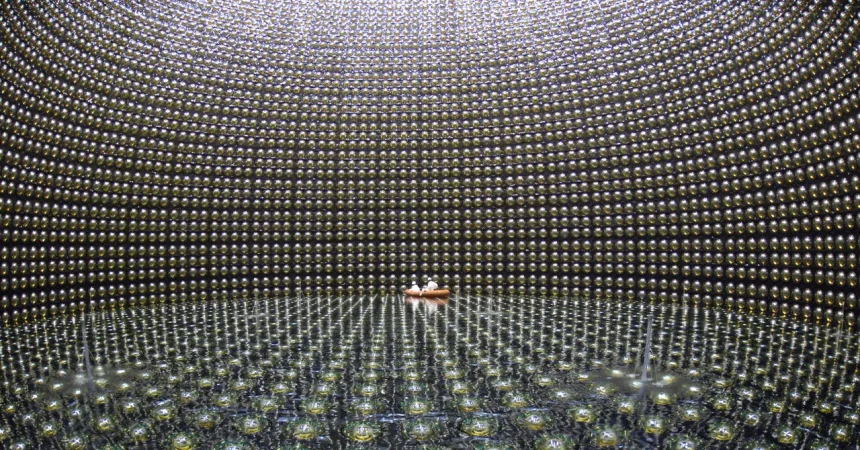
Half a world away, in the mountainous terrain of Japan, another physicist was quietly constructing an even grander and more sophisticated device. Masatoshi Koshiba, a visionary at the University of Tokyo, built the Kamiokande detector deep within the Kamioka mine, a former zinc and lead mine carved into the rock. Instead of chemical fluid, Koshiba’s enormous, gleaming tank held an astonishing three million liters of ultra-pure water, painstakingly filtered until it was optically perfect. The water was so pure that any tiny impurity would scatter the faint light and destroy the crucial data, forcing constant regeneration. The detection principle was entirely different—and revolutionary for its time. When a neutrino interacted with an atomic nucleus in the water, it produced an electron that travelled faster than the speed of light in that medium. This created a unique electromagnetic shockwave, emitting a faint, otherworldly blue glow known as Cherenkov radiation. To capture these microscopic flashes of light, the inner walls of the tank were studded with a thousand sensitive photomultiplier tubes, immense glass orbs functioning like huge, delicate eyes in the dark. Unlike Davis’s laborious method, which required chemical extraction after months of accumulation, Kamiokande could observe the interactions in real-time, allowing physicists to reconstruct the exact arrival direction of each incoming neutrino and thus conclusively confirm that they were indeed streaming from the direction of the Sun. Koshiba’s instrument confirmed Davis’s baffling shortfall with stunning precision, casting the world of physics into deeper turmoil. The mystery was evidently not a flaw in one experimental setup, but a fundamental flaw in humanity’s understanding of the universe. The neutrino, it seemed, was playing a cosmic prank on its human observers. Just as the confusion reached a fever pitch, the astrophysics community was stunned by a spectacular cosmic event—the explosion of Supernova 1987A. In a magnificent bonus, Kamiokande—along with Davis’s Homestake detector—captured a handful of neutrinos racing away from the collapsing star’s core. This historic moment proved that these gigantic instruments could not only study our Sun, but also witness the violent death throes of stars millions of light-years away, opening the field of neutrino astronomy overnight.
The resolution to the riddle came through an extraordinary international collaboration and the construction of even larger and more cleverly designed instruments. In Japan, the Kamiokande detector was upgraded into the colossal Super-Kamiokande, a cavernous cylindrical tank holding fifty million liters of pure water, surrounded by over thirteen thousand massive photomultiplier tubes that lined its inner walls like a shimmering cage of eyes. In Canada, a different, even more ingenious approach was taken with the Sudbury Neutrino Observatory (SNO). Instead of pure water, SNO was filled with 1,000 tonnes of heavy water, a form of water that contains a deuterium nucleus with an extra neutron. This subtle difference gave SNO a unique superpower: it enabled the detector to observe not only the specific electron-neutrinos, but also the other two flavors of neutrinos—the muon and tau variants. By comparing the rates of electron-neutrinos against the rate of all three flavors combined, physicists finally cracked the code of the mystery. They made the stunning discovery that neutrinos were shape-shifters. Neutrinos are born in three distinct ‘flavors,’ and they have the ability to oscillate, or morph, into each other as they travel across the vast emptiness of space. The Sun was indeed producing the correct number of electron neutrinos, but many of them had transformed into muon and tau neutrinos during their eight-minute journey to Earth; Davis’s chlorine detector and Kamiokande’s water-based system were blind to those other flavors. For this metamorphosis to occur, however, the Standard Model of particle physics demanded a radical reinterpretation: neutrinos must have mass. Though their mass is unforgivably tiny, its existence is a seismic revelation, pointing directly to physics beyond the reigning theoretical framework. It was a revelation that forced a recalibration of the entire cosmological model, influencing theories from dark matter to the formation of galaxies. The implications were profound, signaling that the standard model was incomplete and opening the gates to a zoo of exotic new physics. The pioneering work of Davis and Koshiba, spectacularly verified by Super-K and SNO, earned them the 2002 Nobel Prize in Physics. They had not only solved a forty-year-old puzzle that had stumped the brightest minds, but had fundamentally rewritten the physics textbooks, proving that the universe’s most elusive particles guard secrets far stranger than anyone had ever suspected.
The intrepid spirit of “Project Poltergeist” thrives today, but on a scale so immense that it would leave Clyde Cowan and Frederick Reines utterly breathless. In the deep, crystalline darkness beneath the geographic South Pole, the IceCube Neutrino Observatory has turned an entire cubic kilometer of Antarctic ice into its detector. Instead of a man-made water tank, they have drilled thousands of holes into the frozen continent, embedding sleek strings of sensitive optical modules to catch the faint Cherenkov flashes caused by neutrinos striking the ice. This frozen behemoth has achieved the seemingly impossible: it has produced the very first map of the Milky Way galaxy created entirely from neutrinos, painting a stunning portrait of our galaxy not in light, but in the ghostly whispers of cosmic particle accelerators. IceCube has successfully traced ultra-high-energy neutrinos back to distant active galaxies, enormous cosmic powerhouses fueled by supermassive black holes that devour their surroundings with unimaginable ferocity. Meanwhile, far below the azure waters of the Mediterranean Sea, the Cubic Kilometer Neutrino Telescope (KM3NET) has claimed its own breathtaking breakthrough. In a triumphant feat of deep-sea engineering, this detector recently recorded the highest-energy cosmic neutrino ever observed—a particle carrying hundreds of times more energy than anything created by Earth’s most powerful particle collider, the Large Hadron Collider. Its origin remains a complete and tantalizing mystery, seemingly sourced from some astronomical phenomenon unknown to us, millions of light-years away. This eternal element of surprise is the enduring beauty of the neutrino chase. The journey from a feverish midnight hypothesis to a global network of frozen and submerged observatories is a remarkable chronicle of human stubbornness. For seventy years, human beings have built ever more colossal contraptions to hunt these ethereal phantoms. We have built them in abandoned mineshafts, in deep mountain tunnels, in the frozen wastes of Antarctica, and on the pitch-black floors of our oceans. Yet every monumental effort has paid off with paradigm-shifting leaps in understanding. What began as Pauli’s apologetic confession of an impossible particle has evolved into our most powerful cosmic telescope. We are no longer merely catching ghosts; we are using them to see the entire universe in a startlingly new and ethereal light.