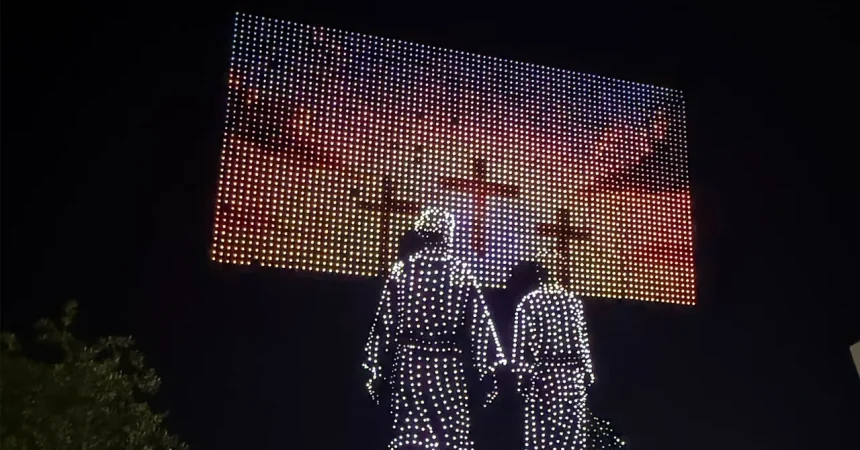
On a crisp September night in 2025, the heart of the Catholic world became the stage for a spectacle that blurred the line between ancient faith and Silicon Valley ingenuity. Thousands of pilgrims and curious onlookers gathered in St. Peter’s Square for an event dubbed “Grace for the World,” the first concert ever held on such sacred ground. As night fell, the sky above the Vatican began to shimmer, not with stars, but with a swarm of drones that coalesced into the ethereal, luminous visage of Baby Jesus. As the crowd watched in breathless silence, the image underwent a startling transformation, shifting into the familiar, weathered features of the late Pope Francis. The display was a startling marriage of the divine and the digital, a pixelated testament to a prophecy long whispered by believers, delivered through the medium of modern aerospace engineering.
The emotional weight of the evening was anchored by an unlikely duo whose voices floated over the hushed square: the world-renowned tenor Andrea Bocelli and the soulful, tattoo-adorned American singer Teddy Swims. Their rendition of “Amazing Grace” served as the heartbeat for a visual performance that evolved from moving portraits of humanity into the iconic, outstretched fingers of Michelangelo’s The Creation of Adam. For those in the square, the boundary between technology and transcendence seemed to vanish. Many wept, finding themselves caught in a moment that felt less like a tech demonstration and more like a bridge between the spiritual longings of the past and the technological realities of the future. It was a synthesis that proved how even the cold, calculated precision of drone light-shows could stir the deepest reservoirs of the human soul.
The mastermind behind this celestial theater is Nova Sky Stories, a company spearheaded by Kimbal Musk, the younger brother of tech titan Elon Musk. While Elon is busy colonizing the literal reaches of space with rockets, Kimbal has set his sights on reclaiming the sky as a canvas for storytelling. During a quiet afternoon in San Francisco, Kimbal reflected on the Vatican project with an air of “folksy” humility, far removed from the sharp-edged reputations of his family name. He described the logistical odyssey of coordinating between rigid Vatican officials and creative minds like Pharrell, seeking to foster a message of unity. In a world deeply fractured by religious conflict and ideological wars, Kimbal saw the drone show as a rare, powerful vessel for reconciliation, a way to use light to break down the walls built by dogma.
The origins of this ambition trace back to the isolated, dust-blown expanse of the Nevada desert. During the 2021 “Free Burn”—a makeshift gathering held after the official Burning Man event was canceled—Kimbal found himself grappling with a unique problem: desert authorities had banned fire. Tasked with replacing the traditional bonfire of the “Man,” he turned to Dutch artist Ralph Nauta, who utilized a swarm of drones to manifest a shimmering, intangible effigy in the night sky. As the drone-made figure raised its arms and dissolved into a red glow, the crowd of hardened desert adventurers was moved to tears. That singular moment of collective awe taught Kimbal that technology, when stripped of its utility and repurposed for beauty, could become a direct conduit to the human spiritual center.
Following that desert breakthrough, Nova Sky Stories gained rapid momentum, drawing in heavy hitters like Hollywood mogul Jeffrey Katzenberg, who invested after witnessing the transformative power of drone art firsthand. For Kimbal, the goal is to systematically dismantle the modern cynic. He believes that by replacing the artificial glare of our devices with a shared, sky-high wonder, we can tap into a primal sense of community that feels increasingly lost. The Vatican performance was the ultimate test of this theory—a high-stakes experiment in whether a tech-driven display could hold space for genuine religious reverence. By weaving the aesthetics of Renaissance art into the pixelated precision of a machine-controlled sky, the show aimed to prove that the future of spirituality might just be as high-definition as the past was hand-painted.
The ultimate validation for the project came not from the cheering crowd or the viral footage, but from a handwritten note passed to Kimbal after the performance. Pope Leo, having witnessed the display from his private apartment, offered words that confirmed the success of a delicate, high-tech gamble: “You made Michelangelo proud.” It was a profound endorsement of the idea that humanity’s greatest potential lies in the intersection of our traditions and our tools. In the end, the “Grace for the World” concert served as a reminder that awe remains a potent, unifying force. Whether composed of drone hardware or divine inspiration, the act of looking up and seeing a reflection of our own humanity gazing back remains one of the most effective ways to remind us that we are all, in some small way, connected beneath the same heavens.