In an era where our digital lives are constantly colliding with our physical workspaces, the paradox of productivity has reached a breaking point. We are drowning in a sea of apps designed to silence our phones, block intrusive notifications, and curb our social media addictions, yet these digital barriers are deceptively fragile. With a single tap, the resolve to focus crumbles, and we fall back into the infinite scroll. It is a constant battle between our intentions and our impulses, and for many, the software meant to save us from distraction ends up being just another notification on a screen we can’t stop checking. The truth is that virtual boundaries are easily ignored when the device itself is a portal to everything that distracts us.
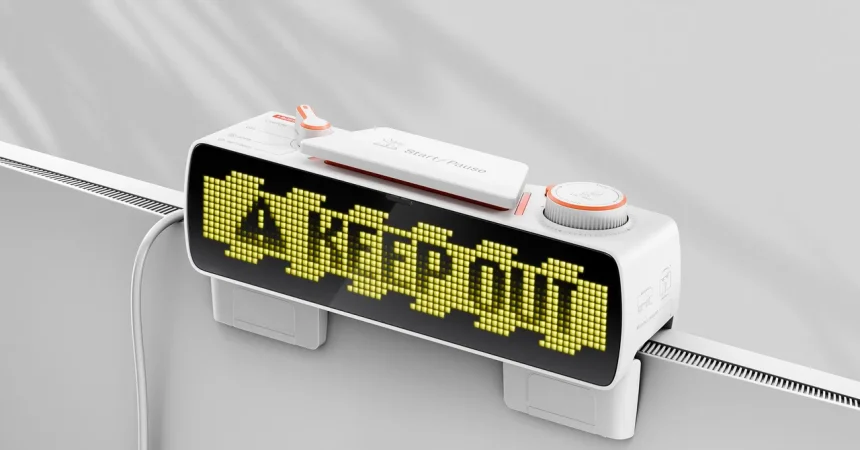
Enter the Busy Bar, a novel solution from Flipper Devices that attempts to solve the problem of focus by literally hard-coding your availability into your physical environment. At $249, this isn’t your typical office trinket; it is a dedicated, LED-lit hardware signal designed to broadcast your focus to anyone within visual range. By slamming the oversized button on the device’s face, you can flash a bold, unavoidable “BUSY” status to your coworkers, family members, or anyone else who might be planning to interrupt your flow. It is a blunt, uncompromising way to draw a line in the sand, opting for a bright visual barrier over the often-ignored polite request of a status update in a chat app.
The irony of this device is not lost on anyone who followed the company’s recent history. Flipper Devices became a household name—and a regulatory target—due to the Flipper Zero, a controversial $200 handheld hacking tool that gained social media superstardom for its ability to interact with wireless frequencies and RFID locks. That device caused such alarm that it sparked international friction, including a proposed ban in Canada and a massive seizure of units by US Customs and Border Protection. In the landscape of tech, the Flipper Zero was seen as a digital master key, a chaotic tool that challenged our notions of security and access. To go from creating a “hacker’s Tamagotchi” to a $249 “do not disturb” desk sign is a massive shift in direction.
Despite being manufactured by the same company, the Busy Bar is pointedly devoid of the illicit or “hacking” utility that made its predecessor so infamous. The team at Flipper is quick to emphasize that the Busy Bar is a standalone, benign item with absolutely no connection to the wireless-cracking tech of their flagship products. It is an honest piece of hardware intended for the mundane task of human management. For those concerned about the company’s rogue reputation, this device acts as a pivot toward the mundane, effectively saying that even the most notorious tinkerers eventually need to find a way to get their own work done without others barging into their office.
At its core, the Busy Bar represents a growing trend in the tech industry: the “hardwareization” of focus. It is essentially an “On Air” light for the remote or office worker, a physical manifestation of boundaries that we find increasingly difficult to maintain in a digital-first world. By utilizing a separate piece of hardware, Flipper is tapping into the philosophy that if you want to change your behavior, you need to change your environment. The device also pairs with a companion app to manage notifications on your phone, but the real power lies in the physical act of hitting that button. It forces a moment of intentionality, a tactile declaration that you are closing the door on the world for the sake of your productivity.
Ultimately, the Busy Bar is a expensive experiment in social psychology. It argues that software tools fail because they live on the same devices that create our distractions, making them feel like suggestions rather than mandates. A flashing red light on a desk adds a layer of social accountability that a quiet phone simply cannot replicate. While the price tag is steep and the concept is essentially a high-tech “go away” sign, it highlights a universal human need: the desire for an uninterrupted space to think. Whether or not it succeeds as a commercial product, it serves as a stark reminder that in a world of constant connectivity, the most powerful productivity tool we have is still the one that tells the rest of the world to wait.