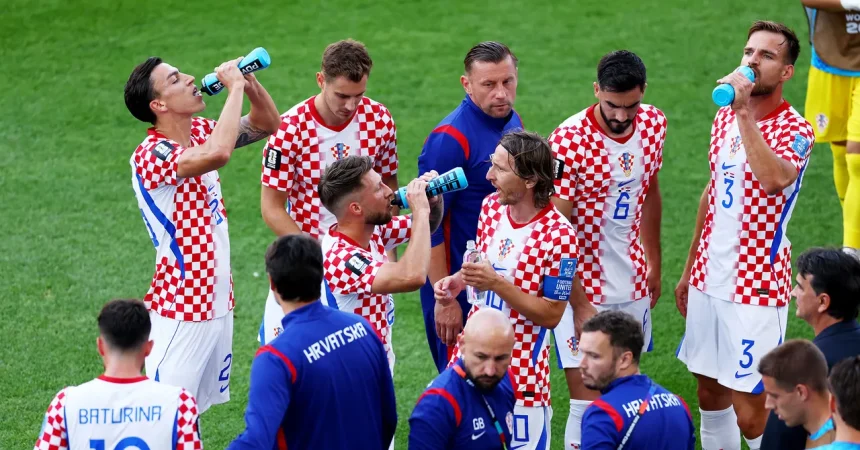
This summer, as the World Cup kicks off across the United States, Mexico, and Canada, eagle-eyed viewers will notice something peculiar. Precisely around the 22nd and 67th minutes of every match, the action will grind to a halt. FIFA has officially designated these as “hydration breaks,” framing them as a necessary measure for player welfare to combat the potential for extreme heat. However, there is a catch: these stops occur regardless of the actual temperature outside. Even on a cool, breezy day in Los Angeles or New York, the players will stand idle while the clock keeps ticking, a mandate that has sparked a wave of skepticism and debate among spectators who value the sport’s traditional, uninterrupted flow.
To the cynical eye—and many fans—these mandated pauses look less like a health necessity and more like a tactical business move. While FIFA has remained tight-lipped about the exact revenue tied to these stoppages, the mathematical reality is clear: three minutes of dead air in the middle of a high-stakes match provides a guaranteed, premium window for commercial advertisements. For networks broadcasting to a global audience, this creates a lucrative new advertising inventory that didn’t exist before. The backlash has been swift, with supporters arguing that injecting corporate pacing into a sport that has historically thrived on the intensity of continuous play fundamentally alters the viewing experience.
Take Ghazi Saoud, a dedicated football fan living in Chicago, who articulates the frustration felt by millions. For Saoud, soccer is defined by its 150-year endurance as a sport of rhythm and momentum—two 45-minute halves with minimal interruptions. He views these new breaks as “concealed advertisement windows,” arguing that while players certainly need a sip of water, they don’t need an entire three-minute ceremony to do it. The sentiment is echoed by sports historians like David Goldblatt, who points out the absurdity of the timing. According to industry estimates, network giants like Fox are expected to generate roughly $250 million in advertising revenue solely from these break periods, casting a long shadow of commercial motivation over a policy supposedly rooted in player safety.
The friction surrounding these hydration breaks is symptomatic of a larger conflict regarding the evolution of the World Cup itself. FIFA is currently tracking toward massive financial milestones, with broadcast rights alone projected to bring in nearly $3.9 billion. When you add in another $1.8 billion in sponsorship and marketing, the total economic impact on the global advertising market is expected to reach a staggering $10.5 billion. For the powers that be, these breaks are simply a vehicle to maximize the profit potential of the world’s most-watched event, turning soccer into a commodity that fits neatly into the high-revenue, commercial-heavy model of American sports entertainment.
Academic experts, such as Penn State professor Mark Dyreson, argue that this is clearly a form of “Americanization” of the beautiful game. By adopting the pacing and advertising structures common in the NFL or NBA, FIFA is effectively shifting the World Cup toward a business-first broadcast mentality. While this approach inevitably offends purists who cherish the cultural heritage of soccer, historians like Goldblatt remind us that this isn’t a new development. Football has been moving toward this extreme commercialization for decades, slowly shedding its traditional skin to become a dominant player in the global entertainment industrial complex.
Ultimately, the debate over hydration breaks acts as a mirror for the changing landscape of professional sports. Whether this is a cynical cash grab or an inevitable adaptation to the demands of modern, multi-billion-dollar media contracts remains a point of contention. While FIFA insists that these breaks are about the health of the athletes, reality suggests that the sport is being restructured to suit the appetites of broadcasters and advertisers. As we watch the tournament unfold, we aren’t just witnessing a soccer match; we are seeing the final transition of the World Cup into an entertainment product where, regardless of the weather, the bottom line is never allowed to go dry.