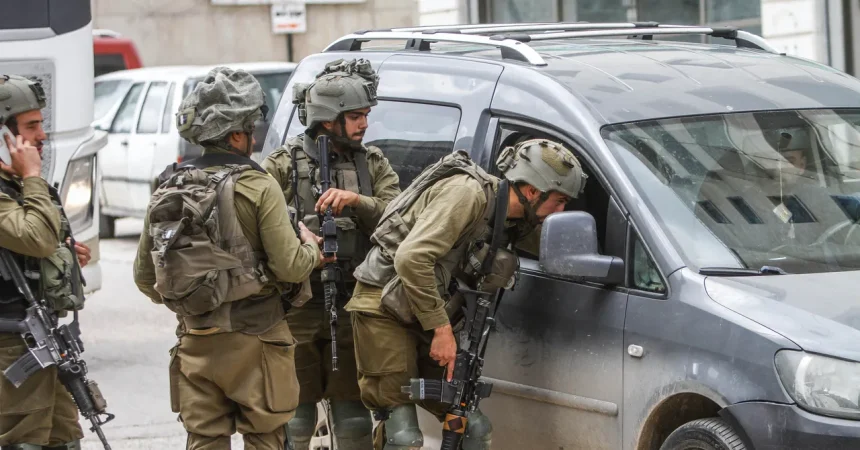
The West Bank does not appear on most maps as what it has become. It looks like a single shaded territory, but for the people who live there it is a fractured world — a patchwork of villages, cities, valleys, and hilltops divided by roads, walls, gates, terminals, and checkpoints. The joint investigation that begins with the words “Lost time. Lost jobs. Lost friends. Lost family. Lost lives.” is not an abstraction. It is a careful accounting of what it actually costs ordinary people to move through the system that governs their lives. The system is often described as security, but when it makes a mother miss a child’s first steps, a farmer unable to reach his olive trees, or a patient late for dialysis, security no longer explains what is happening. The investigation quantified what Palestinians have long known: that the distance from one home to another is not measured in kilometers but in hours, in permissions, in anxiety, in humiliation. To cross from one Palestinian community to another, a person must present a permit, leave their identity card, pass through metal detectors, stand behind steel railings in the open air before dawn, and answer questions from a soldier who may be younger than their own child. Some crossing points are open only twice a day. Others close without explanation. One day a permit works; the next it does not. The investigation found that movement is not a right for Palestinians; it is a temporary privilege that can be revoked at any moment. The West Bank is not only occupied by soldiers and settlements. It is occupied by minutes, hours, and days. Time is life. Every minute spent standing in a concrete queue is a minute that will never come back.
Take lost time first, because it is the foundation of everything else. Every morning, long before the sun rises, thousands of Palestinians gather at checkpoints like the ones around Jerusalem, Ramallah, Nablus, and Hebron. They leave their homes in darkness, not knowing what the day will bring. Some wait twenty minutes. Some wait three hours. Some wait all night, sleeping on the ground with their work tools and lunch bags beside them. A journey that would take twenty minutes by car becomes a two-hour maze of taxi rides, bus transfers, pedestrian terminals, and military inspections. The investigation measured these delays and compared them to direct routes, but the numbers can never show the true cost: the father who leaves at four in the morning and returns at ten at night, only to find his children asleep; the nurse whose shift begins at seven but who must leave at three, not because the hospital is far, but because the road is a game of chance; the student who misses lectures, exams, and whole semesters because a checkpoint is closed for a “security event.” Time poverty is not a side effect of the system; it is the system’s daily work. When a person spends a fifth of their waking life waiting to move, they lose more than hours. They lose the ability to plan, to rest, to be present with the people they love. The investigation describes this as cruel in a quiet way. There is no explosion, no bullet, no dramatic moment. There is only the slow wearing away of a finite life, one minute at a time, inside a queue that looks temporary but is permanent.
Lost time becomes lost work, and lost work becomes lost dignity. The permit system in the West Bank is tied to employers, jobs, and concrete purposes; you must prove you have a reason to move, and that reason must be approved by an Israeli official who does not know you. For decades, Palestinians worked on the other side of the checkpoints; today, many cannot reach the workplace they have had for years. A permit can be denied without explanation, renewed late, or canceled without notice. Some workers have never seen the inside of the offices where their files are kept; they rely on agents, middlemen, smuggling routes through mountain paths, and apps that tell them which military gates are open. The investigation tells of farmers separated from their olive groves by a barrier that runs across the land their families have tended for generations. On one side of the gate lies the harvest; on the other side waits the farmer, unable to reach it. When the harvest season ends, the income is gone. The same story repeats in every sector: teachers cannot reach schools; engineers cannot reach construction sites; mothers cannot reach jobs; nurses cannot reach hospitals. The economy of the West Bank has not collapsed by accident; it has been slowly strangled by a system that makes labor expensive, unpredictable, and humiliating. But the deeper loss is not just the salary. It is the human sense of being able to provide. A father who cannot buy medicine for his child, a woman who cannot attend her own graduation ceremony, a young man who sits at home with a university degree because the city where his profession exists is forbidden to him — these are the faces of lost jobs. The investigation refuses to let unemployment remain a statistic. Each number is a life interrupted, a plan canceled, a family pushed closer to despair.
Even those who manage to work and move are not spared, because the system divides people from the people they love. Palestinian society is built on families, clans, neighbors, and lifelong friendships, and the West Bank landscape is small enough that most communities belong naturally to one another. But the checkpoints, permits, and restrictions have turned that landscape into a collection of islands. A Palestinian from Ramallah can rarely visit Jerusalem, even though Jerusalem is only twenty minutes away. A Palestinian from Nablus cannot easily enter Tulkarem, and a resident of Hebron may need special permission to visit Bethlehem. Grandparents grow old on one side of a separation wall while their grandchildren live on the other side, visible in the distance but unreachable without paperwork. The investigation records moments that should be joyful and turns them into catastrophes of bureaucratic cruelty. A wedding is planned, a dress is bought, a hall is decorated, but the groom’s brother cannot get a permit to attend. A mother gives birth, and her own mother waits outside a checkpoint, watching through the window of a taxi, unable to hold her daughter’s hand. Friends who grew up together in the same neighborhood cannot meet because a military gate cuts their street in half. People use video calls to show each other their children, their new homes, their parents’ graves. Love becomes long-distance. Loss becomes doubly painful: you not only lose someone; you lose the right to be at their funeral. The investigation tells of a man who learned that his father had died in Jerusalem. He applied for a permit to attend the burial. The permit was denied. He watched the funeral on a phone screen, alone, in the country where his father had raised him. The system does not need to forbid love directly. It simply makes love so expensive, so distant, so impossible, that people learn to stop expecting to be together.
The heaviest word in the investigation is “lost lives.” It is not a metaphor. There are Palestinians who have died because the system made them wait too long. A woman in labor trapped at a checkpoint, a man having a heart attack in the back of a car while soldiers check his permit, a child with an asthma attack whose mother must prove why she is running through the turnstile. In an emergency, minutes are the difference between life and death, and the system is built to consume minutes. Ambulances are regularly delayed at military checkpoints while soldiers call supervisors to confirm that the patient is allowed to be on this road. Some patients die before the confirmation arrives. Others die waiting for a permit to reach hospital; their medical files are clear, their condition is urgent, but the officer in charge decides that the delay is necessary. The investigation does not claim that every death was intentional. It claims something more terrible: that the system has made delay into a normal procedure, and that Palestinians must plan their emergencies around an occupation that does not care about their lives. A family knows that a heart attack does not wait for a permit. A woman knows that her pregnancy due date means nothing at a closed gate. Every ambulance ride is a gamble. Every chronic illness is a sentence of uncertainty. The investigation measures deaths that are not listed as casualties, because they happened in the margins: a stroke during a three-hour wait, a difficult birth at a checkpoint at dawn, a diabetic man who could not obtain the permission to visit his endocrinologist. These are not accidents. They are the logic of a system that treats Palestinian time as worthless and Palestinian life as something to be managed from a distance.
What the investigation ultimately reveals is that movement is a human right, and that the West Bank has been structured as a place where that right is systematically denied. The system is not natural; it has been built, gate by gate, permit by permit, wall by wall. It has divided not only territory but also hearts, memories, children from grandparents, workers from their wages, patients from their doctors, families from their dead. The cost is enormous, and the investigation asks us to see it in personal terms. Lost time is a mother who no longer knows how to laugh. Lost jobs are a father who cannot look his children in the eye. Lost friends are the silence that grows between people who used to share everything. Lost family is a wedding hall with empty chairs. Lost lives are the empty rooms in homes all over the West Bank. To humanize the data is to refuse to let Palestinians become numbers in a conflict narrative. It is to understand that every queue is made of people with names, faces, dreams, tired feet, phone calls home, and prayers that today will be easier than yesterday. The system has made a simple thing — going to see someone you love — into a test of endurance. It has made ordinary life extraordinary in its difficulty. And it has done so in a way that can be measured, documented, and understood. The investigation gives us the tools to see it. The question remaining is whether we have the courage to respond. If we know the cost, can we still look away? The people of the West Bank have already paid. The rest of us must finally begin to count, not for the sake of numbers, but for the sake of their lives — and, if we are honest, for the sake of our own shared humanity.