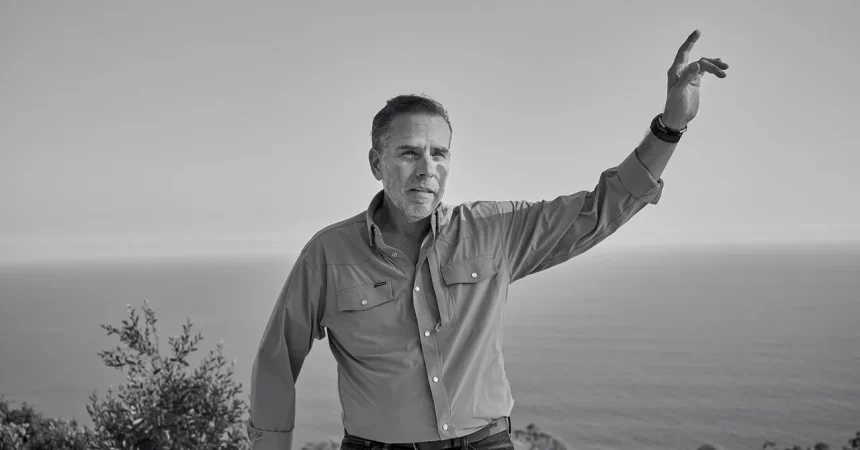
Following his initial public disclosures, Hunter Biden found himself at a crossroads. When producers from various platforms—ranging from South African interest programs to the high-profile podcast hosted by former Navy SEAL Shawn Ryan—reached out, Biden chose to say yes. He claims he didn’t have a grand political strategy or a calculated roadmap at the time; instead, he simply possessed an intuitive sense that he was ready to step into the light. Even when faced with the prospect of speaking to Ryan, a man who had spent years as a fierce critic of his family and a vocal proponent of anti-Biden conspiracies, Hunter remained unfazed. By his own admission, he chose not to research Ryan’s past vitriol, preferring to meet his skepticism with an open door and a commitment to answer any question thrown his way, regardless of how hostile or pointed it might be.
By the beginning of this year, however, what began as a series of ad-hoc interviews began to coalesce into a deliberate strategy of personal and professional reinvention. Hunter had come to a realization shared by many modern figures: the traditional gatekeepers of mainstream media, such as CNN, no longer hold the cultural sway they once did. In a landscape where trust in institutional journalism has cratered, he realized that speaking directly to the audience through independent media—podcasts with millions of subscribers—was a more effective way to be heard. His pivot toward these unconventional, often hostile, digital spaces has drawn inevitable comparisons to Donald Trump’s media style, a parallel Hunter is quick to dismantle. For Hunter, the distinction lies in the difference between a calculated performance and the raw exposure of his own history.
Hunter is acutely aware that the public has already seen him at his absolute lowest, leaving him with no facade to maintain; for him, authenticity isn’t a political tool—it’s an inescapable reality of his life. He isn’t looking to play to the choir or engage in the polite, predictable exchanges of legacy networks. Instead, he is specifically targeting platforms like Channel 5, which reach deep into the counter-cultural and anti-establishment corners of the internet. He also set his sights on influencers like Candace Owens, whose massive reach into MAGA-leaning demographics offered him a unique opportunity. He isn’t interested in preaching to those who already agree with him; he is interested in bridging a gap, hoping to find common ground with those who have been conditioned to view him as a caricature rather than a human being.
Central to Hunter’s current philosophy is a genuine belief that the American divide is largely manufactured. He argues that our intense polarization is less a reflection of fundamental human character and more a byproduct of algorithmic manipulation designed to enrich a small group of digital oligarchs. By inserting himself into spaces dominated by right-wing ideologies, he is essentially attempting a “hearts and minds” campaign, hoping that if he can strip away the digital anger and show the human behind the headlines, he might help lower the temperature of our national discourse. For Hunter, the goal isn’t necessarily to convert people to his political worldview, but to prove that even in our most toxic echo chambers, a shared human experience still exists beneath the noise.
His engagement with the platform X—formerly Twitter—serves as the tactical engine for this mission. Setting aside his personal misgivings about the platform, he has dived into the fray with intense energy, posting with the fervor of someone who has finally found a way to take control of his own narrative. He describes X as the “most dangerous and frightening” space to be, but that is precisely why he chooses to be there. By intentionally placing himself in the midst of hostile conversations, he is testing his theory that direct engagement can cut through the noise. It is an exercise in vulnerability, where he invites the world’s most aggressive critics to interact with him on their home turf, betting that his willingness to be radically open will be more persuasive than any polished press release ever could be.
The success of this approach culminated in his high-profile sit-down with Candace Owens, an interview that surprised nearly everyone by evolving into a moment of genuine mutual respect. Owens famously apologized for her past rhetoric, describing it as “warped,” and her audience, previously some of his loudest detractors, responded with an unexpected level of empathy. Owens later noted that in a world of political gaslighting, Hunter’s raw honesty served as a “breath of fresh air,” proving that the public is often far more perceptive and willing to forgive than partisan pundits assume. By choosing to show up, own his mistakes, and look his fiercest critics in the eye, Hunter Biden has successfully reframed his story, suggesting that perhaps the way back from the brink—both for himself and for a fractured nation—is not through more shouting, but through the uncomfortable, honest act of simply talking.