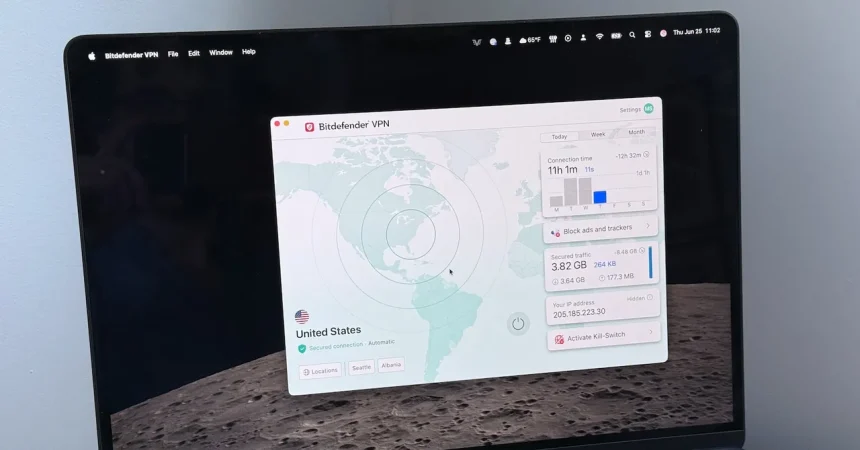
When it comes to daily digital life, consistency is often more valuable than raw, theoretical speed. In my hands-on testing, Bitdefender VPN proved itself to be a remarkably reliable companion. I didn’t experience the frustrating connection drop-outs or the erratic performance dips that often plague lesser services. While some competitors—like IVPN using the WireGuard protocol—technically outpaced it in benchmarking, those differences are largely academic. In the real world, whether you are streaming, browsing, or working, Bitdefender provides a fluid and stable experience that most users won’t be able to distinguish from a top-tier connection. For the average person, it hits the “sweet spot” where speed is more than enough to handle anything you throw at it.
However, it is crucial to understand the philosophy behind Bitdefender VPN. It isn’t trying to be an anonymous, underground tool built for resisting mass surveillance; instead, it is a practical utility designed for the modern, casual user. Its primary mission is to help you duck around annoying geo-restrictions, block intrusive trackers, and secure your data when you’re forced to hop onto an untrusted public Wi-Fi network. If your goal is to add a protective layer to your daily browsing habits, it succeeds brilliantly. But, if you are looking for a service that prioritizes aggressive, absolute anonymity, you might find that Bitdefender’s focus is a bit more restrained than what privacy purists are after.
One of the most important aspects to understand is that Bitdefender doesn’t build its own network infrastructure from scratch. Instead, it relies on a partnership with IPVanish to handle the heavy lifting behind the scenes. This relationship carries a bit of historical baggage; back in 2016, IPVanish faced a significant controversy regarding data logs. However, the company has changed hands multiple times since then and is now under the umbrella of Ziff Davis. It has spent the intervening years working hard to repair that reputation, submitting to rigorous third-party, no-log audits—including one as recently as 2025—and maintaining a transparent, public record of investigative requests it receives. It is a different company today than it was a decade ago, though that history still gives some users pause.
The jurisdiction of the service is another point worth weighing. Since IPVanish is a U.S.-based company, it operates under the lens of American law, which is notoriously proactive regarding data demands. While a legitimate no-logs policy means they cannot hand over data they don’t possess, some privacy advocates prefer providers based in more neutral or “privacy-friendly” jurisdictions. Furthermore, because Bitdefender requires you to have an account and pay via credit card, they are already keeping some level of user data on file. It is a reminder that there is a distinct difference between “securing your connection from hackers” and “erasing your digital footprint.” If you need the latter, this might not be your best bet, but if you want to keep your ISP or airport cafe from snooping on your traffic, it remains a strong, sensible choice.
When looking at the product as a whole, it’s clear that Bitdefender VPN is built for accessibility rather than specialized, high-end power user needs. It is an incredibly easy service to set up and manage, perfectly suited for those who want to “set it and forget it.” That said, it does lack some of the bells and whistles that more niche VPNs offer, such as native Linux support or the option for a static, dedicated IP address. If your technical needs are straightforward, you honestly won’t miss these features. But for the small percentage of users who need a specific setup for coding or server access, the simplicity here might feel a little bit like a limitation.
In the final analysis, the value proposition is hard to ignore, especially for the budget-conscious. The introductory pricing is genuinely aggressive, often allowing you to grab an entire year of protection for about $35, which is an absolute steal in the current market. As long as you keep an eye on the auto-renewal rates—which tend to jump significantly after that first year—it’s a fantastic deal for the performance you receive. Bitdefender VPN isn’t setting out to be for everyone, but for the average person who just wants a fast, reliable, and invisible layer of security for their everyday internet life, it is a well-rounded and dependable tool that gets the job done without a fuss.