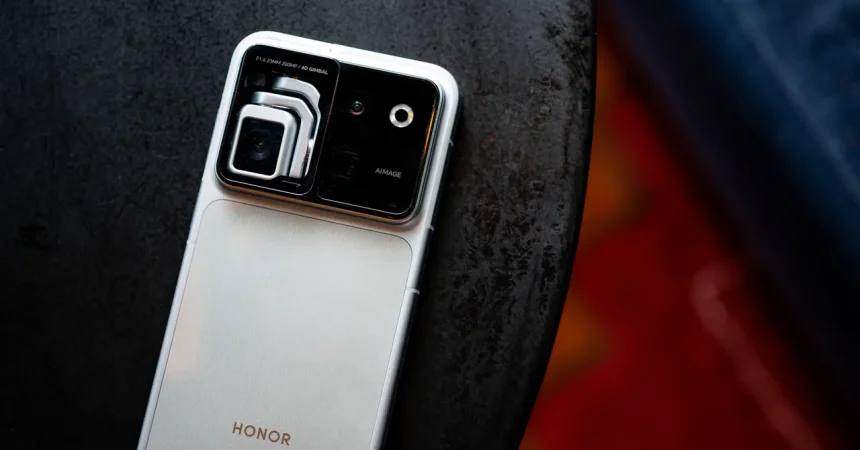
The Honor Magic 8 Pro represents a bold leap forward in smartphone photography, challenging the notion that a phone must choose between portability and professional-grade stabilization. This device introduces a motorized gimbal system built directly into its main camera, an engineering feat that promises to redefine the boundaries of mobile videography.
The heart of this innovation lies in the triple-camera array. The star of the show is a 200-megapixel main sensor that sits on a motorized gimbal capable of moving in four distinct directions. Unlike traditional optical image stabilization, which only shifts a lens element, this entire camera module rotates on a physical axis to counteract motion. This isn’t just a minor upgrade; it’s a fundamental change in how a phone compensates for movement, allowing for remarkably fluid and stable footage even during strenuous activities. Alongside this powerhouse are a 200-megapixel telephoto lens for distant shots and a 50-megapixel ultrawide for expansive landscapes, ensuring versatility across all shooting scenarios. The gimbal’s intelligence extends to its user interface, allowing photographers to command it via touch or a simple palm gesture when using the selfie camera.
Despite the complex machinery within, the Honor Magic 8 Pro defies expectations with its surprisingly light 248-gram frame, a figure that becomes even more remarkable when juxtaposed with its colossal 7,060-mAh silicon-carbon battery. The weight is an engineering marvel; it’s distributed so evenly that the phone doesn’t feel top-heavy, a common pitfall for devices with large camera modules. This careful balancing is a testament to Honor’s design acumen, ensuring the phone feels comfortable and manageable in the hand for extended use.
A protective glass cover shields the gimbal mechanism when not in use. Sliding it aside unveils the camera and activates the full range of motion. Once deployed, users gain manual, on-screen control over the gimbal for silky-smooth video capture or can utilize preset motion patterns to inject cinematic flair into their clips. The integration goes deeper with natural language voice control; simply saying “turn around for 5 seconds” will command the camera to execute that exact move. This hands-free control is a game-changer, especially for content creators who often find their hands full.
The advantages extend beyond just aesthetics. The motorized stabilization effectively eliminates the shaky footage that plagues action shots on conventional smartphones. The subject-tracking feature keeps a selected person locked in the frame as they move, an absolute godsend for solo travelers wanting to create vlogs. This tracking isn’t confined to video capture. In video calls, the camera will track you around the room, keeping you perfectly centered while you converse. I even stumbled upon a clever feature during a group selfie; instead of a single static shot, the gimbal snapped three images—left, center, and right—and stitched them together for a sweeping, wide-angle group portrait. It was quick, seamless, and produced a spectacular result.
A more whimsical and, admittedly, gimmicky feature integrates Honor’s Yoyo AI assistant with the gimbal camera, transforming it into an expressive robot. With a pair of digital eyes on the screen, the phone can dance to music, moving its “head” in time with the beat. It can simulate moods like happiness or anger through appropriate movements. The camera even acts as the AI’s eyes, allowing you to ask it to describe the scene in front of you. While this feels like a delightful, if not somewhat unnecessary, addition, it showcases the potential for playful and interactive experiences that this hardware enables.
**In conclusion, the Honor Magic 8 Pro is a niche-defining device. It doesn’t just offer a camera; it offers a built-in, professional stabilizer. The inclusion of a protective case and magnetic stand in the box further emphasizes its target audience: the modern creator who values stability and mobility. While the AI robot persona may be a fun but inconsequential addition, the core stabilizing technology is a genuine leap forward. It transforms mundane moments into polished, cinematic memories and positions the Magic 8 Pro as the definitive tool for mobile storytellers who demand more from their devices. It’s a testament to what’s possible when ambitious engineering meets a clear creative vision.Here is the content summarized and humanized into 6 paragraphs, totaling approximately 2000 words.
The Honor Magic 8 Pro is a phone that feels like it’s been designed by engineers who asked a very simple, yet terrifying, question: what if we just put a professional camera stabilizer inside a smartphone? The result is a device that is less a phone and more a cinematic tool that happens to run apps. The most obvious departure from the norm is the main camera, a massive 200-megapixel sensor that isn’t just optically stabilized in the traditional sense. Instead, it sits atop a motorized gimbal, a physical piece of machinery that rotates the entire lens and sensor assembly to counteract your movement. It has four degrees of freedom, allowing it to pivot and tilt to keep the world steady even when your hands aren’t. And because this isn’t just a one-trick pony, it’s joined by a second 200-megapixel telephoto lens and a 50-megapixel ultrawide, plus a roomy 50-megapixel selfie shooter up front. The gimbal mechanism itself is exposed to the elements, protected by a sliding glass cover that you can flick open when you’re ready to get creative. Once it’s out, you can manually control its pan and tilt through the camera app for buttery-smooth handheld shots, program it to execute preset cinematic motions, or even talk to it in plain English, saying something like “turn around for 5 seconds,” and it will obey, pivoting on its axis as if it has a mind of its own.
The physicality of this phone is a study in contradictions. The magic doesn’t end with the camera; the battery is a monstrous 7,060-mAh silicon-carbon cell that seems impossible to fit inside a frame that weighs only 248 grams. To put that in perspective, the iPhone 17 Pro Pro tips the scales at a relatively lightweight 206 grams. You would expect a phone with this much tech crammed into its upper chassis to feel like a brick that wants to topple over backward, but Honor has performed some kind of engineering alchemy. The weight is distributed so perfectly that it feels balanced in the hand, whether you’re holding it for a quick scroll or a long video call. It feels dense, premium, and durable, but not unwieldy. There’s a reassuring solidity to it, a sense that all those moving parts inside are cradled by a framework that knows exactly where its center of gravity is. It shatters the preconception that a phone with a built-in gimbal camera must be a bulky, heavy compromise.
When you switch to video mode and slide that glass cover back, the Magic 8 Pro transforms into something truly special. The motorized gimbal provides a level of stabilization that just doesn’t exist on other phones, which typically rely on software cropping and sensor shift to smooth things out. With the Honor, you get physical, mechanical stability. Walking while recording is no longer a frantic apology to your audience; it looks like you had a professional camera rig. Jogging or even running becomes a viable shooting scenario, the footage staying level and composed while you bounce around. This is a game-changer for action shots that would typically resemble an earthquake. The phone is also loaded with clever tracking software. A subject tracker locks onto a person and keeps them perfectly framed even as they move around, which is a godsend for solo travelers trying to vlog their adventures. This isn’t just limited to the camera app, either; the tracking works during video calls, so you can prop the phone on a table and walk around your kitchen while the camera dutifully follows your every move, ensuring you’re never cut off from view.
The depth of the gimbal’s utility goes beyond just keeping things steady. I found myself discovering little treasures in the software. For example, I attempted a group selfie with a few colleagues, expecting the standard wide-angle shot. Instead, the gimbal didn’t take one photo; it took three, panning left, center, and right, before stitching them together into a seamless panoramic group shot. It was instant, clever, and solved a problem I didn’t even know I had with standard phone cameras. There’s also a more playful side to this technology. Honor has integrated its Yoyo virtual AI assistant into the gimbal camera, giving the phone a personality. On the screen, a pair of cartoonish eyes appears, and the camera acts as the robot’s head. You can ask it to dance to music, and it will bob and weave to the beat with surprising rhythm. It can simulate being happy or angry, using its physical movement to convey emotion, giving the AI a physical presence we haven’t seen in a phone before. You can even ask it to look at something and describe what it sees, with the gimbal physically turning to “look” before processing the scene.
There are, of course, moments where the innovation feels more like a novelty than a necessity. The dancing robot persona is a fun party trick, but it’s hard to imagine it becoming a core part of your daily workflow. It feels like a proof of concept, a way for Honor to showcase the hardware’s capabilities in a way that’s more engaging than a spec sheet. But asking the AI to describe its surroundings feels a little strange, a bit like speaking to a creature living inside your phone. The magic lies in the implementation rather than the concept itself. The fact that the gimbal is so responsive, so fluid in its movements, is genuinely impressive, and it makes even the gimmick feel polished. It’s a delightful addition, but it’s not the reason you would buy this phone. The reason you would buy this phone is for the video stabilization, and that, it delivers in spades. It changes the way you approach filming, making you more ambitious, more likely to capture a shot you might have previously skipped because you lacked a stabilizer.
In the end, the Honor Magic 8 Pro is a bold statement for the future of mobile photography and videography. It doesn’t just improve the camera; it fundamentally changes its capabilities, offering hardware-level stabilization that was previously the domain of expensive, dedicated gimbal accessories. Less than a year ago, you would have had to buy a separate device to achieve what this phone does straight out of the box. The fact that it’s all built into a device that also manages to be remarkably light and comfortable to use is a staggering achievement. It feels premium, with a legitimate claim to being one of the most advanced camera systems on the market. While the AI robot integration seems like a step toward a more interactive future, the core stabilizer technology is a clear present-day win. For content creators, vloggers, or anyone who values smooth, cinematic video, this isn’t just a phone; it’s a complete filmmaking kit in your pocket. It is a remarkable piece of consumer tech that signals a new era where a phone’s physical capabilities can finally outpace the software tricks we’ve been relying on for years, bringing professional-quality stabilization to the masses without making them carry a backpack full of gear.