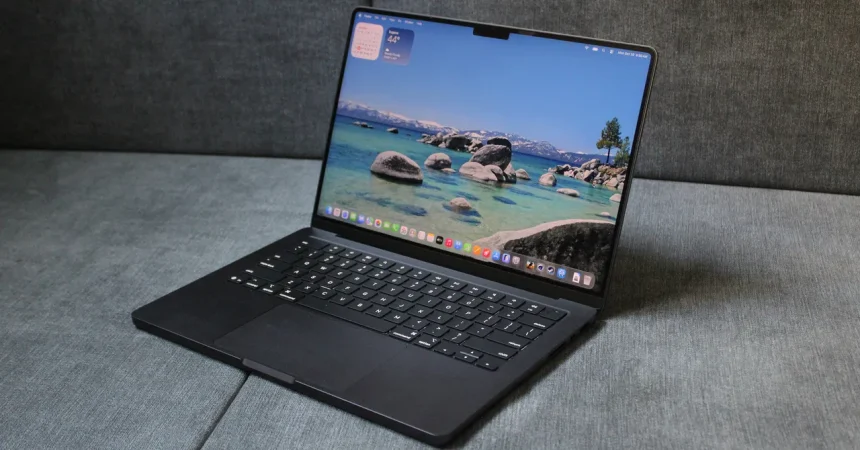
Last month, Apple refreshed the 14-inch MacBook Pro with the M6 chip, and on paper, it’s a stunner. The new processor delivers more than enough power for demanding apps, the battery life is excellent, and that mini-LED display is bright, punchy, and an absolute joy for watching HDR video. I completely understand why you might be tempted to order one right now—the packaging is fresh, the reviews are glowing, and there’s a certain thrill in having the latest thing from Apple. But here’s the thing: you probably shouldn’t buy it. At least, not yet. The M6 MacBook Pro is a perfectly capable laptop in its own right, but it fits awkwardly into Apple’s current lineup. Externally and internally, it’s nearly identical to the M5 model that arrived in late 2025. Same design, same screen, same ports, same battery, same webcam, same everything—except the chip. And because the M5 version is still on sale at various retailers, you can currently pick it up for about $200 less than the M6 on Amazon and Walmart. That price gap is not chump change. It’s enough to buy a nice pair of headphones, extend your AppleCare coverage, or simply keep in your pocket. For a laptop that looks and feels exactly the same, that $200 difference makes the M6 a hard sell. Is the upgraded chip worth the extra cash? I’m not convinced. Don’t misread this as “the M6 is bad” or “Apple has lost its touch.” It’s still an excellent laptop. If you’re coming from an Intel-based MacBook Pro from 2019, either the M5 or the M6 will feel like a revelation. But if you already own an M5 or even an M4-based MacBook Pro, the M6 is a marginal update, not a must-have. Let’s break down why.
Let’s talk about what the M6 actually changes under the hood. The chip comes with two additional CPU and GPU cores compared to the M5, and that’s where most of its performance gains come from. On a benchmark graph, you’ll see a small step up. But in real life, this is one of the smallest generational improvements Apple Silicon has seen in the past six years. It’s not like the jump from Intel to Apple Silicon, or even the leap from last year’s M4 to the M5. The more meaningful improvements are in AI-related tasks—there’s a second 16-core Neural Engine and faster memory bandwidth, so machine-learning models and on-device AI features will run more smoothly. That’s great if you’re a developer building AI apps, or if you rely on diffusion models and large language models every day. But for the average person doing everyday work—email, spreadsheets, web browsing, writing, maybe some photo editing or short video projects—the M6 is unlikely to feel faster than the M5. You won’t open Microsoft Word any faster. You won’t notice the extra cores while exporting a 10-minute YouTube video unless you’re doing it all day, every day. And remember, the base 14-inch MacBook Pro uses the same chip you’d find in a MacBook Air or an iPad Pro. That’s not a criticism; it’s a reality check. The base Pro is not a true pro machine in the performance sense. It’s essentially a MacBook Air in a Pro chassis, with a nicer screen and more ports. The “Pro” name is about the display and connectivity more than raw power. So paying a $200 premium for a slightly faster version of a chip that already isn’t the bottleneck for most workflows? I’d say no. The only other meaningful difference is Wi-Fi 7 on the M6 model, which is nice for future-proofing, but hardly worth $200 today.
If you’re going to buy a 14-inch MacBook Pro, I’d steer you toward the M5 version—but even then, I’d also want you to consider the 15-inch MacBook Air. The Air has a different personality. It’s thinner, lighter, and completely fanless, which means it’s silent and more portable. It also gets outstanding battery life. For many people, the Air is honestly all the laptop they need. The main reason to choose the 14-inch MacBook Pro over the Air is the display. The mini-LED panel on the Pro is dramatically brighter, with deeper blacks, better contrast, and more vivid colors. HDR content looks stunning on it, and if you watch a lot of movies or work with HDR video, that alone might justify the extra weight. The Pro also has more ports: HDMI for an external monitor or TV, an SD card slot for photographers, and USB-C ports on both sides, so you can charge from whichever side is convenient. I love that small touch. The Air has only two USB-C ports, both on the left, and no HDMI or SD slot. But if those things don’t matter to you, the 15-inch Air offers a bigger display and a lighter body, and it’s often on sale. Right now, for example, the M5 Air with 16GB of memory and 1TB of storage is down to $1,549—its lowest price since June and $150 off Apple’s retail price. That’s a really compelling deal. You get the same M5 chip that’s in the 14-inch Pro, a large screen, and you save money. It’s hard to argue with that.
Now, I know what some of you are thinking. Isn’t the MacBook Pro better at handling sustained workloads? Doesn’t it have a fan and better thermals? Yes, that’s true. If you’re a pro video editor or a 3D artist rendering constantly, the Pro will hold higher performance for longer periods before thermal throttling. The Air, being fanless, will eventually slow down under sustained heavy load. But again, we’re talking about the base M5 chip, not the M5 Pro or M5 Max. The base chip is designed for efficiency, not extreme performance. For most creative work—editing 4K video, working with large RAW photo libraries, music production—the MacBook Air can handle it, just maybe with more pauses and fanless silence. The Pro with the same base chip will be a little more consistent, but not on another level. If you’re doing serious heavy lifting, you’d want to move up to the higher-tier chips, and at that point the price goes up substantially. So if you’re a student, a writer, a consultant, a small business owner, or anyone who mostly lives in a browser, email, and Office apps, the Air is more than enough. The 14-inch Pro’s extra ports and display are nice, but they’re not necessary. The smartest move is to decide based on your actual habits, not on marketing names. Ask yourself: Do I need HDMI and an SD card slot? Do I watch HDR content on my laptop often? Do I mind carrying a slightly heavier machine? If the answer is no, then the 15-inch Air is the better value. If the answer is yes, then the M5 MacBook Pro is a good choice—just not the M6.
Let’s also talk about the emotional side of buying a new laptop, because that’s part of why this whole dilemma exists. There’s a seductive quality to having the newest, fastest thing. The M6 MacBook Pro is a fresh release, with unboxing videos, YouTube reviews, and excited social-media posts. But do you need it? No. And here’s the thing: if you buy an M5 MacBook Pro today, it’s not going to feel slow next year. Apple Silicon chips have gotten to the point where daily tasks are simply snappy, and the differences between generations are increasingly academic. The M5 is incredibly fast; the M6 is a little faster in specific ways. Unless you’re hitting those specific ways, you won’t feel the difference. Moreover, laptops are expensive. A MacBook Pro is a serious investment, and it’s okay to be a little conservative and buy the previous generation at a discount. That’s not being cheap; that’s being smart. It’s also worth considering the environmental side of things: buying a previous-generation model doesn’t mean supporting wasteful production of yet another incremental upgrade. You’re using what works and saving money. I’m not saying the M6 is bad—it’s a great laptop. But “great” and “right for you right now” are different things. If you can wait, perhaps the M6 will drop in price in a few months, and then it’ll be a better buy. If you can’t wait, the M5 is right there, often for less, and it’s still fantastic. The only people who should buy the M6 MacBook Pro today are those who absolutely need the latest AI performance or Wi-Fi 7 and are willing to pay for it. For everyone else, the smart money is on a deal.
All of this leads to a simple conclusion: Apple’s MacBook lineup is full of excellent laptops right now, but the value is not where you’d expect. The newly refreshed M6 MacBook Pro might be the shiny new object, but it’s an awkward fit. It’s too similar to its predecessor to justify the price premium, and it doesn’t offer enough real-world performance gains for most people. The better choices are the M5 MacBook Pro—especially at a $200 discount—or the 15-inch MacBook Air M5, which is also on sale with generous storage and a low price. Both of those give you nearly all the things you’d love about the M6, while saving you money and still feeling fast and modern. So take a breath. Don’t let the launch-day hype make you rush to the checkout page. Evaluate what you actually do with your laptop, how much you want to spend, and where you want to be plugged in. The best laptop for you is the one that fits your life and your wallet—not necessarily the one with the newest chip. The M6 MacBook Pro will still be around later, and by then it’ll probably be cheaper. When it is, it might make more sense. Until then, save yourself the $200 and enjoy the MacBook you actually need.