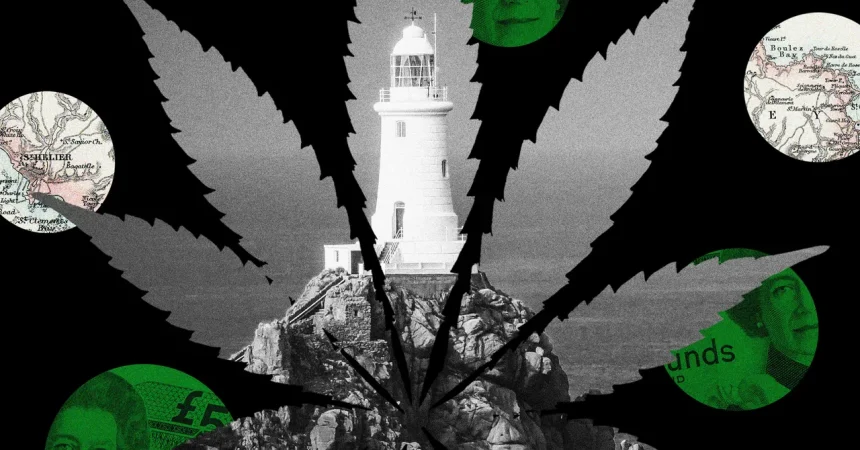
On the surface, Jersey seems an unlikely place for a cannabis revolution. It is a small, wind-scrubbed Channel Island, better known for offshore banking, dairy herds, and the famous Jersey Royal potato than for marijuana. Yet today, roughly 90 percent of the island’s cannabis production flows from a single company: Northern Leaf. In 2025, that firm exported £8.4 million — around $11.3 million — worth of medical marijuana to markets including the United Kingdom and Germany. Those numbers already make it a meaningful player in Europe’s growing medicinal cannabis sector. But there is a strange twist buried in the island’s laws: Northern Leaf is only permitted to grow cannabis for export. It cannot sell to customers in Jersey itself. This creates a quiet, almost absurd contradiction. A place known for discretion and financial engineering now grows a controversial plant under sealed glasshouses, sending it to patients hundreds of miles away, while the people walking past those greenhouses have no legal way to buy what is being produced in their own backyard. The island’s neatly kept lanes, granite farmhouses, and tea-shop charm sit beside a modern, security-heavy agricultural operation that symbolizes just how far Jersey has drifted from its pastoral postcard image — and how quickly an old economy can be reinvented by a new crop.
The man behind this transformation is Datuk Tan, a 50-year-old entrepreneur with enormous ambitions. He does not simply want to run a profitable medical cannabis exporter; he wants to make Jersey’s cannabis industry bigger than one of the island’s most beloved traditions. Speaking with the confidence of a man who has spent two decades watching legalization sweep the globe, Tan points to the potato trade as his benchmark. In 2025, Jersey’s potato industry generated £40 million in revenue. Northern Leaf, he notes, is already doing a quarter of that business while using only about 5 percent of the land the potato industry needs. That math fascinates him. If he were to scale up to just 20 percent of the land, he believes the cannabis industry could eclipse the potato economy entirely. “That is where it will get interesting,” he says. It is a bold claim, but not an idle one. Cannabis, after all, is a high-value, intensively cultivated crop, and medical marijuana prices have remained robust in countries where domestic supply lags demand. Tan envisions a future in which Jersey, already famous for its tiny, buttery potatoes, becomes equally known as a hub for pharmaceutical-grade cannabis. It would be a remarkable economic pivot for a place that has spent decades positioning itself as a discreet tax haven — and a sign that even the most established industries must share the island with new, more profitable forms of cultivation.
Tan’s path to this point was anything but direct. Born in Malaysia to a Chinese father and an Irish mother, he spent his childhood surrounded by different cultures, languages, and ways of seeing the world. As a young man, he dreamed of becoming a veterinarian. Animals, science, and biology all fascinated him, and he imagined a life caring for creatures rather than pursuing corporate success. But after graduating from university in 1998, he found himself drawn into the fast-moving world of technology and finance. He took a job developing software for Citibank, where he earned a comfortable salary and built the kind of résumé that could have carried him through a conventional career. Yet something was missing. He was good at his work, but his heart was not in banking. What truly interested him was the forbidden plant that would later define his life: cannabis. “I loved the science of it, the genetics, the seeds, the smells,” Tan says. That love was not merely recreational or countercultural; it was the fascination of a naturalist and an entrepreneur. He saw cannabis not just as a drug, but as a biological marvel with complex chemistry, subtle variations, and extraordinary potential for medical application. The decision to leave the safety of Citibank and immerse himself in the weed world took courage, but for Tan, it was never really a choice. It was the only path that made sense.
The timing, as it turned out, was perfect. In the early 2000s, governments around the world were beginning to rethink their approach to marijuana. Medical cannabis programs were being introduced in a handful of countries, and even places with harsh anti-drug laws were moving toward decriminalization. Sentences that once seemed immovable were being softened. Tan recognized that this was a once-in-a-generation opportunity. He began hopping from jurisdiction to jurisdiction, wherever the legal landscape was changing. He worked as a consultant in California, where medical dispensaries were emerging out of the shadows. He spent time in the Netherlands, which had already become a laboratory for tolerance and regulated sales. He also worked in Canada, where the medical cannabis system was being rebuilt from the ground up. Everywhere he went, he studied the rules, the business models, and the science. “I started to see these legal frameworks opening up,” he recalls. “The minute they existed, I went there.” That knack for anticipating the next wave became his signature. While others hesitated, he packed his bags. While traditional investors avoided the stigma, he leaned in. By the time cannabis began to look like a legitimate industry, Tan had already accumulated years of hands-on experience in three of the most advanced legal markets in the world. He understood cultivation techniques, licensing requirements, supply chains, and regulatory pitfalls better than almost anyone. When Jersey decided to create its own medical cannabis framework, he was ready to build a world-class facility on an island with almost no history of growing marijuana.
Jersey’s regulatory environment is unusual, and that is precisely what made it so attractive to Tan. As a Crown Dependency, the island has close ties to Britain, but it is not part of the United Kingdom. More importantly, it is self-governing: Jersey makes its own laws. This legal autonomy allows it to move faster than larger, more unwieldy countries, and to create policies tailored to its own economic needs. For decades, the island has used those powers to build a thriving offshore finance industry. There is no capital gains tax, and most companies pay zero percent corporation tax. This has attracted some of the world’s wealthiest individuals and largest financial institutions, all eager to park their money in a secure, low-tax jurisdiction. Along Jersey’s scenic coastline, next to twee beachside cafes and the thick concrete remains of Nazi bunkers — the Channel Islands were the only part of the British Isles occupied by Hitler’s forces during World War II — visitors will find sleek offices of international banks and wealth management firms catering to the super rich. The juxtaposition is striking: quiet tourist beaches, vestiges of wartime occupation, and billionaires’ money all coexisting within a few square miles. Into this strange mix, Tan inserted a high-tech cannabis farm. It is a natural fit for an island that has long understood the value of discretion and regulatory arbitrage. Cannabis may carry more stigma than securities trading, but the underlying logic is the same: Jersey offers a stable, well-regulated environment with tax advantages and access to European markets. For a company like Northern Leaf, that combination is almost irresistible.
In the end, Tan’s story is not just about marijuana. It is about the reinvention of a place and a man. Jersey, once known mostly for potatoes and offshore money, is now discovering that it can grow something far more valuable per acre. Tan, the Malaysian-born son of a Chinese father and an Irish mother, has found his calling on a small island far from where he grew up. He left behind the predictability of finance to pursue a passion, and that passion has turned him into one of the most significant figures in Europe’s medical cannabis industry. His vision is still unfolding. The £8.4 million in exports from 2025 is impressive, but he believes it is only a beginning. With more land, better genetics, and expanding demand from countries like Germany and the UK, the potential is enormous. And yet, there remains a poignant irony: the cannabis grown in Jersey helps patients elsewhere, but local patients cannot legally obtain it. This regulatory limitation may change in the future, but for now, it means the island’s cannabis industry exists almost entirely for the outside world. Tan, ever the pragmatist, seems at peace with that. He is building something bigger than local politics. He is building an industry that could outshine the potato, re-shape the island’s economy, and prove that a controversial plant can become as central to Jersey’s identity as its famous royal potatoes. Whether or not he succeeds, his journey is a reminder that sometimes the most unexpected people — and the most unlikely places — are the ones that rewrite the rules.