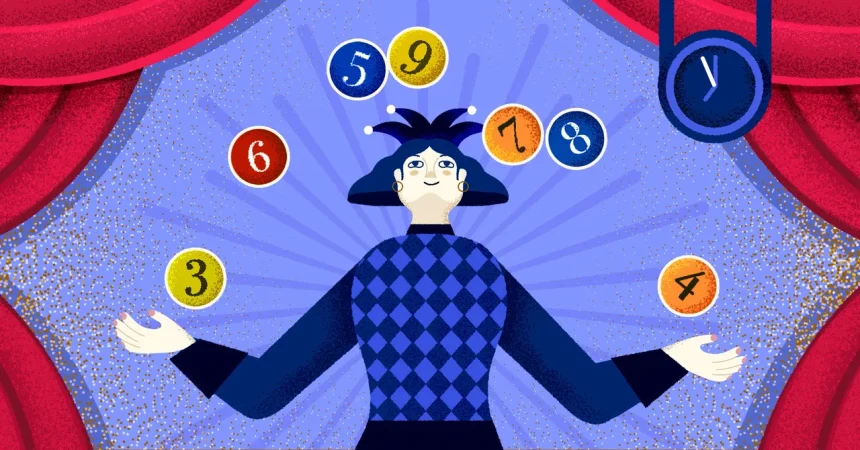
Ronald Graham lived a life that defied the conventional boundaries of intellectual pursuit, embodying two distinct personas that most would consider irreconcilable. On one hand, he was a towering figure in the world of pure mathematics, eventually serving as the president of the American Mathematical Society and earning a reputation as one of the most brilliant combinatorialists of his generation. On the other hand, he was a deeply serious and skilled juggler, rising to the presidency of the International Jugglers’ Association. This wasn’t a casual hobby confined to a brief hobbyist phase; it was a parallel career pursued with equal vigor and dedication. His wife, the mathematician Fan Chung, remembers him not just for his theorems but for his playful, kinetic energy. “He loved tricks,” she recalled, painting a warm portrait of a man who could spin a ball or a coat hanger with the same casual confidence that he could spin a complex proof in his head. He would throw pens against the wall during moments of deep thought, turning the mundane artifacts of the academic office into toys, fidgeting between abstractions. This duality was not a contradiction but a seamless fusion of a single, relentless curiosity about how the world—and the mind—moves and organizes itself.
Graham himself was acutely aware of this deep, structural connection between his two greatest passions. In a television interview in 1980, he articulated a profound insight that united his craft and his career. “It’s interesting, in fact, that many mathematicians and computer scientists have an interest in juggling,” he observed. “I think it’s the search for patterns and structure that is responsible for this.” This observation rings true for anyone who has ever watched a skilled juggler. The act of juggling is, at its core, a live performance of algorithmic logic. The juggler is not just throwing objects chaotically; they are executing a sequence of timed throws, tracking the position of each ball in space, and mapping out a geometrical pattern that exists only in the split-second calculations of their cerebellum. It is a physical form of pattern recognition, a ballet of cause and effect. Conversely, mathematics is often described as the search for patterns in abstract space. A combinatorialist like Graham looks at a set of numbers or objects and seeks the hidden order, the underlying structure that explains why they behave the way they do. Over the years, Graham and his wife Chung collaborated on numerous papers that formalized this bridging of worlds—applying rigorous mathematical frameworks to analyze juggling patterns, drawing direct lines between sequences of throws and sequences of integers. This work elevated juggling from a performing art to a legitimate subject of mathematical inquiry, proving that the rhythm of a tossed ball could be written in equations.
Yet, the most fascinating intersection of his two passions might have come decades before that explicit 1980 reflection, in a seemingly innocent question he posed in 1971. The problem he constructed is elegant in its simplicity, yet surprisingly profound. Imagine you have a random set of distinct integers—numbers that are all different from each other, and critically, none of them are zero. The question is: Can you always rearrange these numbers into some specific order so that when you add up the first two, then the first three, then the first four, and so on, every one of these “partial sums” turns out to be distinct? No two sums can be the same. Graham was likely inspired by his own physical practice. To understand the juggling analogy, think of each number as representing the flight time of a particular ball—how many beats it stays in the air before returning to the hand. You have a collection of balls with different flight times. If you throw them in a specific sequence, the moment each ball returns to the hand is a cumulative sum of the throw times. If two of these cumulative sums are identical, it means two balls would try to land on the exact same “beat,” causing a collision and ruining the entire rhythm of the performance. Graham’s question was essentially: given any set of such flight times, can you always find a throwing order that guarantees a clean, collision-free routine?
For many simple cases, the answer to Graham’s question is intuitively and mathematically obvious. If all the numbers in your set are positive, the answer is a resounding yes. The partial sums are strictly increasing—adding a positive number always makes the sum larger, so no two sums can ever equal each other. Similarly, if you are taking numbers from the full set of integers, including both negative and positive values, the answer is also known to be yes, though the logic is a bit more nuanced. With a mix of signs, the sums can rise and fall like a heartbeat, but a clever mathematical argument shows that you can always permute them to avoid any duplicate values. The problem becomes fiendishly interesting, however, when you enter a finite world. This is where Graham’s juggling instincts and his mathematical genius truly converge. Imagine that instead of counting upward indefinitely, your numbers are wrapped around a clock face. You are working modulo a certain integer, say, modulo 7. Here, if you add up 3 and 5, you don’t get 8; you get 1 (because the clock wraps around). Now, the simple logic of increasing sums completely disintegrates. The partial sums are trapped in a tight, cyclical cage.
This shift to a modular or finite world transforms the problem from a simple curiosity into a profound mathematical mystery. The intuition that provides an easy answer for positive or mixed integers completely fails when you are working on a clock. Because the sums wrap around, the monotonicity is lost; you are now moving through a finite set of possible sums, and the challenge becomes proving that you can find a path that visits all of them without repetition. Mathematicians have since framed this in the language of graph theory. You are essentially being asked to find a Hamiltonian path—a route that visits every vertex exactly once—through a specific type of graph built upon a cyclic group. It’s a beautiful, hard combinatorial problem. While some partial results and specific conditions have been established over the decades, the general question remains a battleground of open research. It’s the type of problem Graham enjoyed—one that could be stated in a single, playful sentence at a blackboard during a coffee break, yet resisted the combined efforts of the world’s best minds for decades. The fact that it might have been born from the motion of a throwing wrist makes it even more poetic. It suggests that the hardest problems often arrive not from cold formalism, but from the sensory, rhythmic observation of the physical world.
What makes Graham’s legacy so lasting is the seamless way he unified these two seemingly disparate pursuits, demonstrating that they are not separate disciplines but rather two dialects of the same universal language of structure. He didn’t just “do” mathematics and “do” juggling; he folded them into each other. The 1971 problem is the perfect crystallization of this synthesis—a question that feels like a physical challenge translated into arithmetic, then elevated into a deep combinatorial theorem. Mathematicians still wrestle with the modular version of his question, finding partial results, constructing complex counterexamples for certain moduli, and building intricate proofs for others. Each time they make progress, they are tracing the ghost of Graham’s curiosity. And for those of us who look back on his life, the human lesson is profound. Graham’s unorthodox combination of skills teaches us that playfulness and rigor are not opposites; that the person who can appreciate the arc of a thrown ball is often the best equipped to map the arc of a logical argument. The search for patterns is a universal instinct, whether it manifests in the graceful cascade of clubs in the air or the elegant sequence of integers on a chalkboard. Ronald Graham, the juggling mathematician, proved that a life dedicated to patterns can be both intellectually profound and physically joyful, and that these two paths, when merged, can produce questions that outlast us all.