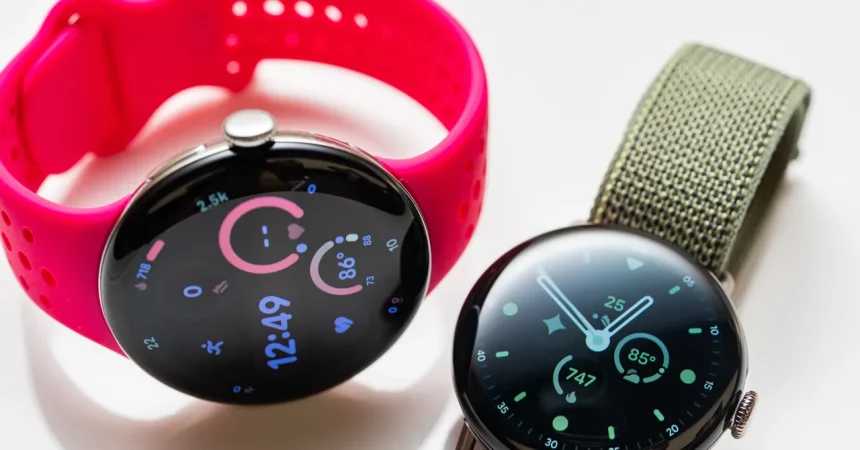
Four years ago, when Google finally released its first Pixel Watch, the company walked into a room where Apple and Samsung had already been sitting for years. Rather than trying to outdo everyone on battery life or screen size, Google did something a little quieter: it went out of its way to stress how accurate the watch’s heart rate sensor was. At the time, that may have seemed like a strange thing to fixate on. A heart rate sensor is a pretty ordinary part of a smartwatch, after all, and people mostly cared about notifications, workouts, and how long the battery lasted. But that early, almost stubborn focus on the quality of the raw sensor signal is now paying off in a big way. On Wednesday, Google introduced the Pixel Watch 5, alongside the new Pixel 11 family of smartphones, and the headline health feature is something that has not been seen in a competing product yet: Breathing Emergency Detection. It is a safety feature designed to recognize a sudden, dangerous drop in oxygen saturation and automatically call emergency services for the wearer. Similar in spirit to the Loss of Pulse Detection feature that arrived on the Pixel Watch 3, this new capability feels less like a fitness tool and more like a guardian angel sitting on your wrist, waiting to act when you cannot.
Breathing Emergency Detection works by combining data from several advanced sensors inside the watch, including a PPG sensor, which measures blood flow, an accelerometer, which tracks movement, and a barometer, which can detect pressure changes. An artificial intelligence algorithm running entirely on the device continuously looks for a persistent drop in oxygen saturation, a sign that something may be seriously wrong with the wearer’s breathing. If that pattern is detected, the watch can automatically call emergency services and share the wearer’s location, giving first responders a way to find them even if the person is unconscious or unable to speak. Francis Hoe, a product manager on Google’s Pixel Watch team, described it simply: “Using a combination of data from the advanced sensors, including a PPG, accelerometer, and barometer, we’ve designed an AI-based algorithm running on device to detect a persistent drop in oxygen saturation and then call Emergency Services for you and even share your location.” The kinds of situations this could help with are not rare or exotic. Google says the feature may be triggered by factors such as drug toxicity, accidents, severe pneumonia, and choking. Imagine a person living alone who suddenly starts choking on food, or someone who has a serious accident and cannot reach a phone. In those moments, a watch that can sense something is wrong and call for help could be the difference between life and death. It is a deeply human kind of technology, even though the mechanics are firmly rooted in sensors and algorithms.
Of course, because this feature is designed to respond to medical emergencies, Google is moving carefully. Breathing Emergency Detection has not been cleared by the Food and Drug Administration, which means it will not launch in the United States for now. Instead, it will be available in select markets in the European Union to start, and Google says it is working with regulators to expand availability in other regions over time. The company is also being cautious about how people should understand the feature. It is not intended for people with preexisting respiratory conditions, and it is not designed to diagnose or treat any medical condition. In other words, this is not a health app that tells you something might be wrong with your lungs; it is an emergency response tool that is meant to step in when something has already gone dangerously wrong. There is a certain responsibility that comes with putting that kind of power in a consumer device, and Google seems to be trying to balance innovation with accountability. One of the more encouraging details is that you do not need to buy the new Pixel Watch 5 to get this feature. Google is bringing Breathing Emergency Detection to the Pixel Watch 4 as well. That means people who bought the previous generation watch will not be forced to upgrade simply to access a lifesaving feature, which is a refreshingly consumer-friendly move in a tech industry that often ties new capabilities to new hardware.
But Breathing Emergency Detection is not the only thing Google is working on. The company also announced two other major new capabilities: blood pressure trends and insulin resistance trends. These are coming to the Google Health app later this fall and will be available to people using a Fitbit Air, Pixel Watch 3, Pixel Watch 4, or Pixel Watch 5. It is worth pausing on what these features actually are. They are not devices that measure blood pressure with a cuff or test blood sugar directly. Instead, they are trend insights, giving users a sense of how their blood pressure or insulin resistance may be shifting over time, based on data from the wearable’s sensors. That might sound like a subtle distinction, but it is an important one. These are not meant to be clinical diagnoses. They are early-warning signals, gentle nudges that might encourage someone to talk to a doctor before a small issue becomes a larger one. And they all rely on the same foundation that Google has been quietly building for years: an exceptionally good heart rate sensor. Sandeep Waraich, Google’s senior director of Wearables, explained the logic behind the company’s early obsession with heart rate accuracy. “It might have felt strange—why are we harping about heart rate accuracy so much—back then,” he said. “We kept investing in that, and now it’s very improved, because all these large sensor models can detect these signatures, insulin resistance, blood pressure trends—but underneath, they need a really capable raw signal.” That quote gets right to the heart of Google’s strategy: if you want a watch to detect subtle changes in the human body, you need sensors that can capture clean, reliable data in the first place. Everything else, from new algorithms to new health features, is built on top of that foundation.
Google is organizing these safety and wellness tools under a new umbrella category called Health Guardian. It brings together existing features like irregular rhythm notifications, high and low heart rate notifications, Loss of Pulse Detection, and Sleep Breathing Quality, along with the new Breathing Emergency Detection. The idea is to create a single, clear place where users can see what safety features are turned on and how they work. This is similar to Google’s Personal Safety app on Pixel phones, which houses Emergency SOS, Safety Check, and Car Crash Detection in one convenient spot. The comparison makes sense. Just as a phone can call for help after a car crash, a watch can now be a more personal kind of lifeline, one that is always with you, always aware of your body’s rhythms, and always ready to act if those rhythms go badly wrong. The Health Guardian approach also makes these features feel less like scattered experiments and more like a coherent promise. Instead of hunting through menus to find out whether you have high heart rate alerts enabled, you can go to one place and see exactly what your watch is monitoring. You can decide which layers of protection you want, and which ones feel unnecessary. There is something reassuring about that transparency. It treats the wearer as an active participant in their own safety, not just a passive body attached to a screen.
Taken together, all of this suggests a major shift in what smartwatches are for. For years, wearables have been primarily about self-improvement: getting more steps, closing rings, burning calories, improving sleep scores. That is still important, and it will not disappear. But Google is increasingly moving toward a more profound promise: a smartwatch can be a safety net, a companion that watches over you when you cannot watch out for yourself. The path to that vision is not completely smooth. Breathing Emergency Detection is not available in the United States yet, and it is not cleared by regulators there. The blood pressure and insulin resistance features are trends, not diagnoses, and they come with disclaimers that remind you they are not for people with existing conditions. These are real limitations, and they show how complex it is to build health features that are both useful and responsible. But the direction is unmistakable. Google’s early decision to invest so heavily in heart rate sensor accuracy, and to keep investing in it even when it seemed like a strange priority, is now beginning to unlock capabilities that other companies have not yet matched. The Pixel Watch 5 is not just another smartwatch with a slightly larger screen or a better battery. It is an attempt to create a guardian that lives on your wrist, always listening to the quiet signals your body sends, always ready to step in when those signals turn into alarms. And in a world where many people live alone, and where a few seconds can matter in an emergency, that is not just a technological breakthrough. It is a human one.