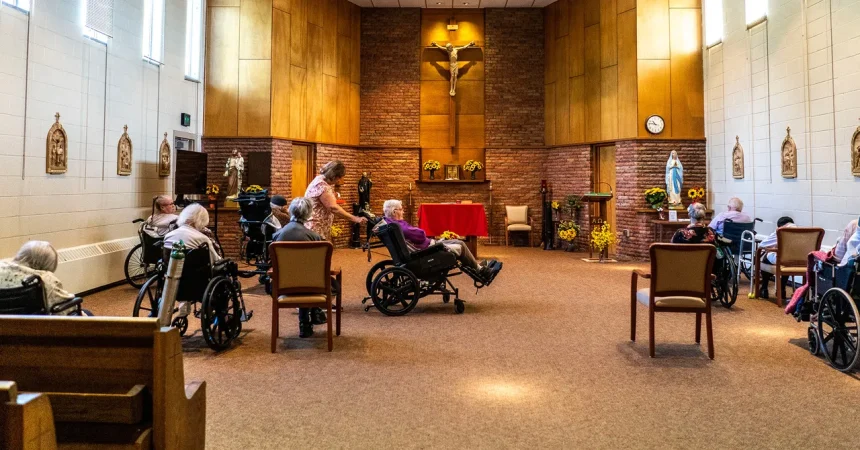
On a gray autumn afternoon, in a long-term care home somewhere in a politically divided state, an elderly woman sits by the window with an absentee ballot on her lap. A staff member kneels beside her, reading each candidate’s name slowly, waiting for her nod before making a mark. The scene is quiet, ordinary, and profoundly democratic. For many residents of nursing homes and assisted-living facilities, this is the only way to participate in an election. They cannot drive to a polling station. They may struggle to see, to write, or to remember. They depend on the kindness of caregivers, family members, and volunteers. But with just weeks to go before the midterms, this simple act of help has been transformed into something suspicious. Election denial groups, led by the right-wing Election Integrity Network, have found a new target: the places where some of the oldest and most vulnerable Americans live. Without evidence, they claim that left-wing organizations are infiltrating nursing homes, care homes, and assisted-living facilities to steal votes. Cleta Mitchell, the network’s founder, appeared on Steve Bannon’s War Room and repeated the allegation: “These left-wing groups go into the nursing homes, and they go into the group homes, and they basically steal the votes of these most vulnerable.” The claim is meant to provoke outrage. It is also meant to recruit ordinary people to monitor their neighbors. The network is urging followers to contact and question long-term care facilities, and to treat residents as potential victims rather than as citizens. What gets lost is the human reality: the woman at the window has a lifetime of experience behind her. She has voted for presidents, watched wars begin and end, buried friends, and raised children. Her vote is not a prize to be stolen. It is a right she has carried for decades. To treat her as a helpless pawn is not a sign of concern; it is a denial of her dignity.
The evidence for this fear is extremely thin. To support her sweeping accusation, Mitchell reached back to a single case from Wisconsin in 2020. In that case, a sheriff alleged that eight residents in a care home had their ballots filled out for them. The Wisconsin Election Commission looked at the matter and rejected the claims. There were no charges, no findings of fraud, and no reason to believe the residents had not voted freely. But Mitchell did not let the facts stop her. She told Bannon that the case could have cost Donald Trump the 2020 election. That claim is not just unproven; it is mathematically absurd. Trump lost Wisconsin by more than twenty thousand votes. Even if every challenged ballot had been thrown out, the outcome would not have changed. Yet the story continues to circulate, because its purpose is not accuracy. Its purpose is atmosphere. Every time a dubious anecdote is repeated, it becomes easier to believe that fraud is everywhere, and harder for election officials to be trusted. The Wisconsin commission’s rejection never got the same attention as the original allegation, and that is exactly how the narrative is designed to work. For nursing home residents and those who care for them, the accusation is deeply painful. Imagine being told that your grandfather, a veteran who spent his life working and raising a family, is not capable of making his own choice—or that his choice should be presumed illegitimate because he needed help filling in a box. Imagine being the home health aide who drives a resident to the polls, or the nurse who reads the ballot aloud, and then being accused of predation. The aide may be the person who knows the resident best. She may know that the resident always votes for the same party, or that her late husband’s memory is honored by a particular candidate. She is not there to control; she is there to serve. To criminalize that service is to condemn the very people who make voting possible.
The Election Integrity Network is not just making speeches. It has built an operation. On its website, the group encourages followers to download a toolkit and to email, call, or otherwise contact nursing homes in their area. It has created a series of social media images designed to be shared widely. Some of those images map residential care facilities in competitive congressional districts across Arizona, California, New Hampshire, Pennsylvania, and Virginia. The maps identify what the group calls “vulnerable residents” who “may become targets for political predators seeking easy access to ballots.” That language is carefully chosen. It frames every assisted-living facility as a potential crime scene, every resident as a potential victim, and every caregiver as a potential criminal. It invites people who have never stepped inside these facilities to call their local nursing homes, to question staff, and to demand explanations. It tells the staff that helping a resident vote is not a kindness but a risk. It tells residents that their participation is suspect. The social media campaign is designed to spread suspicion faster than facts can catch up. Once a map is shared, the image circulates without context. People who see it may not know that the Wisconsin case was rejected, or that actual voter fraud in long-term care facilities is exceptionally rare. They only know that something looks wrong. The toolkit treats every facility as an adversary, rather than as a community of people who are already overburdened and under-resourced. The effect is to create a chilling atmosphere of fear around one of the most basic acts of citizenship. Some facilities, desperate to avoid conflict, may decide that they will no longer offer voting assistance at all. Some family members may decide that it is not worth the trouble to help their loved ones vote. The result will not be an increase in integrity. It will be a decrease in participation. And the people most likely to be silenced are the very people the campaign claims to protect.
This campaign is not an isolated effort. It is part of a much broader movement to undermine trust in American elections. For years, election deniers have pushed false claims about noncitizen voting, about widespread mail-in fraud, about ballot boxes being stuffed and votes being manipulated. Those claims have been amplified by powerful political figures, including Donald Trump, and by a segment of the conservative media that treats every election it loses as evidence of a stolen country. The nursing home campaign is the newest edition of that old playbook. It may sound like a grassroots concern about vulnerable people, but it is really a way of preparing the ground for contested results. If the midterms are close, we should expect to see the same people who spread lies about nursing homes now to challenge the legitimacy of any result they do not like. They have already shown that they will use the most vulnerable Americans as props in that fight. The Trump administration helped feed this with years of attacks on mail-in voting and election security. Then, in July, the Centers for Medicare and Medicaid Services issued a memo that removed previous guidance on how staff at nursing homes could help residents vote—guidance that had allowed assistance with mail-in ballots and transporting residents to polling places. The new memo replaced that guidance with a threat: staff who “engage in inappropriate coercion or other violations of residents’ rights” could face prosecution. On the surface, that sounds reasonable. No one wants residents to be coerced. But in practice, the lack of clear examples leaves many facilities afraid to help in even the most ordinary ways. The memo does not say that helping a resident fill out a ballot is wrong. It does, however, create confusion. And in the absence of clarity, fear wins. A nursing home director, already worried about staffing shortages and regulatory scrutiny, may simply decide that the safest course is to do nothing. That is a quiet form of disenfranchisement, and it affects millions of people.
The real scandal in long-term care is not the sudden wave of voter fraud invented by conspiracy theorists. It is the steady, quiet disenfranchisement of people who have the right to vote but need help exercising it. Residents of nursing homes and assisted-living facilities are often isolated from the outside world. They move into these homes at the end of long lives, leaving behind their houses, their neighborhoods, and the polling places they once knew. Many have physical limitations that make it difficult to travel. Some have cognitive decline that makes it hard to keep track of names and issues. They rely on others to bring the ballot to them, to explain what is at stake, and to ensure that their votes are counted. That reliance is not weakness. It is part of being human. We all depend on others in some way. The fact that a person needs help to vote does not mean that their choice is not their own. Yet the new campaign treats all help as potential manipulation. It does so at a time when voting rights for older people and people with disabilities are already under pressure. Some states have tightened voter ID laws, making it harder for people without driver’s licenses or birth certificates to vote. Some have limited mail-in voting, eliminating the option that many nursing home residents depended on. And now, with the new guidance, even the simple act of arranging a ride to the polls can feel dangerous. Many residents are not even asked whether they want to vote because staff are unsure how to help without exposing themselves to accusations. The result is that people who have voted in every election since they were twenty-one may be left out of the most important decision of all. They may not complain. They may not march. But their absence is a loss—not just for them, but for the democracy that claims to represent them.
We can do better. We can insist, first of all, that the right to vote does not end when a person enters a nursing home. It is not a privilege that disappears with a diagnosis or a wheelchair. It is a constitutional right, and it belongs to every citizen, no matter how old, how frail, or how dependent. We can support the dedicated people who work in long-term care and who understand that helping a resident vote is a service, not a crime. We can create clear, nonpartisan protocols that allow residents to make their own choices and to receive the assistance they need without fear. We can educate family members and staff about the difference between helping and pressuring, about the importance of secrecy, and about the many ways to make voting accessible. And we can push back against the ugly rhetoric that treats elderly voters as pawns in a political game. When a group with no evidence points to a nursing home and says “fraud,” we should ask questions. We should check the facts. We should remember every documented case of older people being denied ballots, bus passes, and absentee applications because someone decided they were too vulnerable to be trusted. The people who truly care about election integrity should be working to remove barriers, not to add them. They should be helping residents register, apply for mail-in ballots, and get to the polls. They should be celebrating the fundamental idea that every vote matters, including the votes of the oldest Americans. In the final weeks before the midterms, we have a choice. We can believe the dark stories and let fear dictate policy. Or we can remember the woman by the window, the aide kneeling beside her, and the quiet determination of citizens who refuse to be written out of history. The vote is not something to be stolen, and it is not something to be feared. It is something to be honored. Let us honor it by preserving access, not by spreading suspicion.