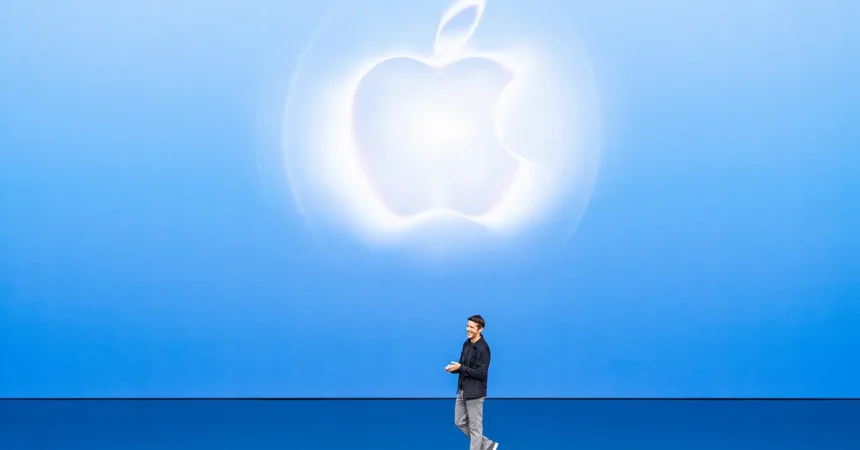
It’s a brand new era for Apple. After fifteen remarkable years at the helm—years that saw the App Store become a global cultural juggernaut, the Apple Watch evolve into a lifesaving medical companion, and the Mac undergo a stunning renaissance with custom silicon—Tim Cook has officially stepped down. The torch has been passed to a familiar face, the former VP of Hardware, John Ternus. This moment carries immense emotional and strategic weight. Cook wasn’t just a CEO; he was the steady, unflappable hand that steered the ship through the treacherous waters following Steve Jobs’s passing, turning Apple into the most valuable company on Earth. Now, all eyes turn to Ternus, a quieter, engineering-first leader who has been the unsung hero behind the iPhone’s legendary durability and design for years. As he took the stage for his inaugural major product event, the atmosphere inside the auditorium was electric, a heady mix of anticipation, nostalgia, and a little bit of fear. Would he play it safe, faithfully executing the roadmap Cook left behind? Or would he swing for the fences with a spectacularly bold move to define his tenure from day one? The tension was palpable, and then, he did exactly that. With a deep breath and a flick of his wrist, Ternus unveiled the future of the company—not just an iterative update, but a paradigm shift that answered every critic who dared to whisper that Apple had lost its innovation edge. It was a declaration of a new era, and it sent a shiver of genuine excitement through the entire tech world.
Ladies and gentlemen, meet the iPhone Duo. This is Apple’s first-ever folding device, a passport-sized pocket marvel that unfolds into a new kind of screen experience. The price tag is eye-watering—a cool $1,999 for the base model with 256GB of storage—but let’s pause on the sticker shock for a moment, because this device is far more than a number. It is a statement. For over a decade, Apple has watched competitors like Samsung, Google, and Motorola stumble and fumble through the foldable landscape. We saw the cracked hinges, the dreaded center crease, the flimsy plastic screens, and the half-baked software adaptations. Apple, meanwhile, sat back and waited, quietly perfecting the chemistry, the materials, and the engineering until they could get it absolutely right—or at least, as flawlessly Apple as humanly possible. The Duo is a landscape-style foldable, meaning it opens horizontally like a book, held together by a sleek, vertical magnetic hinge that clicks with a deeply satisfying, almost mechanical snap. When closed, you’re greeted by a compact, utterly practical 5.3-inch exterior screen, perfect for checking notifications, firing off a quick text, or making a rapid call with one hand. But crack it open, and the magic unfolds—literally. The device transforms into a stunning 7.7-inch landscape display, designed to be held like a miniature cinema screen in your palms. However, there is a significant trade-off that I have to be brutally honest about: this thing is heavy. Weighing in at 254 grams, the Duo is noticeably heftier than a standard Pro Max phone, and some users might find that extra bulk cumbersome in their pockets. But Apple has clearly chosen durability over lightness, constructing the frame from aerospace-grade titanium and wrapping the flexible screen in what they are calling a proprietary “custom polymer” that allegedly resists scratches and cracks far better than the plastic screens we’ve seen on other foldables. It feels solid, premium, and unmistakably expensive, which is exactly the vibe Apple wants to project.
Under the hood, the Duo is an absolute powerhouse. It runs on Apple’s proprietary A20 Pro chip—the exact same silicon you’ll find inside the brand new iPhone 18 Pro models—paired with Apple’s custom C2 modem for lightning-fast 5G connectivity and improved battery efficiency. But the real genius of the Duo isn’t just the raw horsepower; it’s the sheer software magic that Apple is touting as its killer feature. Remember how Apple was historically hesitant to make a foldable because they demanded a seamless, frictionless experience? Well, the Duo finally delivers on that promise. The device runs full iPad-style apps. Imagine opening the device and having your favorite productivity suite, like Pages, Numbers, or even a proper email client, fill the entire 7.7-inch screen with a genuine toolbar and multi-pane layout, just as if you were holding an iPad mini. But your life is never static, and the Duo’s software knows it. As you fold the screen halfway to rest it at an angle on your desk, the interface adapts on the fly. The top half gracefully hosts a video call while the bottom half morphs into a touchpad or a virtual keyboard. It’s fluid, intuitive, and responds without a hint of lag or jankiness. And for the creative set, the Duo fully supports the Apple Pencil Pro. Yes, you read that correctly. You can literally sketch, doodle, annotate documents, and take meticulous handwritten notes directly on the unfolded screen, instantly transforming your pocket device into a portable sketchpad. This feature single-handedly blurs the line between iPhone and iPad in a way we have never seen before. It is a bold bet on the future of mobile computing, suggesting that Apple views the foldable not as a gimmick, but as a legitimate, high-performance productivity tool that might one day replace both your phone and your entry-level tablet.
Cameras have always been a massive part of the Apple experience, and the Duo absolutely does not disappoint. On the back, you have a dual-lens system featuring two 48-megapixel sensors—one standard wide shooter and one ultrawide. This configuration allows you to capture stunning, high-resolution landscapes, detailed night shots, and rich portrait photography with remarkable clarity and color accuracy. On the front, you get a pair of 12-megapixel selfie cameras: one cleverly positioned on the outer screen for you to use when the phone is closed, and another integrated into the inner display for crisp video calls or self-portraits when you’re unfolded and working. Both are capable of recording crystal-clear 4K video, ensuring your content creation game reaches brand-new heights whether you’re vlogging on the go or presenting a project in a meeting. But the iPhone Duo was far from the only headline today. In a whirlwind presentation, Ternus rolled out a comprehensive refresh across the entire product ecosystem. We saw the new iPhone 18 Pro lineup, which, while aesthetically similar to the previous generation, shines with vastly improved display technology, enhanced low-light performance, and—most importantly—a heavily upgraded, generative AI-infused Siri. This is Apple’s resounding answer to the AI wave sweeping through technology. Siri is no longer just a voice assistant that sets timers and tells jokes; it is now being positioned as a proactive, contextual copilot that can write nuanced emails, summarize threads of text messages, and interact with apps in entirely new ways. Beyond that, we got meaningful updates to the Apple Watch line, featuring new health sensors and deeper, more actionable fitness tracking metrics, alongside new AirPods with refined audio drivers and better spatial audio immersion. It was a full-blown product buffet, clearly designed to demonstrate that under Ternus, Apple isn’t standing still—it’s diversifying, innovating, and doubling down on all of its core cherished devices.
However, for all the fanfare and spectacle, there were some notable no-shows that left analysts scratching their heads. As expected, there were no announcements for the base-model iPhone 18—that budget-friendly refresh is coming early next year, so if you’re patiently waiting for a more affordable upgrade, you’ll have to hold off for a few more months. Interestingly, there was also absolutely no mention of the Vision Pro headset, no new iPads, and no desktop Macs (those were already refreshed back in August). This laser-focused prioritization of the iPhone and wearable lines strongly suggests that Ternus is strategically concentrating on his core revenue generators first, but it also leaves some burning questions about his long-term vision for the more experimental spatial computing side of the company. So, exactly how does the Duo stack up against the established competition? Following in the footsteps of Samsung’s Galaxy Z Fold series and Google’s Pixel Fold, Apple is entering a somewhat crowded arena, but it’s doing so with its trademark polish and an air of supreme confidence. The price point of $1,999 is steep—the highest starting price for any iPhone to date—but Apple knows its incredibly loyal and affluent user base will happily pay a premium for that seamless integration, superior build quality, and undeniable prestige. The real question is whether the Duo can genuinely win over skeptics who have already tried other foldables. Samsung has already ironed out many of the early durability issues, and the heavier weight of the Duo (254g) compared to the Galaxy Z Fold 6 (around 240g) shows that Apple still has a bit of work to do on ergonomics and weight distribution. But where Apple lacks in weight optimization, it more than compensates with ecosystem coherence. The impeccable way the Duo interacts with iPad apps, the Apple Pencil, and the A20 Pro chip creates a synergy and fluidity that Android’s fragmented, inconsistent ecosystem simply cannot replicate. It’s not just a bigger phone with a fold; it’s a fundamentally different way of thinking about your mobile workspace, your creative output, and your daily digital flow.
In the end, John Ternus’s first major public appearance was a gamble—but it was a beautifully calculated one, and it was undeniably impressive. He proved to the world that he is not going to be content simply playing defense or cautiously releasing safe, iterative updates while competitors catch up. Announcing the Duo on his very first stage is a massive statement of intent: Apple is not afraid to reinvent its most iconic product, even if it means pricing out most of its user base. There is a truly magical quality to that unfolding screen, the satisfying, precision-engineered snap of the hinge, and the way the software instantly morphs to fit your specific needs in a given moment. Yes, the weight is a legitimate concern. Yes, the price is completely outrageous for the average consumer. Yes, it might very well be a niche product for early adopters, tech enthusiasts, and creative professionals. But this is exactly the kind of bold, boundary-pushing innovation that Apple has been sorely missing for the last several years. It feels like the swagger of the Steve Jobs era is back, albeit delivered with the quiet, methodical confidence of a career engineer. As Ternus wraps up the keynote and the lights dim, we are left with a crystal-clear image of the road ahead: a future where your phone can seamlessly be a phone, a tablet, and a digital canvas all at once, depending on how you fold it. The iPhone Duo might not be for everyone, but it signals that a vibrant, daring new era of Apple has truly arrived, and it is more exciting and unpredictable than we could have possibly hoped for. The tech world just got a whole lot more interesting, and for the first time in a long time, I find myself genuinely, eagerly waiting to see what this new leadership will dream up next.